Why Start With Affordable Exotics
The exotic fishkeeping hobby does not require a six-figure budget to get started. Some of the most visually spectacular freshwater species in the trade cost less than a restaurant dinner. Starting with affordable exotics lets you build essential husbandry skills — water chemistry management, disease recognition, feeding protocols — before investing in high-value specimens like Arowana or freshwater stingrays.
Every expert aquarist began somewhere. Many of the species on this list were gateway fish for collectors who now maintain six-figure tanks. The skills transfer directly: if you can keep a healthy Oscar, you understand the biological filtration demands of large predatory fish. If you can maintain stable parameters for an Elephant Nose, you are ready for Discus.
What Makes a Fish Beginner-Friendly
We define beginner-friendly not as "easy" but as "forgiving." These species tolerate minor parameter fluctuations better than ultra-sensitive fish like Discus or Zebra Plecos. They share several traits:
- Wide parameter tolerance. They accept pH ranges of 1.0+ units and temperature swings of 2–3 °C without immediate stress.
- Readily available diet. They accept commercial pellets, frozen foods, or easily sourced live foods — no specialised feeding protocols required.
- Clear behavioural indicators. When stressed or ill, they display obvious symptoms (colour loss, lethargy, surface gasping) that beginners can recognise quickly.
- Captive-bred availability. Most are bred in large numbers, meaning specimens are pre-adapted to aquarium conditions and carry lower disease risk than wild-caught fish.
Top 10 Exotic Fish Under $100
Each species below is ranked by a combination of visual impact, hardiness, and accessibility. Prices reflect typical US retail in 2026.
1. Dragon Goby — $15–$30
The Dragon Goby (Gobioides broussonnetii) looks like a miniature sea serpent — elongated, iridescent purple-blue body with a mouth full of tiny teeth that it uses to sift sand, not attack tankmates. Despite its fearsome appearance, it is a peaceful bottom-dweller that does best in brackish water (SG 1.005–1.015). Provide a 50+ gallon tank with fine sand substrate, plenty of hiding caves, and dim lighting. They reach 30–60 cm in captivity and live 8–10 years with proper care.
Feed sinking pellets, frozen bloodworms, and brine shrimp. Their poor eyesight means they rely on scent to locate food — target-feed near their caves for best results.
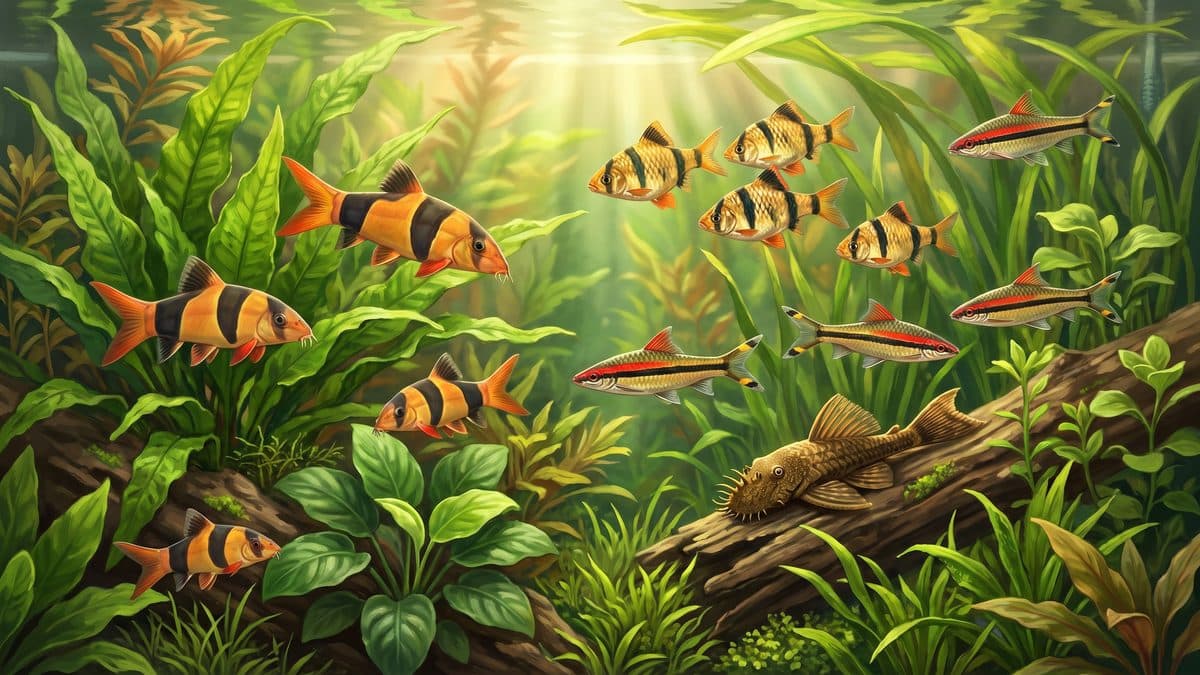
2. Tiger Barb — $3–$8
The Tiger Barb (Puntigrus tetrazona) is one of the most recognisable freshwater fish in the hobby — vivid orange body with four vertical black bands and red-tipped fins. Kept in schools of 8+ in a 30-gallon tank, they form a dynamic, constantly moving display. Their reputation as fin-nippers is largely a schooling issue: in groups under six, they redirect their energy toward tankmates. In proper schools, aggression stays within the group.
Parameters: pH 6.0–7.5, temperature 24–28 °C, GH 5–15 dGH. They accept flake, pellet, and frozen foods without hesitation. Colour-enhancing foods with astaxanthin intensify their orange pigmentation. Lifespan: 5–7 years.
3. Clown Loach — $10–$25
The Clown Loach (Chromobotia macracanthus) is the most popular loach in the hobby for good reason — bright orange body with three bold black wedge-shaped bands, active schooling behaviour, and a lifespan that can exceed 20 years. The catch for beginners: they grow large (30 cm+) and need a 125+ gallon tank long-term. Start with a group of 5+ in a 75-gallon tank and plan your upgrade path early.
They are champion snail eaters, making them excellent biological pest control. Parameters: pH 6.0–7.5, temperature 25–30 °C. Clown Loaches are prone to ich (white spot disease), so maintain stable temperatures and quarantine all new additions. See our tank setup guide for proper system planning.
4. Oscar Cichlid — $10–$40
Oscars (Astronotus ocellatus) are the dogs of the fish world — they recognise their owners, beg for food, and develop distinct personalities. Wild-type Oscars display olive-green bodies with orange ring markings, while captive-bred varieties include Tiger, Red, Albino, and Lemon morphs. Adults reach 35 cm and need a 75-gallon tank minimum — 125 gallons for a pair.
They are messy eaters that produce significant bioload. Filtration rated for 10× turnover is not optional. Feed high-quality cichlid pellets as the staple, supplemented with frozen shrimp, earthworms, and occasional feeder insects (gut-loaded crickets). Avoid feeder fish — they carry parasites and provide poor nutrition. Browse The Fish Collection's cichlid collection for select Oscar specimens.
5. Betta Splendens — $5–$50
The Betta (Betta splendens) may be the most recognisable tropical fish on earth, but the specimens available today bear little resemblance to the dull wild form. Selective breeding has produced Halfmoon, Crowntail, Plakat, Dumbo Ear, and Galaxy Koi varieties with flowing finnage and colours spanning the entire spectrum. Common pet-store Bettas run $5–$15; imported Thai show-grade specimens reach $30–$50.
The critical message for beginners: Bettas do not belong in bowls. They need a heated, filtered tank of at least 5 gallons — ideally 10+. Parameters: pH 6.5–7.5, temperature 25–28 °C. Males must be housed individually; females can form sororities in 20+ gallon tanks with heavy planting. For full details, see our Betta care guide.
6. Elephant Nose Fish — $20–$45
The Elephant Nose Fish (Gnathonemus petersii) generates a weak electric field to navigate murky water and locate prey — a biological adaptation that makes it one of the most fascinating freshwater fish to observe. Its elongated "trunk" (actually a chin extension) probes the substrate for insect larvae and worms.
They require dim lighting, fine sand substrate, and plenty of hiding spots (PVC pipes, driftwood caves). Tank size: 50+ gallons. Parameters: pH 6.0–7.5, temperature 24–28 °C. They are sensitive to water quality — maintain ammonia and nitrite at absolute zero and keep nitrate below 15 ppm. Feed frozen bloodworms, blackworms, and tubifex as staples.
7. Rope Fish — $15–$30
The Rope Fish (Erpetoichthys calabaricus) is a snake-like polypterid that reaches 40 cm in captivity. Its elongated, eel-like body and primitive lung (it breathes atmospheric air) make it a living fossil that predates the dinosaurs. Despite its predatory classification, it is peaceful toward tankmates too large to swallow.
House in a 75+ gallon tank with a tight-fitting lid — Rope Fish are notorious escape artists that can squeeze through gaps smaller than their head diameter. Parameters: pH 6.5–7.5, temperature 24–28 °C. Feed frozen shrimp, bloodworms, and earthworms after lights-out; they are primarily nocturnal hunters.
8. Figure Eight Pufferfish — $10–$20
The Figure Eight Puffer (Dichotomyctere ocellatus) is one of the most accessible pufferfish species — small (8 cm adult), hardy, and full of personality. Named for the figure-eight-shaped markings on its back, it thrives in brackish water (SG 1.005–1.010) but tolerates fully freshwater conditions. Keep in a species-only 20+ gallon tank with sand substrate and plenty of visual barriers.
Like all pufferfish, it requires hard-shelled foods (snails, clams, shrimp with shell) to maintain its continuously growing beak. See our pufferfish feeding guide for detailed dietary protocols. Parameters: pH 7.5–8.5, temperature 24–28 °C.
9. Peacock Gudgeon — $8–$15
The Peacock Gudgeon (Tateurndina ocellicauda) is a micro predator from Papua New Guinea that packs an astonishing amount of colour into a 7.5 cm body — electric blue flanks, red-orange belly, yellow-edged fins, and a distinctive black ocellus on the caudal peduncle. Keep in groups of 6+ in a planted 20+ gallon tank.
They are cave spawners that breed readily in captivity. Parameters: pH 6.5–7.5, temperature 24–27 °C. Feed small frozen foods (baby brine shrimp, daphnia, micro bloodworms) and high-quality micro pellets. Their peaceful nature makes them excellent community fish with similarly sized, non-aggressive species.
10. Senegal Bichir — $15–$40
The Senegal Bichir (Polypterus senegalus) is the most commonly available species of bichir — a group of armoured, air-breathing freshwater fish that have remained virtually unchanged for 100 million years. Adults reach 30 cm and display an olive-grey body with a distinctive row of dorsal finlets that resemble a saw blade.
They are nocturnal predators that eat anything they can fit in their mouth, so choose tankmates carefully (nothing smaller than half their body length). Tank size: 75+ gallons with sand substrate and driftwood cover. Parameters: pH 6.5–7.5, temperature 25–28 °C. Feed sinking carnivore pellets, frozen shrimp, and earthworms.
Setting Up Your First Exotic Tank
Before bringing home any of these species, ensure your system is properly established. The fundamentals apply universally:
- Cycle the tank first. Run the nitrogen cycle for 4–6 weeks until ammonia and nitrite read 0 ppm within 24 hours of dosing. No exceptions.
- Oversize your filtration. Aim for 8–10× turnover per hour. A filter rated for 200 gallons on a 75-gallon tank is not overkill — it is appropriate.
- Invest in a quality heater with an external controller. Built-in thermostats drift. An Inkbird ITC-308 costs $35 and prevents catastrophic overheating.
- Test water parameters weekly using liquid reagent kits (API Master Test Kit or equivalent). Test strips are unreliable for precise readings.
For a complete equipment-by-equipment walkthrough, read our Exotic Fish Tank Setup guide.
Common Beginner Mistakes to Avoid
- Overstocking. More fish means more waste, faster parameter degradation, and increased aggression. Follow the one-inch-per-gallon rule as a rough minimum, then research each species individually.
- Skipping quarantine. Every new fish should spend 2–4 weeks in a separate quarantine tank before joining your display. One sick fish can wipe out an entire collection.
- Using feeder fish. Feeder goldfish and minnows carry parasites and provide poor nutrition. Frozen foods and quality pellets are safer and more nutritious.
- Ignoring adult size. That 5 cm Clown Loach will be 30 cm in three years. That 8 cm Oscar will be 35 cm. Plan for the adult, not the juvenile.
- Impulse buying. Research every species before purchase. Compatibility, tank size, diet, and lifespan should all be confirmed before the fish enters your home.
Next Steps: Growing Your Collection
Once you have mastered the fundamentals with one or two species from this list, the entire exotic fishkeeping world opens up. Many hobbyists progress from Oscars to Arowana, from Figure Eight Puffers to Fahaka Puffers, or from Senegal Bichirs to Ornate Bichirs. The care principles scale — bigger tanks, more robust filtration, tighter parameter control — but the foundational knowledge remains the same.
The Fish Collection stocks exotic species across every price point and experience level. Browse our cichlid, pleco, and pufferfish collections to find your next specimen, and take advantage of our free pre-purchase consultation with our aquatic biologists.