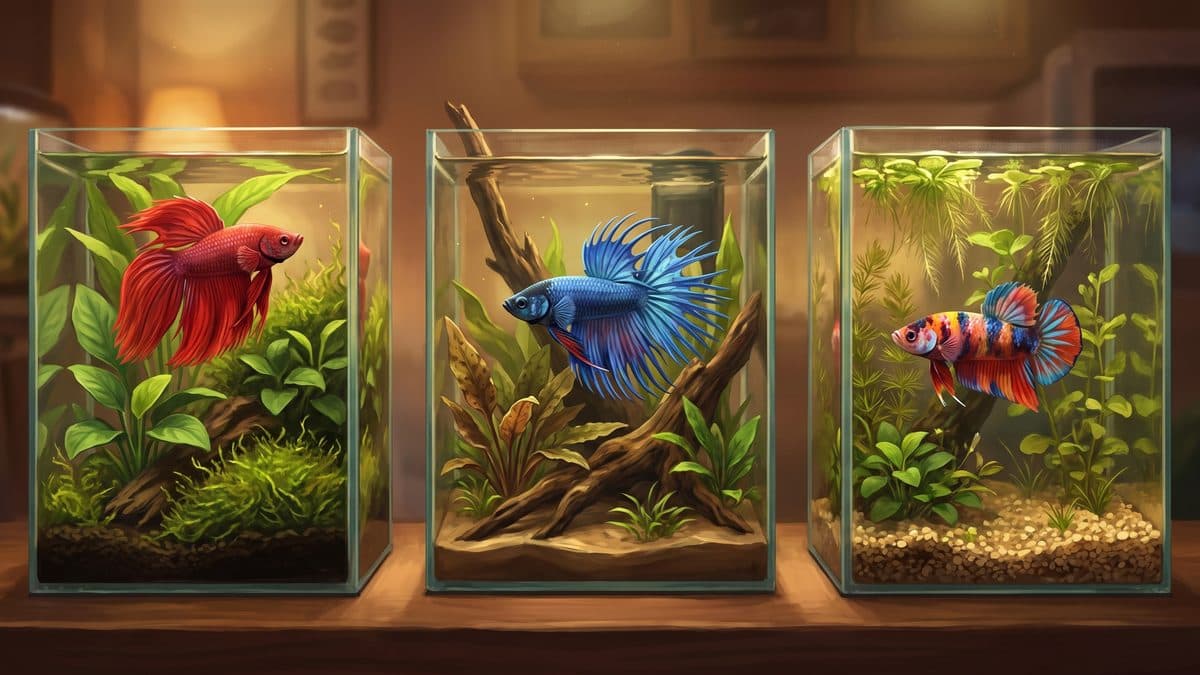
Why Bettas Are the Perfect Starter Fish
The Betta (Betta splendens), also known as the Siamese Fighting Fish, is arguably the most popular aquarium fish in the world — and for good reason. Bettas are hardy, interactive, spectacularly colourful, and can thrive in smaller aquariums (5–10 gallons) that fit on a desk or countertop.
Bettas possess a labyrinth organ that allows them to breathe atmospheric air, giving them a survival advantage in low-oxygen environments. This biological adaptation makes them more forgiving of imperfect water conditions than many other tropical fish — though they still need a heated, filtered, cycled aquarium to truly thrive.
With dozens of tail types, colour patterns, and finnage varieties bred over centuries, choosing your first Betta can be overwhelming. This guide covers the seven varieties best suited for beginners, ranked by hardiness, availability, and ease of care.
Top 7 Betta Varieties for Beginners
1. Veiltail Betta
The Veiltail is the classic Betta — the one you see in every pet store. It features a long, flowing caudal (tail) fin that drapes downward like a veil. Veiltails are the hardiest and least expensive variety ($3–$10), making them the ideal first Betta.
Because Veiltails are so common, breeders have not pushed genetics to extremes, resulting in robust fish with fewer health issues than more exotic varieties. Their longer fins mean they are slower swimmers, so avoid strong currents from filters — use a sponge filter or baffled HOB filter. Available in virtually every colour: red, blue, purple, multicolour, and marble patterns.
2. Plakat (Short-Fin) Betta
The Plakat Betta is the closest to the wild-type Betta splendens — short fins, streamlined body, and powerful swimming ability. Plakats are the healthiest Betta variety because their short fins do not impede movement, trap debris, or tear easily. They are more active, more aggressive, and better jumpers than long-finned varieties.
Plakats are increasingly popular as hobbyists recognise that shorter fins mean fewer health problems (fin rot, lethargy, difficulty feeding). Available in all colour patterns. Price: $5–$25 for standard colours; $30–$100+ for premium genetics like Galaxy, Nemo, or Candy patterns. Always use a tight-fitting lid — Plakats jump.
3. Crowntail Betta
The Crowntail features a dramatic fin structure where the webbing between fin rays is reduced, creating a spiky, crown-like appearance. It is one of the most visually distinctive varieties and remains widely available ($5–$15). Crowntails are hardy and active.
The reduced webbing means Crowntail fins are less likely to droop or drag than Veiltails or Halfmoons. However, the extended rays can curl or break if water quality deteriorates, and they snag on rough decorations. Use smooth decorations only — no sharp plastic plants or rough rocks. The striking silhouette makes Crowntails a favourite among beginners.
4. Halfmoon Betta
The Halfmoon Betta has a caudal fin that spreads a full 180 degrees when flared, creating a perfect "D" shape. This is one of the most spectacular displays in the fish hobby, but the enormous fin surface area comes with trade-offs: Halfmoons are slower swimmers, more prone to fin biting (self-damage from stress or boredom), and more susceptible to fin rot.
For beginners, Halfmoons work well if you provide a calm tank with gentle filtration, plenty of resting spots near the surface (floating plants, Betta hammocks), and pristine water quality. Price: $10–$30 for standard colours; $40–$100+ for show-quality specimens. A beautiful choice if you are willing to invest slightly more attention in care.
5. Delta Tail Betta
The Delta Tail is a moderate-fin variety — the caudal fin fans out in a triangular shape but does not reach the full 180 degrees of a Halfmoon. This makes Delta Tails a perfect middle ground: more dramatic than Veiltails, but without the swimming difficulty of Halfmoons.
Delta Tails are hardy, active, and less prone to fin damage than extreme long-finned varieties. They are widely available ($5–$15) and come in all standard colours. For beginners who want visual impact without the maintenance demands of a Halfmoon, the Delta Tail is an excellent choice.
6. Double Tail Betta
The Double Tail Betta has a genetic mutation that splits the caudal fin into two distinct lobes, creating a unique forked appearance. The dorsal fin is also significantly larger than other varieties, adding to the visual drama. Double Tails are eye-catching and moderately hardy ($8–$20).
The split-tail gene is associated with a slightly shorter body and potential swim bladder sensitivity. Avoid overfeeding (a common cause of swim bladder issues) and maintain stable water temperatures. Despite these minor considerations, Double Tails are fully suitable for beginners and offer a look that no other variety provides.
7. Koi Betta
Koi Bettas are named for their multicolour marble patterning that resembles Japanese Koi fish — typically red, white, and black splotches in unpredictable combinations. They are usually Plakat (short-fin) types, which means they share the Plakat's excellent health and activity level.
The fascinating aspect of Koi Bettas is that their colours can change over their lifetime due to the marble gene ("jumping gene" transposon). A fish that is mostly white at purchase may develop vibrant red and black patches over months. This makes every Koi Betta unique. Price: $10–$40 for standard; $50–$150+ for premium Galaxy Koi patterns.
What to Look For When Buying a Betta
- Active behaviour: A healthy Betta is alert, responsive to movement outside its container, and swims with purpose. Avoid fish that lie motionless at the bottom or float listlessly.
- Vibrant colour: Healthy Bettas display rich, saturated colours. Pale, faded, or greyish colouration indicates stress, illness, or old age.
- Intact fins: Check for tears, holes, black edges (fin rot), or clamped fins. Minor fin damage can heal in clean water, but severe rot indicates systemic illness.
- Clear eyes: Both eyes should be clear and equal-sized. Cloudy eyes or bulging (popeye) indicate bacterial infection.
- No visible parasites: Look for white spots (ich), gold dust (velvet), or cotton-like growths (fungus) on the body and fins.
Common Mistakes with Beginner Bettas
- Keeping Bettas in unheated bowls: Bettas are tropical fish requiring 24–28 °C. Room temperature (18–22 °C) causes lethargy, immune suppression, and shortened lifespan. A small adjustable heater is essential.
- No filter: While Bettas can survive in still water, they thrive with gentle filtration. A sponge filter provides biological filtration without creating the strong current that stresses long-finned varieties.
- Tanks under 5 gallons: Bettas can survive in tiny containers but cannot thrive. A 5-gallon heated, filtered tank is the minimum for good health and natural behaviour. 10 gallons is ideal.
- Overfeeding: Bettas have tiny stomachs (roughly the size of their eye). Feed 2–3 pellets twice daily. Overfeeding causes bloating, constipation, and swim bladder disorder.
- Sharp decorations: Long-finned Bettas tear their fins on sharp plastic plants and rough decorations. Use live plants or silk plants only.
Getting Started Equipment
- Tank: 5–10 gallons with a lid (Bettas jump). The Fluval Spec V (5 gal) and Fluval Flex (9 gal) are popular all-in-one options.
- Heater: Small adjustable heater (25–50 watts) set to 26 °C. Avoid preset heaters that cannot be adjusted.
- Filter: Sponge filter (recommended) or baffled HOB filter. Gentle flow is critical for long-finned varieties.
- Lighting: Low to moderate LED light on a timer (8–10 hours). Bettas do not need intense lighting.
- Plants: Live plants (Java Fern, Anubias, Java Moss) or silk plants. Never plastic plants with sharp edges.
- Resting spots: Betta hammock (leaf near the surface), floating log, or dense floating plants for resting near the surface to breathe.
- Food: High-quality Betta pellets (Hikari Betta Bio-Gold, Northfin Betta Bits) as staple. Frozen bloodworms and daphnia as treats.
- Test kit: API Freshwater Master Test Kit.
Budget $60–$150 for a complete 5-gallon Betta setup. See our aquarium equipment guide.