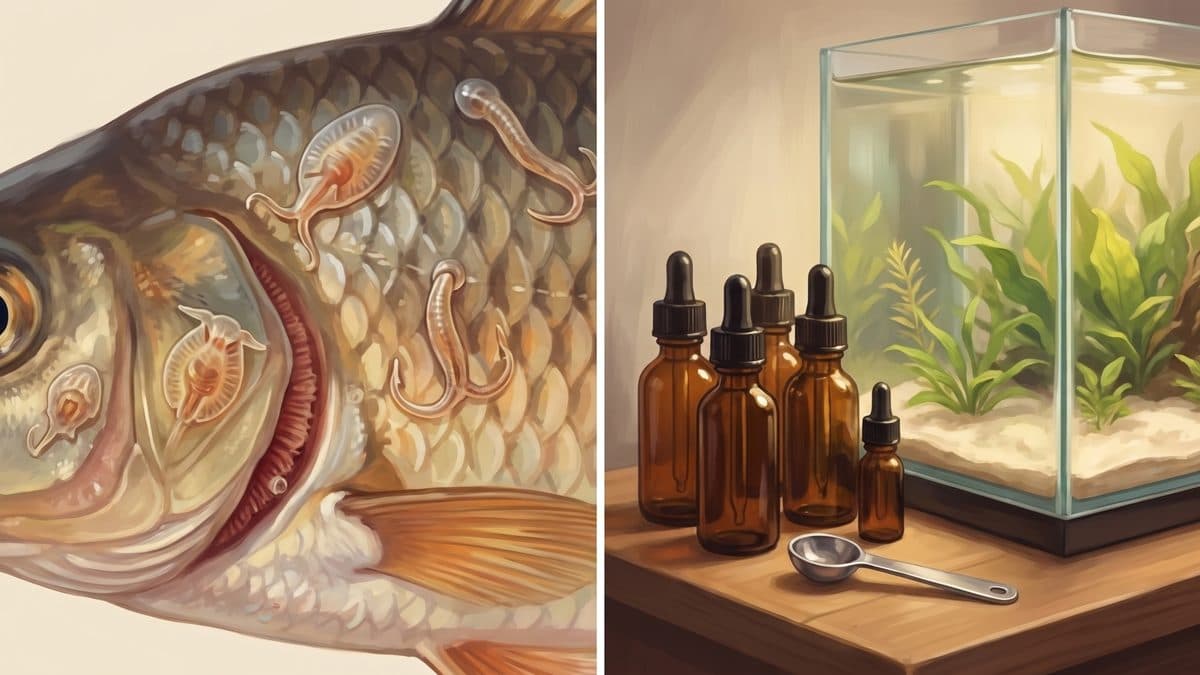
Common Aquarium Parasites
Parasites are organisms that live on or inside a host fish, feeding on its tissue, blood, or nutrients. In the closed environment of an aquarium, parasites can spread rapidly and cause devastating losses if not identified and treated promptly. Unlike bacterial infections, which are often secondary to poor water quality, parasitic infections are typically introduced via new fish, live food, or contaminated equipment — making quarantine the most effective preventive measure.
This guide covers the most common freshwater aquarium parasites: gill flukes, skin flukes, velvet (Oodinium), anchor worm (Lernaea), fish lice (Argulus), and internal helminths (tapeworms, roundworms). For Ich (white spot disease), see our dedicated Ich treatment guide.
Gill and Skin Flukes
Flukes are flatworm parasites belonging to the class Monogenea. The two most common genera in aquarium fish are Dactylogyrus (gill flukes) and Gyrodactylus (skin flukes). They are microscopic — invisible to the naked eye — and attach to the fish using hooks and clamps on their posterior end.
- Dactylogyrus (gill flukes): Attach to gill filaments, feeding on mucus and epithelial cells. Heavy infestations destroy gill tissue, impairing oxygen exchange. Gill flukes are egg-layers — they deposit eggs into the water that hatch into free-swimming larvae.
- Gyrodactylus (skin flukes): Attach to the body and fins, feeding on skin cells and mucus. They are live-bearers — each adult carries a developing offspring inside it, which in turn carries a developing offspring inside it (telescoping generations). This means a single fluke can produce a population explosion without the egg stage.
Fluke Symptoms
- Flashing: Scratching against substrate, rocks, or decorations — the hallmark symptom. Fish are trying to dislodge the irritating parasites.
- Excessive mucus production: The skin may appear cloudy or slimy as the fish produces extra mucus in response to the parasite irritation.
- Rapid gill movement: With gill flukes, respiration rate increases as gill damage impairs oxygen uptake. Fish may hang near filter outputs or air stones seeking oxygenated water.
- Clamped fins and lethargy: General stress responses.
- Red or inflamed gills: Visible when the operculum (gill cover) is lifted — though do not handle stressed fish unnecessarily.
Fluke Treatment Protocol
- Praziquantel is the gold standard treatment for flukes. Use Hikari PraziPro (liquid) or API General Cure (powder containing praziquantel and metronidazole).
- Dose per label instructions. PraziPro: 1 teaspoon (5 mL) per 20 gallons.
- Maintain the dose for 5–7 days. Perform a 25 % water change on day 3 and re-dose to maintain concentration.
- After the first course, perform a 50 % water change, wait 3 days, then repeat the full treatment to catch any larvae that hatched from eggs during the first course (praziquantel does not kill eggs of Dactylogyrus).
- Praziquantel is remarkably safe — it can be used at double dose in emergencies with minimal toxicity to fish, shrimp, and plants. It is not copper-based and will not harm invertebrates.
Velvet Disease (Oodinium)
Velvet is caused by the dinoflagellate parasite Oodinium pilularis (freshwater) or Amyloodinium ocellatum (marine). It presents as a fine, gold or rust-coloured dust covering the fish's body and fins — much finer and more uniform than Ich spots. Because the individual parasites are very small, velvet is often missed until the infestation is advanced.
To confirm velvet, shine a torch on the fish at an angle in a darkened room. The gold sheen of thousands of tiny parasites becomes clearly visible. Velvet is highly lethal — it progresses faster than Ich and can kill within days if untreated.
Velvet Treatment Protocol
- Blackout the tank. Oodinium is a photosynthetic parasite — it uses light to produce energy. Complete blackout (cover the tank with towels or blankets) weakens the parasite significantly.
- Raise temperature to 82–84 °F (28–29 °C) to accelerate the parasite's life cycle.
- Treat with copper: Seachem Cupramine is the recommended copper treatment. Dose per label (0.5 mg/L copper). Maintain copper concentration for 14 days. Use a copper test kit (Seachem or Hanna Instruments) to verify concentration every 2 days — copper degrades and must be re-dosed to maintain therapeutic levels.
- Increase aeration — velvet damages gills, and copper reduces oxygen availability.
- Continue treatment for the full 14 days even if symptoms resolve earlier. Remaining parasites in the tomont (cyst) stage will re-emerge.
Critical warning: Copper is lethal to invertebrates (shrimp, snails, crabs) and many scaleless fish. If your display tank contains invertebrates, treat the fish in a separate hospital tank. Copper also adsorbs into silicone and porous substrates, making it nearly impossible to remove completely — never use copper in a tank you later intend to use for invertebrates.
Anchor Worm and Fish Lice
These are macroscopic parasites — large enough to see with the naked eye:
- Anchor worm (Lernaea): A crustacean parasite that embeds its head into the fish's muscle tissue, with a worm-like body (5–20 mm) protruding from the attachment point. Often seen with a red, inflamed wound at the base. Female anchor worms carry paired egg sacs at their posterior end.
- Fish lice (Argulus): A flat, disc-shaped crustacean (3–10 mm) that clings to the fish's body and feeds on blood and tissue fluid using a needle-like stylet. Fish lice are mobile — they can detach and swim to a new host.
Anchor Worm Treatment
- Manual removal: Using fine-tipped tweezers, grasp the anchor worm as close to the attachment point as possible and pull steadily. Do not yank — the embedded head must come out cleanly or it will cause a secondary infection. Dab the wound with an antiseptic (Betadine or mercurochrome).
- Tank treatment: Diflubenzuron (Dimilin) is the most effective chemical treatment for anchor worm and fish lice. It inhibits chitin synthesis, preventing larvae from developing their exoskeleton. Dose at 0.03 mg/L. One treatment breaks the reproductive cycle; repeat after 14 days to catch any remaining larvae.
- Alternative: Potassium permanganate dip (10 mg/L for 30 minutes) kills external parasites but is stressful to the fish. Use as a supplementary treatment after manual removal.
- Treat secondary bacterial infection at the attachment wound with appropriate antibiotics if the wound shows signs of infection (redness, swelling, white exudate).
Internal Parasites
Internal parasites include tapeworms (Bothriocephalus), roundworms (Camallanus, Capillaria), and protozoa (Hexamita, Spironucleus). Symptoms are often subtle:
- White, stringy faeces: The classic indicator. Normal fish faeces are solid and coloured; parasitised fish produce long, pale, mucoid strings.
- Wasting: The fish eats normally but loses weight — a "pinched belly" appearance behind the head.
- Bloating: Severe internal infestations can cause abdominal distension.
- Red, thread-like worms protruding from the anus: Pathognomonic for Camallanus worms — a serious and common aquarium parasite.
- Hole-in-the-head (HITH): Pitting erosion on the head and lateral line, associated with Hexamita/Spironucleus infection, particularly in cichlids and Discus.
Internal Parasite Treatment
- Tapeworms and flatworms: Praziquantel (PraziPro) — effective both in-water and when soaked into food. Two courses, 7 days each, with a 5-day gap between courses.
- Camallanus (red worms): Levamisole (Levamisole HCl) at 2 mg/L as an in-water treatment for 24 hours. Perform a large water change, then repeat in 14 days. Alternatively, fenbendazole (Panacur) soaked into food at 0.25 % concentration for 3 days.
- Hexamita/Spironucleus: Metronidazole (Seachem MetroPlex) — 1 measure per 10 gallons every 48 hours for 3 doses, combined with food soaking using Seachem Focus as a binder. Raise temperature to 86 °F for Discus and cichlids during treatment.
Parasite Prevention
- Quarantine every new fish for 30 days minimum. See our quarantine guide for setup details.
- Prophylactically treat new arrivals with praziquantel during quarantine — this eliminates flukes and internal worms before they enter your display.
- Avoid live tubifex worms — they are a common vector for parasites and bacteria. Use frozen or cultured alternatives (blackworms from reputable sources, frozen bloodworm).
- Dip new plants in potassium permanganate (10 mg/L for 10 minutes) or a dilute bleach solution (1:20 for 2 minutes, then rinse and dechlorinate) to kill hitchhiker parasites, snails, and eggs.
- Do not share equipment between tanks without sterilising. Nets, siphons, and buckets can transfer parasites between systems.
- Maintain water quality. Healthy fish with strong immune systems resist parasitic infection far more effectively than stressed fish in poor conditions.
For broader disease prevention strategies, see our disease prevention guide.