Overview
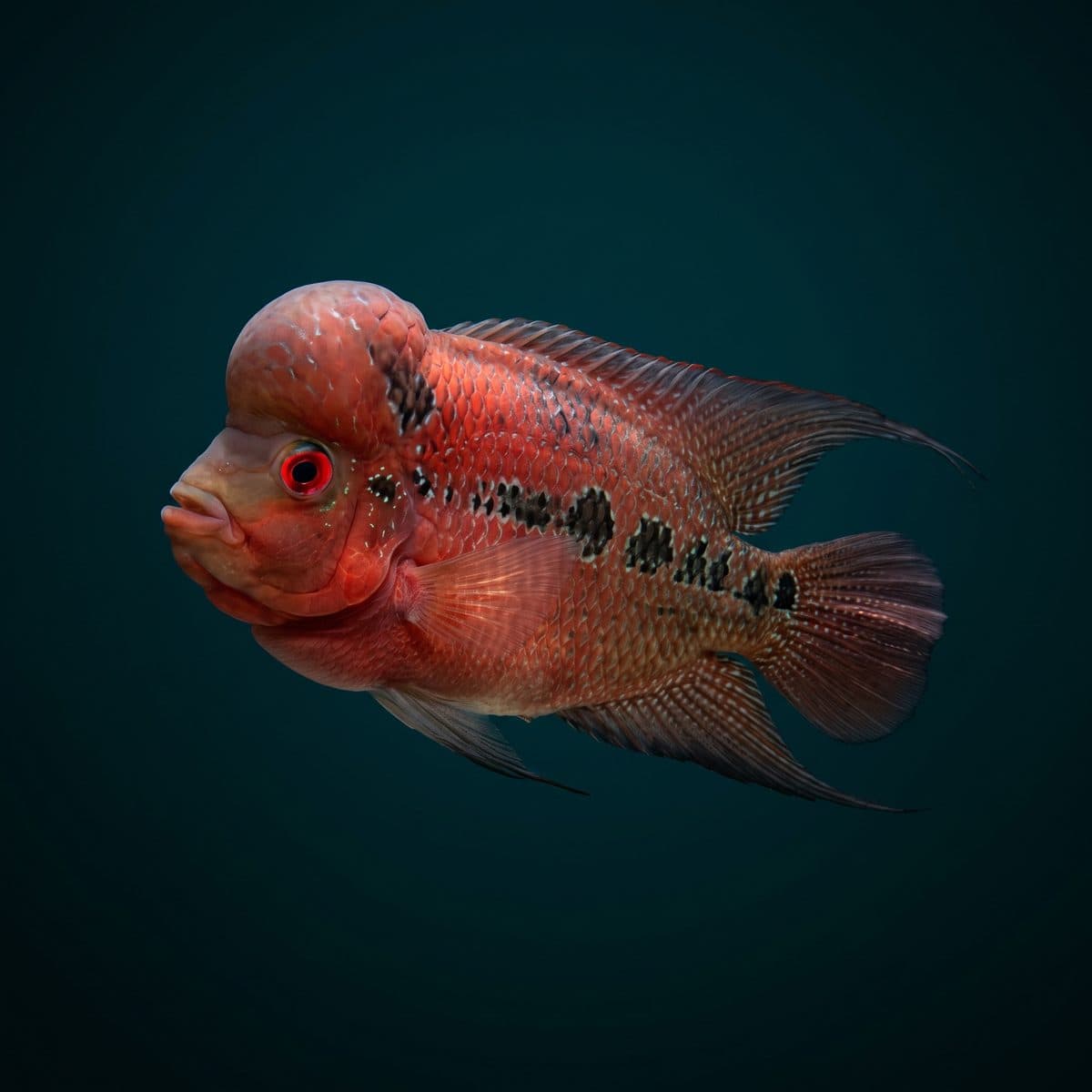
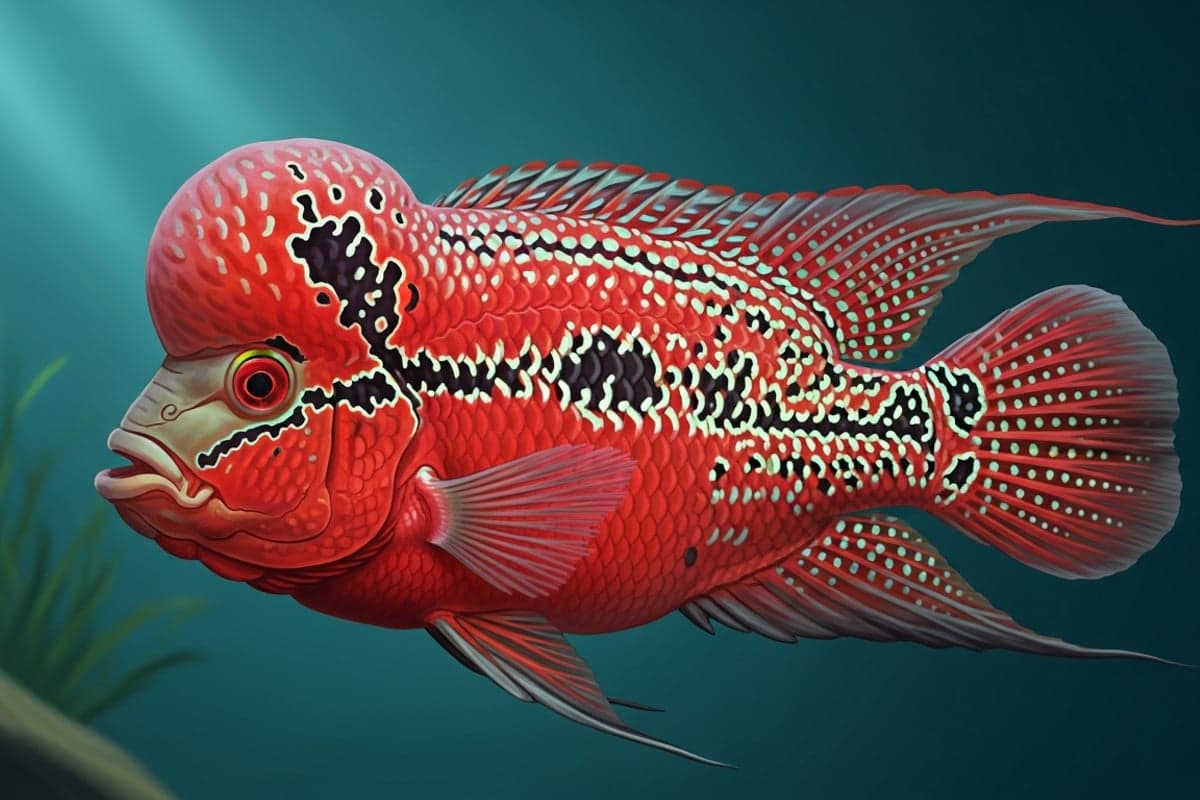
The Flowerhorn Cichlid is an entirely artificial creation — a hybrid that does not exist in nature, produced through deliberate crosses of Central American cichlid species beginning in Malaysia and Taiwan in the late 1990s. Its appeal lies in three features: a prominent nuchal hump (called the "kok" in the Flowerhorn community), vivid red, orange, or yellow body colouration often overlaid with "pearl" or "flower" markings, and an extraordinarily interactive personality. Flowerhorn will follow their owner's movement through the room, "beg" at the glass for food, and allow — sometimes demand — physical interaction during feeding.
The Flowerhorn industry is a multibillion-dollar global enterprise, with competition-grade specimens selling for $5,000–$100,000+ at shows in Southeast Asia. Judging criteria emphasise hump size and shape, body proportions, colour intensity, pearl coverage, and dorsal fin profile. For the hobbyist, however, the Flowerhorn's charm lies not in competitive valuation but in its personality — no other aquarium fish provides the same level of interactive engagement.
Flowerhorn husbandry is relatively straightforward compared to many exotic species, but the fish's extreme aggression demands a specific management approach. This is almost certainly a fish that will be kept alone, and the keeper must accept that this single specimen will be the sole inhabitant of a 75+ gallon system. Those who embrace this arrangement discover one of the most rewarding fish-keeping experiences available.
Origins & Strains
The Flowerhorn's origins trace to Malaysian hobbyists in the late 1990s who crossed Blood Parrot cichlids (themselves a hybrid of Amphilophus citrinellus and Paraneetroplus synspilus) with various Central American cichlids, primarily Amphilophus trimaculatus (Trimac Cichlid). Subsequent generations were selectively bred for hump development, colour, and body shape. Today, the major Flowerhorn strains include:
- Zhen Zhu (Pearl): The original and most widely available strain. Characterised by pearl-like floral markings across the body, a well-developed kok, and red or orange base colouration. Available from $30 to $5,000+ depending on quality.
- Kamfa: Developed from crosses incorporating Vieja synspila and possibly Vieja melanurus. Kamfa strains feature a more compact, rounded body, larger eyes, shorter face, and the prized "water head" kok (a smooth, bulbous hump). King Kamfa specimens with exceptional pearl and colour can exceed $10,000.
- Super Red Dragon (SRD): Bred for intense, uniform red colouration across the entire body. SRD Flowerhorn lack the pearl markings of Zhen Zhu and Kamfa strains, instead displaying a clean, saturated red from head to tail. Top specimens command $5,000–$20,000.
- Golden Monkey / Golden Base: A strain emphasising golden-yellow body colour with red trim on fins and facial features. Less common than red strains but increasingly popular.
- Thai Silk / Titanium: A short-bodied, metallic blue-silver strain with reduced hump development but striking iridescent colouration. Considered a separate category by some Flowerhorn organisations.
Tank Requirements
Tank Dimensions & Layout
A single adult Flowerhorn requires a minimum 75-gallon (285 L) aquarium. For large males (35+ cm) or if you intend to attempt any form of tank-mate introduction, 125 gallons (475 L) is the minimum. The tank should measure at least 120 cm long × 45 cm wide × 50 cm tall (48 × 18 × 20 inches) to provide adequate swimming space.
Flowerhorn tanks are typically kept bare-bottom or with a thin layer of sand for ease of cleaning. These fish produce a heavy bioload, and a bare bottom simplifies waste removal via siphoning. If you prefer a substrate, use fine pool filter sand in a layer no deeper than 2 cm — deep sand beds trap detritus in a high-waste predator tank.
Décor should be minimal and robust. Flowerhorn will rearrange anything they can move — decorations weighing less than 2 kg will be pushed to the corners or flipped. Large ceramic pots (turned on their side as caves), heavy slate rocks, and PVC pipe sections provide enrichment without the risk of injury. Avoid sharp-edged rocks that could damage the nuchal hump during the fish's inevitable rearrangement efforts.
Many competition-oriented keepers house their Flowerhorn in bare tanks with a mirror placed against one end for 15–30 minutes daily. The mirror stimulation encourages the fish to flare, which some breeders believe promotes hump growth (through increased blood flow and hormonal response). Whether this is effective is debated, but it undeniably provides behavioural enrichment.
Filtration & Flow
Flowerhorn produce substantial waste. Budget for filtration rated at 2× your tank volume — for a 75-gallon tank, use filters rated for 150+ gallons. A large canister filter (Fluval FX4, Eheim 2262) combined with a sponge filter for supplemental biological capacity is a proven configuration. If your setup allows it, a sump with a wet/dry trickle tower provides the gas exchange and biological capacity that predator tanks demand.
Flow can be moderate to strong — 8–12× turnover per hour. Flowerhorn are powerful swimmers from river-adjacent habitats and handle current better than many other large cichlids. Strong flow also helps keep waste in suspension for mechanical filtration to capture.
Water Parameters
- Temperature: 26–30 °C (78–86 °F). Higher temperatures (28–30 °C) are often used during growth phases and for hump development, as they increase metabolic rate and feeding response. Reduce to 26–27 °C for maintenance of fully grown adults.
- pH: 7.0–8.0. Flowerhorn are adaptable across this range. Most breeders in Southeast Asia maintain pH 7.4–7.8.
- GH: 8–20 dGH. Moderately hard water is preferred and typical of Central American cichlid habitats.
- KH: 4–10 dKH. Adequate buffering prevents pH crashes in these high-bioload systems.
- Ammonia / Nitrite: 0 ppm — always.
- Nitrate: <30 ppm. Weekly water changes of 25–40% are standard practice for Flowerhorn keepers. Many competition breeders perform daily 20% changes during growth phases.
Water changes are the single most important factor in Flowerhorn health and appearance. Clean water promotes vibrant colour, healthy hump growth, and strong immune function. Flowerhorn kept in old, nitrate-rich water display washed-out colour, reduced hump size, and increased susceptibility to hole-in-the-head disease. There is no substitute for regular, generous water changes.
Diet & Feeding
Flowerhorn are enthusiastic, indiscriminate feeders — they will eat virtually anything offered. The challenge is not getting them to eat but ensuring the diet promotes optimal colour, hump growth, and long-term health without causing obesity or digestive issues.
A staple diet should be built around high-quality cichlid pellets formulated for large Central American species:
- Primary pellets (60–70% of diet): Grand Sumo (the gold standard in the Flowerhorn community for hump growth), Okiko Platinum, or Northfin Cichlid Formula. These pellets are formulated with astaxanthin and other carotenoids for colour enhancement and high protein content (40%+) for growth.
- Supplemental protein (20–30%): Market prawns (shell-on), earthworms, bloodworms (frozen, not live — to avoid parasites), and krill. These provide dietary variety and essential nutrients that pellets alone cannot deliver.
- Vegetable matter (5–10%): Blanched peas (shelled), spirulina flakes, or nori strips. Vegetable fibre supports digestive health and helps prevent the bloat that plagues overfed cichlids.
Feed juveniles (under 15 cm) 2–3 times daily with portions consumed in 2–3 minutes. Sub-adults (15–25 cm) should be fed twice daily. Adults (25+ cm) can be fed once daily with one fasting day per week.
Nuchal Hump Development
The nuchal hump is a fat and fluid deposit on the forehead that is genetically determined but environmentally influenced. Not all Flowerhorn will develop a large kok — genetics is the primary factor, and no amount of dietary manipulation will produce a competition-grade hump on a fish that lacks the genetic predisposition. That said, the following factors maximise hump potential:
- Genetics: Source from breeders with documented hump lineage. Both parents should display strong kok development.
- Diet: High-protein pellets (Grand Sumo, Okiko) with supplemental live and frozen foods. Some keepers report that the chitin in prawn shells and the collagen in earthworms specifically benefit hump growth, though this is anecdotal.
- Water quality: Pristine conditions with frequent water changes. Hump size can visibly decrease in poor water conditions.
- Isolation: Flowerhorn kept alone develop larger humps than those housed with competitors. The stress of tank mates diverts energy from hump growth to immune and stress responses.
- Temperature: Slightly elevated temperatures (28–30 °C) during the growth phase (6–18 months) increase metabolic rate and feeding aggression, supporting faster growth and hump development.
Colour Enhancement
Flowerhorn colour is a combination of genetics, diet, and environment. To maximise colour intensity:
- Carotenoid-rich foods: Astaxanthin and canthaxanthin are the primary pigments responsible for red colouration. Grand Sumo, Okiko, and similar Flowerhorn-specific pellets contain high concentrations. Supplement with krill (naturally rich in astaxanthin) and spirulina (which enhances blue and green iridescence).
- Dark substrate or bare bottom: Flowerhorn display more intense colouration against dark backgrounds. Some keepers use black tank backgrounds and dark sand to stimulate melanophore contraction, which makes xanthophore (red/yellow) pigments appear more vivid.
- Lighting: Full-spectrum LED lighting in the 6,500–10,000 K range showcases Flowerhorn colour most accurately. Avoid excessively blue lighting (>14,000 K), which distorts red tones.
- Water quality: Clean, well-oxygenated water. Poor conditions cause mucus overproduction that dulls colour. Regular water changes visibly improve colour within days.
Behaviour & Temperament
Flowerhorn are among the most aggressive freshwater fish in the hobby. Their aggression is not selective — they will attack conspecifics, heterospecifics, your hand, the siphon hose, and the magnetic algae scrubber with equal ferocity. This aggression is a feature, not a bug — it is inextricably linked to the personality traits that make Flowerhorn so engaging. A docile Flowerhorn would not be a Flowerhorn.
Flowerhorn bond with their primary keeper in a way that few fish can match. They will swim to the front of the tank when their person enters the room, follow a pointing finger from one end of the tank to the other, allow their kok to be touched (though this should be done sparingly and with wet hands to avoid removing the slime coat), and display obvious agitation when fed by anyone other than their regular keeper. This intelligence and interactivity is the fundamental reason for the species' enduring popularity.
Compatible Tank Mates
The honest recommendation is: do not keep Flowerhorn with other fish. The vast majority of tank mate introductions end with the tank mate dead, injured, or cowering in a corner with shredded fins. If you insist on trying, observe the following:
- Tank size: 200+ gallons minimum. In a 75-gallon tank, there is no safe tank mate.
- Acrylic dividers: Many keepers use a clear acrylic divider to split the tank, giving each fish its own territory while allowing visual interaction. This is the safest approach for keeping a Flowerhorn alongside another large cichlid.
- Occasionally tolerated: Large, fast-moving Plecostomus (18+ inches), adult Bichirs (armour provides protection), very large Oscar (in 250+ gallon systems — monitor constantly).
- Almost always killed: Other Flowerhorn (unless a proven mated pair during breeding), small cichlids, any fish under 20 cm, any slow-moving or long-finned species.
Breeding
Breeding Flowerhorn is straightforward in terms of the spawning act itself but complex in terms of producing quality offspring. As hybrids, Flowerhorn genetics are inherently unstable, and a spawn between two competition-grade parents may produce fry ranging from stunning to utterly plain.
Breeding protocol:
- Pairing: Place the male and female in the same tank with a clear acrylic divider between them. Allow them to see and interact through the divider for 7–14 days. Look for signs of compatibility: the female displaying vertical barring, both fish "vibrating" or "lip-locking" through the divider. If the male attacks the divider relentlessly with gill-flare displays and body slams, try a different female.
- Spawning: Remove the divider when compatibility signs are strong. Monitor continuously for the first 2–4 hours. The female will clean a flat surface (a ceramic plate or flat stone) and deposit 500–2,000 eggs. The male fertilises them immediately. If aggression escalates to serious injury (torn fins, scale loss), separate immediately and retry later or with a different mate.
- Egg care: Remove the male after spawning — he may eat the eggs or attack the female. The female can tend the eggs, which hatch in 72–96 hours at 28 °C. Alternatively, remove both parents and add an airstone for gentle water circulation over the eggs, along with methylene blue (1 ppm) to prevent fungal infection.
- Fry rearing: Free-swimming fry can be fed baby brine shrimp nauplii (Artemia) from day 5. Transition to crushed pellets at 3–4 weeks. Grade aggressively — separate the best-coloured, best-shaped fry into grow-out tanks and cull or sell the rest. By 3–4 months, individual quality becomes apparent.
Common Health Issues
Hole in the Head (HITH)
Hole-in-the-head disease is the most common health issue in Flowerhorn and presents as pitting erosion on the head and lateral line, often with white, stringy mucus trailing from the lesions. The condition is multifactorial — contributing causes include the flagellate parasite Hexamita, poor water quality (chronically elevated nitrate), vitamin deficiency (particularly vitamins A and C), and activated carbon use.
Treatment: Metronidazole at 250 mg per 40 litres for 3 days (50% water change between doses), combined with improving water quality (increase water change frequency to 40% every other day), enriching the diet with vitamin-soaked foods, and removing activated carbon from filtration. Early-stage HITH is fully reversible. Advanced cases leave permanent scarring.
Bloat (Malawi Bloat Analogue)
Bloat in Flowerhorn presents as abdominal swelling, loss of appetite, stringy white faeces, and lethargy. It is typically caused by internal flagellate parasites (Hexamita, Spironucleus) or bacterial infection of the gut, often triggered by overfeeding, poor water quality, or dietary imbalance (excess protein, insufficient fibre).
Treatment: Stop feeding immediately. Treat with metronidazole (250 mg per 40 litres) and Epsom salt (1 tablespoon per 20 litres) to reduce fluid retention. Perform daily 30% water changes during treatment. Resume feeding with blanched, shelled peas as the first food after symptoms resolve, then gradually reintroduce pellets. Prevention: include vegetable matter in the diet weekly, maintain impeccable water quality, and avoid overfeeding.