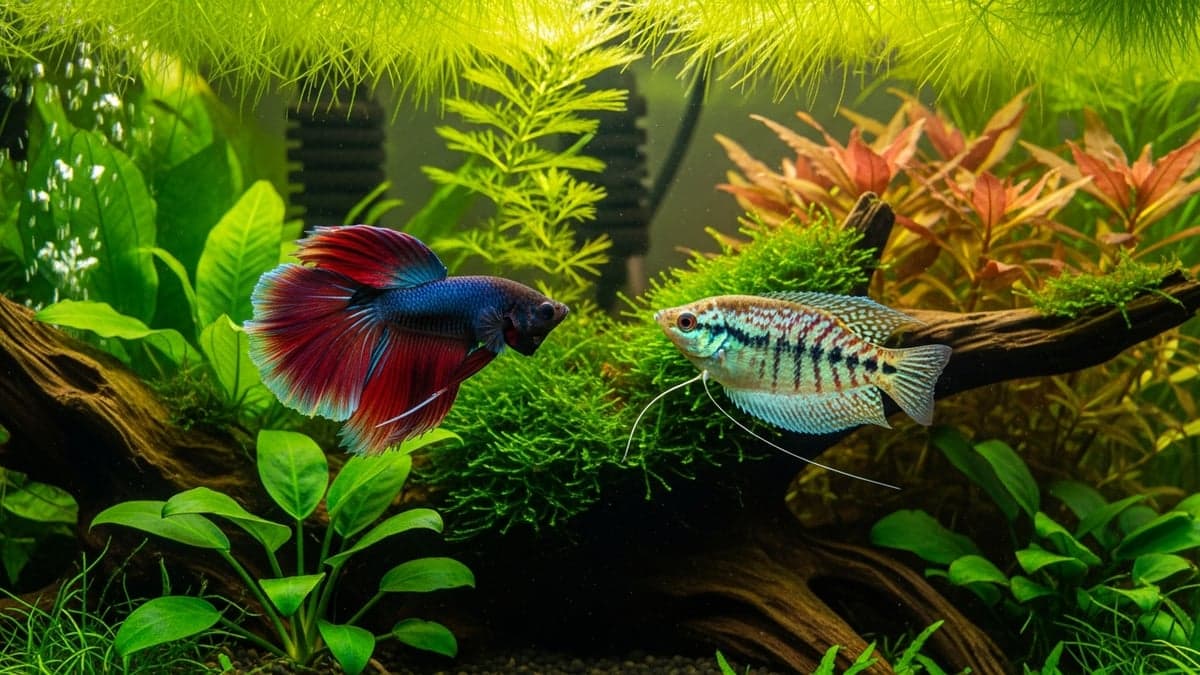
Betta vs Gourami: The Labyrinth Fish Face-Off
Bettas and Gouramis belong to the same suborder (Anabantoidei) and share a defining trait: the labyrinth organ, a specialised respiratory structure that allows them to breathe atmospheric air directly. This adaptation evolved in the warm, oxygen-poor waters of Southeast Asia and gives both groups an advantage in low-oxygen environments — and the charming behaviour of surfacing regularly to gulp air.
Despite their shared ancestry, Bettas and Gouramis occupy very different niches in the aquarium hobby. The Betta is the undisputed king of nano tanks and solo fishkeeping — a jewel-like centrepiece available in hundreds of colour and fin varieties. Gouramis are community-oriented fish that range from tiny Sparkling Gouramis to massive Giant Gouramis, with the mid-sized species (Pearl, Honey, Dwarf) being among the best community fish in the hobby.
This guide compares the two groups across every factor that matters — so you can choose the right labyrinth fish for your tank size, experience level, and fishkeeping goals.
Betta Overview
The Siamese Fighting Fish (Betta splendens) is one of the most recognisable fish in the world. Originally bred for fighting in Thailand (Siam) over 700 years ago, the modern aquarium Betta is bred for extreme colour and finnage rather than aggression — though the fighting instinct remains firmly embedded. Wild-type Bettas are short-finned and dull-coloured; the flowing fins and vivid hues seen in pet stores are the result of centuries of selective breeding.
Adult Bettas reach 6–7 cm (2.5–3 inches) body length, with elaborate fins potentially doubling the total visual size. Males are the colourful sex — females are smaller, shorter-finned, and less vibrant, though selectively bred "sorority" females are increasingly colourful.
Key tail types: Halfmoon (180° tail spread), Crowntail (spiked fin rays extending beyond the webbing), Plakat (short-finned, closest to wild type), Dumbo/Elephant Ear (oversized pectoral fins), Veiltail (long, flowing, asymmetric), Double Tail, and Rosetail/Feathertail (extreme ruffling). Each tail type is available in virtually every colour: red, blue, black, white, multicolour (galaxy, marble, koi), copper, and metallic.
Gourami Overview
Gouramis encompass the family Osphronemidae and several closely related families within the suborder Anabantoidei. The most popular aquarium species include:
- Dwarf Gourami (Trichogaster lalius): The most popular species. Males are brilliantly coloured — Neon Blue, Flame Red, and Powder Blue varieties. Adults reach 5–7 cm. Unfortunately, commercially bred Dwarf Gouramis suffer from high rates of Dwarf Gourami Iridovirus (DGIV), a fatal disease with no cure, making sourcing from reputable suppliers critical.
- Honey Gourami (Trichogaster chuna): A smaller (4–5 cm), hardier alternative to the Dwarf Gourami. Males develop a warm golden-orange body with a dark throat during breeding display. One of the most peaceful community fish available.
- Pearl Gourami (Trichopodus leeri): Arguably the most beautiful Gourami — a silver body covered in iridescent pearl-like spots, with an orange breast in breeding males. Adults reach 10–12 cm. Peaceful, hardy, and an excellent centrepiece for 30+ gallon planted tanks.
- Moonlight Gourami (Trichopodus microlepis): A large (12–15 cm), silvery-green species with a subtle, ethereal beauty. Peaceful and suitable for 55+ gallon community tanks.
- Sparkling Gourami (Trichopsis pumila): A nano species at just 3.5–4 cm with iridescent blue-green scales. Famous for producing audible "croaking" sounds during courtship. Perfect for 10+ gallon planted nano tanks.
- Giant Gourami (Osphronemus goramy): The outlier — a massive fish reaching 40–70 cm that requires 200+ gallon tanks. Intelligent, personable, and vegetarian. An entirely different fishkeeping experience from the smaller species.
Side-by-Side Comparison Table
| Factor | Betta (B. splendens) | Gourami (popular species) |
|---|---|---|
| Family | Osphronemidae | Osphronemidae (and related) |
| Adult Size | 6–7 cm (body) | 4–15 cm (species-dependent; Giant: 40–70 cm) |
| Lifespan | 3–5 years | 4–8 years (species-dependent) |
| Temperature | 24–28 °C (75–82 °F) | 22–28 °C (72–82 °F) |
| pH | 6.5–7.5 | 6.0–8.0 (species-dependent) |
| Minimum Tank Size | 5 gal (single male) | 10 gal (Sparkling), 20 gal (Dwarf/Honey), 30+ gal (Pearl) |
| Aggression (male-to-male) | Extreme (fight to the death) | Moderate (territorial displays, rarely lethal) |
| Aggression (community) | Low-Moderate (fin nipping concern is toward Betta, not from Betta) | Low (most species are peaceful) |
| Community Potential | Limited (solo or carefully selected mates in 10+ gal) | Excellent (most species are ideal community fish) |
| Colour Varieties | Hundreds (colour × tail type combinations) | Moderate (natural colour variations, limited selective breeding) |
| Care Difficulty | Easy | Easy to Moderate |
| Purchase Price | $5–$30 (standard), $30–$300+ (rare imports) | $5–$15 (common), $15–$50 (rare species) |
| Labyrinth Organ | Yes | Yes |
Temperament and Aggression
This is the defining behavioural difference between the two groups:
Betta aggression: Male Bettas are famous for their lethal aggression toward other male Bettas — and toward any fish they perceive as a rival male (brightly coloured, long-finned species are most at risk). Two male Bettas in the same tank will fight until one is dead or critically injured. This is not a behaviour that can be "trained out" — it is hardwired by centuries of selective breeding for fighting prowess.
However, Bettas are not aggressive toward most non-Betta species. A male Betta in a properly sized community (10+ gallons) with appropriate tank mates — small tetras, Corydoras, snails, shrimp (with caution) — is typically peaceful. The aggression risk is directed at the Betta, not from it: fin-nipping species (Tiger Barbs, Serpae Tetras) will shred a Betta's elaborate fins, causing stress and secondary infection.
Female Bettas can be kept in "sorority" groups of 5+ in 20+ gallon tanks with ample hiding spots, though this requires experience and careful monitoring — sorority dynamics can break down suddenly, resulting in injuries.
Gourami aggression: Most Gouramis are peaceful community fish. The primary aggression pattern is male-to-male territorial behaviour within the same species — two male Dwarf Gouramis in a 20-gallon tank will spar, with the dominant male claiming the top territory and the subordinate hiding. In a 30+ gallon tank with ample plants and sight breaks, two males usually establish a stable hierarchy.
The notable exceptions are the Three-Spot (Blue) Gourami (Trichopodus trichopterus), which can be genuinely aggressive as adults, and the Giant Gourami, which is too large to house with most community fish. Honey Gouramis and Sparkling Gouramis are among the most peaceful fish in the entire hobby — suitable for even the gentlest community setups.
Tank Size Requirements
Betta tank size: The absolute minimum for a single male Betta is 5 gallons (19 litres) — heated, filtered, and cycled. The "Betta in a bowl" approach that pet stores perpetuate is animal cruelty: unheated, unfiltered bowls produce ammonia spikes, temperature swings, and chronic stress that cuts the fish's lifespan from 3–5 years to 6–12 months.
For a Betta community (one male Betta with compatible tank mates), 10 gallons is the minimum. A female sorority requires 20+ gallons with dense planting. The ideal Betta setup is a 10-gallon planted tank with a gentle sponge filter, a reliable heater set to 26 °C, and plenty of resting spots near the surface (Betta leaves, floating plants).
Gourami tank size:
- Sparkling Gourami: 10 gallons (pair or trio)
- Honey Gourami: 20 gallons (group of 4–6)
- Dwarf Gourami: 20 gallons (single male or male/female pair)
- Pearl Gourami: 30 gallons (pair), 55+ gallons for a group
- Moonlight Gourami: 55 gallons (pair or group)
- Giant Gourami: 200+ gallons (single specimen)
Gouramis generally require more tank space than a single Betta because they are kept in pairs or groups and benefit from swimming room. However, the larger tank size enables a more diverse community — a 30-gallon Pearl Gourami tank with Corydoras, Harlequin Rasboras, and a Bristlenose Pleco is far more dynamic than a solo Betta in a 5-gallon nano.
Care Level and Water Parameters
Both Bettas and Gouramis are hardy, beginner-friendly fish — their labyrinth organ gives them a survival advantage in imperfect conditions because they can supplement gill respiration with atmospheric air. However, this resilience should not be mistaken for permission to neglect water quality.
Betta parameters: Temperature 24–28 °C (26 °C ideal), pH 6.5–7.5, GH 4–12 dGH. Weekly 25 % water changes in a filtered tank. Feed small, frequent meals of high-quality Betta pellets (Hikari Betta Bio-Gold, Northfin Betta Bits) supplemented with frozen bloodworms and brine shrimp 2–3 times weekly. Bettas are surface feeders with small mouths — ensure food is appropriately sized.
Gourami parameters: Temperature 22–28 °C (24–26 °C ideal for most species), pH 6.0–8.0 (varies by species; Honey and Pearl prefer softer, slightly acidic water; Blue/Three-Spot tolerate harder, more alkaline conditions), GH 4–15 dGH. Standard community tank maintenance — 25 % weekly water changes, high-quality flake or micro pellet food with frozen food supplementation.
The one health concern unique to Gouramis is Dwarf Gourami Iridovirus (DGIV) — a fatal, incurable viral disease that affects commercially bred Dwarf Gouramis at alarming rates (some estimates suggest 20–50 % of farm-bred stock carries the virus). Symptoms include lethargy, colour loss, abdominal swelling, and death within weeks. The best defence is sourcing from local breeders or reputable importers who quarantine stock, and choosing Honey or Pearl Gouramis instead of Dwarf Gouramis if DGIV concerns you.
Varieties and Colour Options
Betta varieties: No freshwater fish matches the Betta for colour and form diversity. The combination of tail types (Halfmoon, Crowntail, Plakat, Dumbo, Veiltail, Double Tail, Rosetail) with colour types (solid, bi-colour, marble, galaxy, koi, dragon, copper, metallic) and colour options (red, blue, black, white, green, purple, orange, yellow, turquoise) produces hundreds — arguably thousands — of distinct combinations. This variety fuels a global breeding and show community where champion specimens sell for $100–$500+.
New varieties emerge regularly as breeders push genetic boundaries. Recent developments include the Galaxy Koi Betta (multicoloured with marbling), Alien Betta (wild-type hybrids with iridescent scaling), and Samurai Plakat (dragon-scale Plakat with metallic overlay).
Gourami varieties: Gouramis offer less variety within individual species but more diversity across the group. The Dwarf Gourami comes in Neon Blue, Flame Red, Powder Blue, and Robin (natural) varieties. Honey Gouramis are available in natural gold and a selectively bred "Sunset" form with intensified orange-red. Pearl Gouramis are consistently beautiful but do not vary significantly — every specimen shows the characteristic pearlescent spots.
Where Gouramis diversify is across species: from the tiny, croaking Sparkling Gourami to the majestic, 70 cm Giant Gourami, the family offers a fish for every tank size. The Blue (Three-Spot) Gourami comes in Gold, Opaline, and Platinum morphs. Kissing Gouramis (Helostoma temminckii) offer their famous "kissing" behaviour (actually a form of combat) in pink and green variants.
If individual customisation and collecting rare colour morphs is your passion, Bettas win decisively. If you prefer species diversity within a natural aesthetic, Gouramis offer a wider ecological range.
Community Compatibility
Betta community tank mates (10+ gallons):
- Best options: Corydoras (pygmy or habrosus for 10 gal; larger species for 20+), Harlequin Rasboras, Ember Tetras, Kuhli Loaches, Nerite Snails, Amano Shrimp
- Acceptable: Neon Tetras (school of 8+), Mystery Snails, Otocinclus, Endler's Livebearers (females only — male Endlers' bright colours may trigger Betta aggression)
- Avoid: Tiger Barbs (fin nippers), Serpae Tetras (fin nippers), other Bettas (males), any Gourami (closely related — may trigger aggression), brightly coloured, long-finned fish (Fancy Guppies — Bettas may see them as rival males)
Gourami community tank mates:
- Best options: Almost any peaceful community fish — Tetras (all common species), Rasboras, Corydoras, Loaches, Bristlenose Pleco, Dwarf Cichlids (Rams, Apistogramma), Livebearers, Snails, Shrimp
- Acceptable: Angelfish (with Pearl or Moonlight Gouramis in 55+ gallon tanks), Rainbowfish, peaceful Barbs (Cherry Barb)
- Avoid: Bettas (will trigger aggression from the Betta), aggressive cichlids, large predatory fish, fin-nipping species with smaller/slower Gouramis
Gouramis are far more versatile community fish than Bettas. A Pearl Gourami or Honey Gourami slots into virtually any peaceful community tank without issues, while a Betta requires careful mate selection and close monitoring.
Breeding Comparison
Both Bettas and Gouramis are bubble-nest builders — the male constructs a floating raft of air bubbles (often reinforced with plant material) at the water surface, courts the female with elaborate displays, and then wraps around her in a spawning embrace beneath the nest. Fertilised eggs float up into the nest, where the male guards and tends them.
Betta breeding: Accessible for dedicated beginners. The male builds a bubble nest, the pair spawns (a dramatic, sometimes rough process — the female should be removed after spawning to prevent male aggression), and the male guards 50–300+ eggs. Fry hatch in 24–36 hours and become free-swimming in 3–5 days, at which point they need infusoria or commercially available liquid fry food, graduating to baby brine shrimp at 1–2 weeks. The challenge: each spawn produces dozens of males that cannot be housed together, requiring a grow-out system with individual containers — a significant space and maintenance commitment.
Gourami breeding: Similar mechanics but generally easier social dynamics. Most Gourami species are less aggressive during spawning than Bettas, and pairs can often remain together post-spawning (though monitoring is wise). Dwarf and Honey Gouramis breed readily in densely planted 20-gallon tanks with warm water (28 °C) and gentle filtration. Pearl Gouramis build impressive bubble nests up to 25 cm in diameter. Fry care follows the same progression: infusoria → baby brine shrimp → crushed flake. The grow-out phase is simpler than Bettas because juvenile Gouramis can be housed together without the male-aggression issues that plague Betta fry rearing.
Verdict: Which Should You Choose?
Choose a Betta if:
- You have limited space (5–10 gallon tank)
- You want a single, stunning centrepiece fish with maximum colour variety
- You enjoy collecting and potentially showing or breeding rare varieties
- You prefer a solo fish or a very small, carefully curated community
- You want an affordable entry point into the hobby ($20–$50 for complete nano setup + fish)
Choose a Gourami if:
- You have a 20+ gallon community tank and want a peaceful, compatible centrepiece
- You prefer watching group dynamics and community interactions
- You want species diversity (from 4 cm Sparkling to 70 cm Giant)
- You want a labyrinth fish that integrates seamlessly with tetras, Corydoras, and other community staples
- You are interested in breeding without the complexity of separating aggressive male offspring
Our recommendation: There is no wrong answer — these fish serve different purposes. A Betta is the perfect "desk fish" or bedroom nano centrepiece. A Gourami is the perfect centrepiece for a living-room community tank. Many hobbyists keep both: a Betta nano on their desk and a Pearl Gourami community in the living room. The labyrinth fish family has something for everyone. Browse The Fish Collection's fish collection for available specimens.