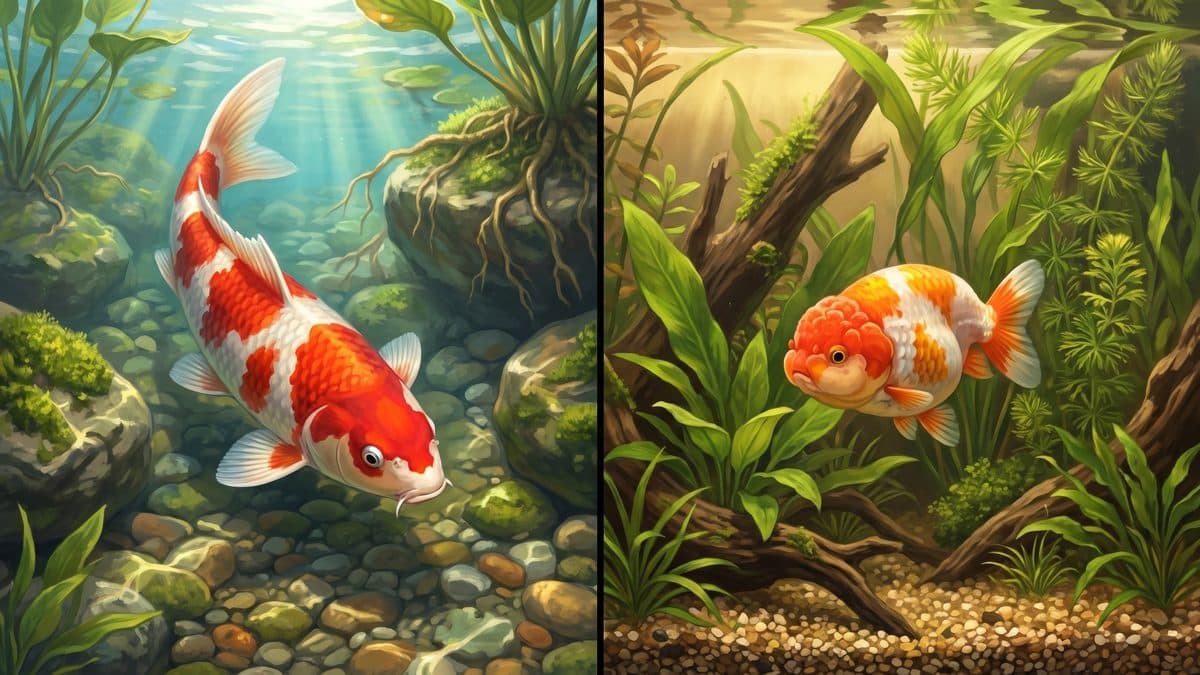
Koi vs Goldfish: Ornamental Carp Compared
Koi and Goldfish are the two pillars of ornamental fishkeeping, with a combined domestication history spanning over a thousand years. Both descend from wild carp species in East Asia, yet centuries of selective breeding have pushed them in dramatically different directions. Koi became the centrepiece of Japanese water gardens — massive, long-lived, and valued like living art. Goldfish became the world's most accessible pet fish — adaptable, varied in form, and suited to everything from a desktop aquarium to a backyard pond.
Despite their common ancestry, choosing between Koi and Goldfish is not a matter of preference alone — it is fundamentally a question of space, budget, and commitment level. This guide breaks down every factor so you can make an informed decision.
Koi Overview
Nishikigoi — commonly called Koi — are ornamental varieties of the common carp (Cyprinus rubrofuscus, formerly classified as C. carpio). Selective breeding in Japan began in the early 19th century in the Niigata Prefecture, where rice farmers noticed colour mutations in their food carp. Today, Japanese-bred Koi from breeders like Sakai, Dainichi, and Momotaro command the highest prices, with Grand Champion fish at the All Japan Koi Show selling for $200,000–$1.8 million.
Koi grow large — 60–90 cm (24–36 inches) is standard for mature fish, with exceptional specimens reaching over 100 cm. They are powerful swimmers that require spacious ponds with excellent filtration. A single Koi needs a minimum of 250 gallons of pond volume, and serious Koi keepers maintain 1,000–10,000+ gallon purpose-built ponds with multi-stage filtration systems.
Major Koi varieties include: Kohaku (white body, red markings), Taisho Sanshoku/Sanke (white, red, black), Showa Sanshoku (black base, red and white), Ogon (metallic gold or platinum), Shusui (scaleless blue with red), Asagi (blue-grey net pattern with red belly), Butterfly Koi (long-finned variant), and dozens more. The "Big Three" — Kohaku, Sanke, and Showa — dominate competition judging.
Lifespan is extraordinary: 25–35 years is typical in well-maintained ponds, and verified records exist of Koi living past 50 years. The famous Koi "Hanako" was reportedly 226 years old at death, though this claim is debated by modern ichthyologists.
Goldfish Overview
The Goldfish (Carassius auratus) was the first fish to be domesticated for ornamental purposes, with records dating to the Jin Dynasty in China (around 960–1279 AD). Originally a dull olive-green fish related to the Prussian carp, gold-coloured mutations were selectively bred in Chinese ponds, and by the Ming Dynasty, goldfish were being kept in ceramic bowls indoors.
Modern Goldfish come in two broad categories: single-tail (Common, Comet, Shubunkin) and fancy/double-tail (Oranda, Ryukin, Ranchu, Telescope Eye, Pearlscale, Bubble Eye, and many more). Single-tail goldfish are hardy, fast swimmers that grow 20–30 cm and are ideal pond fish. Fancy goldfish are slower, more delicate, grow 10–20 cm, and are better suited to large aquariums (20–30+ gallons per fish).
Goldfish lifespan is commonly underestimated. In proper conditions — not a bowl — Common Goldfish live 10–15 years, with some reaching 20+. Fancy varieties average 8–12 years. The record for a pet goldfish is 43 years (a Comet named "Tish" in the UK).
Key Differences
Anatomy
The most reliable way to distinguish Koi from Goldfish is barbels — Koi have two pairs of whisker-like barbels flanking their mouth, inherited from their carp ancestry. Goldfish lack barbels entirely. Additionally, Koi have a more elongated, torpedo-shaped body, while many Goldfish varieties have been bred for rounded, egg-shaped bodies.
Size
Koi outgrow Goldfish dramatically. A one-year-old Koi may already be 15–25 cm; by age three, 35–50 cm. Goldfish growth plateaus much earlier, with Common Goldfish maxing out around 25–30 cm and fancy varieties at 15–20 cm. Koi growth is heavily influenced by pond size — they will not reach full potential in undersized environments.
Cost
Entry-level Koi (domestic-bred, unsorted) cost $5–$20. Japanese-bred Koi from named breeders start at $50–$200 for tosai (one-year-old) and escalate rapidly — nisai (two-year-old) from premium bloodlines cost $500–$5,000, and show-quality mature fish can exceed $100,000. Goldfish range from $0.25 (feeder-grade) to $1–$10 (pet-grade Common/Comet) to $20–$300 (high-quality fancy varieties from specialist breeders).
Intelligence and Behaviour
Koi are notably intelligent for fish — they recognise their owners, can be hand-fed, and learn to respond to visual and auditory cues. They are gregarious and active, spending much of their time foraging along the pond bottom. Goldfish are also social and can be trained (they can learn to swim through hoops and push levers), though they are generally less interactive than Koi with their keepers.
Quick Comparison Table
| Factor | Koi (Cyprinus rubrofuscus) | Goldfish (Carassius auratus) |
|---|---|---|
| Adult Size | 60–90 cm (24–36 in) | 15–30 cm (6–12 in); fancy: 10–20 cm |
| Lifespan | 25–35+ years | 10–15 years; fancy: 8–12 years |
| Minimum Volume | 1,000 gal pond (250 gal per fish) | 20–30 gal aquarium; 200+ gal pond |
| Temperature Range | 2–30 °C (35–86 °F) | 2–28 °C (35–82 °F) |
| pH | 6.5–8.5 | 6.5–8.0 |
| Barbels | Yes (2 pairs) | No |
| Cost Range | $10–$10,000+ (show: $100,000+) | $1–$300 |
| Varieties | 100+ named varieties | 200+ varieties (single-tail and fancy) |
| Indoor Keeping | Difficult (need very large tanks) | Excellent (20+ gal for fancies) |
| Cold Tolerance | Excellent (overwinter in frozen ponds) | Excellent (single-tail); moderate (fancy) |
Tank and Pond Requirements Comparison
Koi pond requirements: A proper Koi pond should hold a minimum of 1,000 gallons with a depth of at least 90 cm (3 feet) — deeper in regions with cold winters to prevent complete freeze-through. Filtration is critical: a multi-stage system with mechanical filtration (settlement chamber or sieve), biological filtration (moving-bed or static media), and optionally UV sterilisation is the standard. Aeration via air pumps or waterfalls is essential for oxygen exchange. Bottom drains simplify waste removal. Koi ponds require significant initial investment ($2,000–$20,000+ for a quality setup) and ongoing costs for electricity, food, and water treatment.
Goldfish requirements: Single-tail Goldfish do well in ponds as small as 200–300 gallons, following the same basic principles as Koi ponds but at a smaller scale and lower cost. Fancy Goldfish are best kept in large indoor aquariums — 20 gallons for the first fish, plus 10 gallons per additional fish. They need strong filtration (canister or oversized HOB — Goldfish are prolific waste producers), moderate flow, and weekly 25–30 % water changes. Fancy varieties should not be kept in outdoor ponds in most climates because their modified body shapes make them vulnerable to predators and poor swimmers in currents.
Which Should You Choose?
Choose Koi if:
- You have (or can build) a pond of 1,000+ gallons
- You want a long-term commitment — Koi outlive most pets
- You enjoy an interactive, hand-feeding relationship with your fish
- You are interested in the art and competition of Koi collecting
- Your budget supports ongoing pond maintenance costs
Choose Goldfish if:
- You have a large aquarium (20–75 gallons) or a modest pond
- You want more variety in body shapes and forms
- You prefer lower initial and ongoing costs
- You want indoor fishkeeping with cold-water tolerance (no heater needed in most homes)
- You are a beginner looking for a forgiving, hardy species
Our recommendation: If you have the space for a pond, Koi offer an unmatched fishkeeping experience — they are personable, stunning, and live long enough to become genuine family members. If you are limited to indoor aquariums or want a lower-commitment setup, fancy Goldfish provide incredible variety and charm at a fraction of the cost and space. Many hobbyists end up keeping both — single-tail Goldfish and Koi coexist beautifully in large ponds.