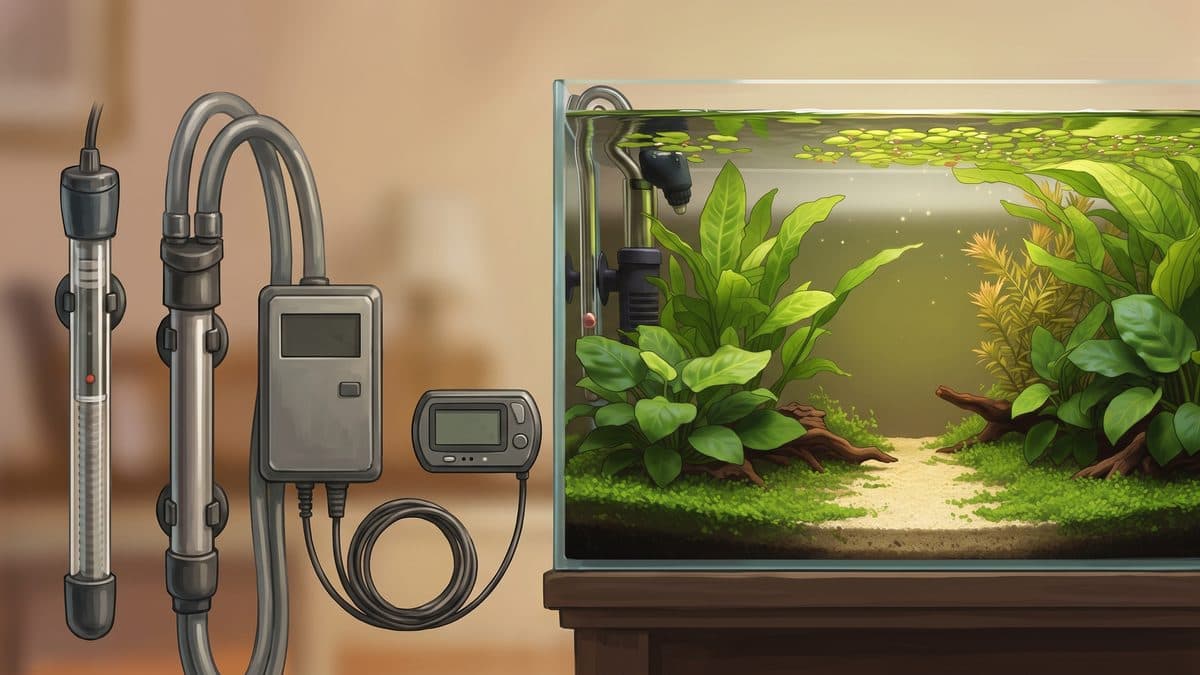
Why Aquarium Heaters Matter
Most aquarium fish are tropical, originating from waters where temperature remains consistently between 75 and 82 °F (24–28 °C) year-round. Ambient room temperature in most homes fluctuates between 65 and 75 °F — too cold for tropical fish, and too variable. A heater maintains the stable, warm temperature that tropical fish require for proper metabolism, immune function, and long-term health.
Temperature stability is as important as the absolute number. A daily swing of 3–5 °F — common in unheated tanks as room temperature changes between day and night — suppresses the fish's immune system and triggers disease outbreaks. A quality heater with an accurate thermostat eliminates these fluctuations, maintaining temperature within ±1 °F of the set point.
Heater Types
Submersible Glass Heaters
The most common and cost-effective type. A glass tube houses a heating element and thermostat, fully submersed in the tank. Modern units are shatterproof (using tempered or quartz glass) and accurate to ±0.5–1 °F.
Recommended models:
- Eheim Jäger: The industry standard for over 30 years. German-made, TruTemp dial calibrated to ±0.5 °F, available in 25–300 W sizes. Dry-run protection shuts the heater off if accidentally exposed to air.
- Cobalt Neo-Therm: Flat, slim design that mounts flush against the glass. LED temperature display, electronic thermostat (more accurate than bimetallic), and a modern aesthetic. 25–300 W range.
- Aqueon Pro: Shatterproof housing, lifetime warranty, LED indicator, and a reputation for consistent accuracy. Available in 50–250 W.
Inline Heaters
Inline heaters connect between the canister filter output hose and the tank, heating water as it passes through the unit. The heater is completely hidden from view — nothing visible inside the tank.
Best for: Aquascapes and display tanks where visible equipment detracts from the aesthetic. Requires a canister filter with appropriately sized tubing.
Recommended: Hydor Inline External Heater (200 W or 300 W). Available for 12/16 mm and 16/22 mm tubing.
Limitation: If the canister filter stops running (power outage, maintenance), the inline heater stops heating. Always pair with a backup thermometer alarm.
Titanium Heaters
The heating element is encased in a titanium tube — virtually indestructible. The thermostat/controller is a separate external unit, allowing precise digital temperature control. Titanium heaters are the professional choice for large, expensive setups (Arowana, stingrays, Discus).
Recommended: Finnex TH-S titanium heaters with the HC-810M controller. Available in 300–800 W for tanks up to 400 gallons. The external controller provides ±0.1 °F accuracy and a fail-safe high-temperature cutoff.
Advantages: Cannot shatter (critical for large, aggressive fish that knock equipment), separate controller allows placement outside the tank, and industrial-grade durability.
Limitation: More expensive than glass heaters ($40–80 for the heater + $30–50 for the controller). Justified for high-value livestock.
Preset vs. Adjustable
Always choose adjustable. Preset heaters are locked at a factory-set temperature (usually 78 °F) with no ability to adjust. In practice, preset heaters frequently run 2–4 °F above or below their stated temperature, and you have no way to correct it. Adjustable heaters allow you to:
- Calibrate the exact temperature using a separate thermometer.
- Raise temperature for heat-based disease treatment (86 °F for Ich).
- Match specific species requirements (82–86 °F for Discus, 60–72 °F for axolotls in summer).
- Lower temperature slightly for breeding triggers in some species.
The cost difference between preset and adjustable is typically $5–10. There is no reason to choose preset.
Heater Sizing by Tank Volume
The standard sizing rule is 3–5 watts per gallon, depending on the temperature difference between your room and the target tank temperature:
- 5 gallon: 25 W
- 10 gallon: 50 W
- 20 gallon: 75–100 W
- 40 gallon: 150–200 W
- 55 gallon: 200 W
- 75 gallon: 250–300 W
- 125 gallon: Two 200 W heaters (dual-heater strategy)
- 200+ gallon: Two 300 W heaters or a 500–800 W titanium heater with external controller
In cold rooms (below 65 °F ambient), err toward 5 watts per gallon. In warm climates or heated rooms, 3 watts per gallon is sufficient. An undersized heater will run continuously without reaching the target temperature — visible as the heater indicator light staying on permanently.
Dual-Heater Strategy
For tanks above 75 gallons, using two smaller heaters instead of one large unit provides significant advantages:
- Redundancy: If one heater fails, the other maintains at least partial temperature control until you notice and replace it. A single heater failure in a 125-gallon tank can drop temperature 10+ °F overnight.
- Even heat distribution: Place one heater at each end of the tank. A single heater creates a warm zone near the heater and a cooler zone at the far end — a gradient that stresses fish and creates behaviour changes.
- Fail-safe against overheating: A stuck-on 300 W heater can raise a 75-gallon tank to lethal temperatures (95+ °F) within hours. Two 150 W heaters individually lack the power to overheat the tank if one sticks on — the other thermostatically shuts off, limiting the maximum temperature rise.
Set both heaters to the same temperature. Each will cycle on and off independently, sharing the heating load and providing mutual backup.
Optimal Heater Placement
- Near the filter output or a circulation pump. Moving water distributes heat evenly throughout the tank, eliminating cold spots. A heater in stagnant water creates a localised hot zone surrounded by cooler water.
- Vertical or diagonal orientation: Heat rises. A horizontally placed heater heats the water above it while the sensor (typically at the top) sits in the warmest zone, causing it to shut off prematurely while the bottom of the tank remains cold. Vertical placement ensures the sensor accurately reads the surrounding water temperature.
- Away from substrate: Leave 2–3 cm clearance between the heater and substrate. Sand and gravel insulate heat, which can cause the glass tube to overheat and crack.
- Behind decorations if possible: Hide the heater behind driftwood, rocks, or tall plants for aesthetics. Ensure water circulation around the heater is not blocked.
- Always use suction cups or the provided mounting bracket. A fallen heater resting on the substrate can melt plastic, crack glass from thermal stress, or burn the substrate organisms.
Heater Safety Practices
- Always use a separate thermometer. Never rely on the heater's built-in thermostat alone. Place a digital thermometer at the opposite end of the tank from the heater to verify the temperature the fish actually experience. Digital probe thermometers with high/low alarms (Inkbird ITC-308) are ideal.
- Unplug before water changes. Exposing a hot heater element to air can crack the glass tube (thermal shock). Unplug the heater 15–30 minutes before lowering the water level, and do not plug it back in until the water level covers the heater completely.
- Use a heater guard for large, aggressive fish (Arowana, large cichlids, pufferfish) that may knock into or bite the heater. Titanium heaters are an alternative that eliminates shatter risk entirely.
- Replace heaters preventively. Glass submersible heaters have a functional lifespan of 3–5 years. After this, thermostat accuracy degrades and failure risk increases. Budget for heater replacement as routine maintenance, not an emergency expense.
- Consider an external temperature controller (Inkbird ITC-308, $35–40) as a fail-safe for high-value tanks. The controller plugs between the heater and the power outlet, independently monitoring temperature and cutting power if the tank exceeds a set maximum — preventing stuck-on heater disasters.
Troubleshooting Common Problems
- Heater running constantly (light always on): Either the heater is undersized for the tank, the room is very cold, or the thermostat is failing. Verify room temperature and heater wattage. If the heater is appropriately sized and the room is not unusually cold, the thermostat may be failing — replace the heater.
- Temperature swings despite heater: Check heater placement — is it in a stagnant zone? Move it near the filter output. Verify the heater is fully submerged. Check for drafts near the tank (open windows, air conditioning vents blowing on the tank).
- Tank overheating: Unplug the heater immediately. If the heater is stuck on, it has failed — discard and replace. Perform a partial water change with slightly cooler water (no more than 2 °F below current tank temperature) to bring temperature down gradually. Add an airstone to increase oxygen (warm water holds less dissolved oxygen).
- Heater cracked or leaking: Unplug immediately. Remove the heater from the tank. Perform a large water change to dilute any contaminants. Glass heater cracks are rare with quality brands but can occur from thermal shock (exposure to air while hot) or impact from large fish.
A quality heater is a modest investment that protects the health of every fish in your tank. Pair it with a separate thermometer, maintain it properly, and replace it preventively — temperature stability is one of the most impactful factors in long-term fish health. For complete tank setup guidance, see our filter guide and lighting guide.