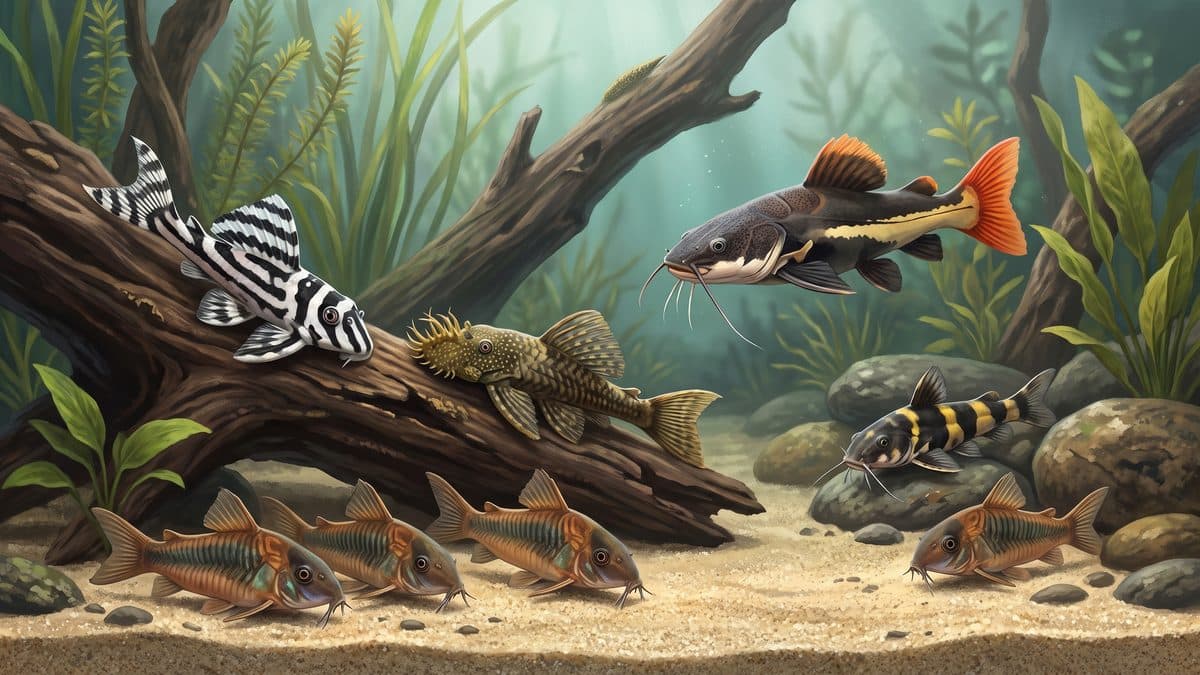
Why Catfish Are the Backbone of the Aquarium Hobby
Order Siluriformes — the catfish — is one of the most species-rich groups of vertebrates on Earth, with over 3,000 described species spread across every continent except Antarctica. In the aquarium trade, catfish occupy a unique niche: they are simultaneously the most practical fish you can own (scavenging uneaten food, controlling algae, sifting substrate) and among the most visually spectacular. From the transparent body of the Glass Catfish to the psychedelic whorls of a Zebra Pleco, this order delivers an astonishing range of form, behaviour, and size.
This guide covers every major type of catfish available to aquarists — from beginner-friendly Corydoras to predatory giants that demand 1,000-gallon systems. Whether you are stocking a 20-gallon community tank or planning a monster-fish showpiece, there is a catfish that belongs in your setup. Browse The Fish Collection's full catfish collection to see what is currently available.
Small Community Catfish
For the majority of aquarists, catfish duty means small, peaceful species that coexist with tetras, rasboras, and other community staples. Two genera dominate this category: Corydoras and Otocinclus.
Corydoras: The Perfect Community Catfish
With over 170 described species and dozens more awaiting formal classification, Corydoras is one of the largest genera of freshwater fish — and arguably the most beloved catfish in the hobby. These small, armoured bottom-dwellers (typically 3–7 cm adult size) are obligate shoaling fish that should be kept in groups of six or more. Their constant foraging across the substrate, punctuated by adorable dashes to the surface for a gulp of atmospheric air, makes them endlessly entertaining.
Bronze Corydoras (Corydoras aeneus) is the gateway species — hardy, inexpensive, and tolerant of a wide parameter range (pH 6.0–8.0, temperature 22–28 °C). They breed readily in captivity, often spawning without deliberate intervention.
Panda Corydoras (Corydoras panda) earn their name from the black patches over the eyes and at the base of the tail. They prefer slightly cooler water (20–25 °C) than many tropical community fish, which makes them ideal tank mates for White Cloud Mountain Minnows and Hillstream Loaches. Keep in groups of at least eight on fine sand substrate — gravel damages their delicate barbels.
Sterbai Corydoras (Corydoras sterbai) are the top pick for Discus tanks because they share the same temperature preference (26–30 °C). Their striking orange pectoral fins against a spotted body make them one of the most attractive species in the genus. Captive-bred specimens are widely available and robust.
Pygmy Corydoras (Corydoras pygmaeus) reach barely 2.5 cm and behave unusually for the genus: they spend much of their time mid-water, hovering in a loose shoal rather than rooting along the substrate. A group of 12 or more in a densely planted nano tank is one of the hobby's quiet pleasures. They are excellent companions for small rasboras and dwarf shrimp.
All Corydoras require fine sand or smooth gravel substrate. Sharp or coarse gravel will erode their barbels over time, compromising their ability to find food and leaving them vulnerable to bacterial infection. Weekly 25 % water changes and a varied diet of sinking pellets, frozen bloodworm, and blanched vegetables will keep any Corydoras group thriving.
Otocinclus: The Planted-Tank Algae Crew
If Corydoras are the bottom-dwellers of choice, Otocinclus are the glass-and-leaf cleaners. These tiny catfish (3–5 cm) are specialised biofilm and soft-algae grazers that spend their days methodically working across plant leaves, glass panels, and hardscape surfaces. In planted aquariums, a group of six or more Otocinclus can keep diatom and green-spot algae under control without harming delicate tissue.
The most common species in the trade is Otocinclus vittatus, though O. cocama (the Zebra Otocinclus) commands a premium for its striking banded pattern. Both species are sensitive to water quality: ammonia and nitrite must be at zero, nitrates below 20 ppm, temperature 22–26 °C, and pH 6.0–7.5. Never introduce Otocinclus to an uncycled tank — they are often the first casualties of new-tank syndrome.
A common mistake is relying solely on algae as a food source. Most aquariums do not produce enough biofilm to sustain a group long-term. Supplement with blanched courgette, cucumber, and spirulina-based wafers. Well-fed Otocinclus develop a noticeably rounded belly; if you see pinched or concave abdomens, increase feeding immediately.
Armoured Catfish: Plecos and Their Relatives
The family Loricariidae — commonly called Plecos, suckermouth catfish, or armoured catfish — contains over 900 described species and is the largest catfish family in the world. Their fused bony plates, underslung sucker mouths, and often spectacular patterning make them some of the most recognisable aquarium fish. The L-number classification system (L001, L046, L102, etc.) was created specifically because new Pleco species were being discovered faster than taxonomists could formally describe them.
Bristlenose Pleco
The Bristlenose Pleco (Ancistrus spp.) is the single most recommended Pleco for the average aquarist — and for good reason. Adults top out at 12–15 cm, making them one of the few Pleco species that genuinely fits in a standard community tank (30 gallons minimum). Males develop the characteristic fleshy tentacles on the snout that give the genus its common name.
Bristlenose Plecos are omnivorous grazers and genuinely effective algae eaters. They do well at temperatures of 23–27 °C with pH 6.5–7.5. Provide driftwood (they rasp the surface for fibre), caves for hiding, and supplement with algae wafers and blanched vegetables. They breed readily in captivity — males guard the eggs in caves, making them fascinating to observe during spawning.
Common Pleco
The Common Pleco (Hypostomus plecostomus and related species) is the fish responsible for the widespread — and often disastrous — misconception that "every tank needs a Pleco." Sold at 5 cm in pet shops, Common Plecos can exceed 45–60 cm within a few years and produce a staggering bioload. A 150-gallon tank is the realistic minimum for an adult, with powerful filtration rated for at least 8× turnover.
If you are looking for an algae-eating Pleco for a standard community aquarium, choose a Bristlenose instead. The Common Pleco is best suited to large cichlid tanks, predator systems, or dedicated monster-fish setups where its size and waste production can be properly accommodated.
Zebra Pleco (L046)
The Zebra Pleco (Hypancistrus zebra) is a 8–10 cm species with dramatic black-and-white striping that makes it one of the most sought-after catfish in the hobby. Brazil banned wild export in 2004, so all legally traded specimens are captive-bred — and prices reflect that scarcity, typically $300–$1,000 per fish. Unlike most Plecos, Zebra Plecos are not effective algae eaters; they are primarily carnivorous, preferring frozen bloodworm, brine shrimp, and high-protein sinking pellets.
House in a 30+ gallon tank with temperatures of 26–30 °C, pH 6.0–7.0, and strong oxygenation via powerheads or airstones. Provide multiple caves (one per fish minimum) and fine sand substrate. Browse The Fish Collection's Pleco collection for Zebra Pleco availability.
Snowball Pleco (L102)
The Snowball Pleco (Hypancistrus inspector) sports bright white spots against a dark brown or black body — the inverse of a night sky. Adults reach 15–18 cm, making them a manageable size for a 40-gallon dedicated setup or a 75-gallon community. Like the Zebra Pleco, Snowball Plecos are omnivorous leaning carnivorous: supplement with protein-rich foods alongside vegetable matter. Water parameters: temperature 24–28 °C, pH 5.8–7.2, soft to moderately hard water.
Predatory Catfish: Monster-Fish Keeping
For a certain category of aquarist, catfish are not cute bottom-dwellers — they are apex predators that dominate a room-sized aquarium. Predatory catfish keeping is a serious commitment: these fish grow fast, eat voraciously, and require systems measured in hundreds or thousands of gallons. The reward is an animal with genuine charisma and interactive behaviour that rivals any pet.
Red Tail Catfish
The Red Tail Catfish (Phractocephalus hemioliopterus) is the poster species for monster catfish keeping. Native to Amazon and Orinoco basin rivers, adults routinely reach 100–130 cm in captivity with a corresponding girth that demands a minimum 1,000-gallon (3,800-litre) system — and that is conservative. Their namesake vivid red caudal fin, combined with a piebald black-and-white body, makes them undeniably striking.
Red Tails are indiscriminate feeders: anything that fits in the mouth will be consumed, including expensive tank mates. Feed a varied diet of whole fish (tilapia, smelt), prawns, and high-quality pellets. Avoid feeder goldfish — they are nutritionally poor and carry parasites. Temperature 22–26 °C, pH 6.0–7.5. Check The Fish Collection's catfish inventory for available predatory species.
Tiger Shovelnose Catfish
The Tiger Shovelnose (Pseudoplatystoma fasciatum) is a sleek, fast-swimming predator reaching 90–120 cm in captivity. Its elongated, flattened head and bold black striping on a silver body give it an unmistakable silhouette. In the wild these fish inhabit deep river channels, so aquarium current should be strong — aim for 10× turnover with a combination of canister filters and circulation pumps.
Tank mates must be too large to swallow: adult Arowana, large cichlids, and other sizeable catfish are the only safe options. Minimum tank size: 500 gallons, though 750+ is preferable for an adult. Temperature 24–28 °C, pH 6.0–7.5.
Irwini Catfish (Tiger Catfish)
The Irwini Catfish (Brachyplatystoma filamentosum) — sometimes sold under the name "Piraíba" — is among the largest freshwater catfish on Earth, with wild specimens exceeding 3 metres. In captivity, expect 90–150 cm depending on tank size, which needs to be 1,000 gallons or more. This is a true specialist fish for dedicated monster-fish keepers with the space and filtration capacity to match. Their elongated dorsal filament and metallic-silver body are visually dramatic, but the care commitment is extraordinary.
Unusual Catfish: The Oddballs
Beyond the mainstream genera, the catfish order harbours some of the most genuinely unusual fish in the hobby. These species challenge expectations about what a catfish can look like and how it behaves.
Glass Catfish
The Glass Catfish (Kryptopterus vitreolus) is one of the few truly transparent vertebrates available to aquarists. Its entire body — minus the head and a small visceral mass — is see-through, revealing the skeleton and internal organs in real time. They are peaceful, obligate shoaling fish that must be kept in groups of at least six. In smaller numbers they become stressed, refuse food, and fade to an opaque milky white.
House in a 30+ gallon planted tank with gentle to moderate flow, temperature 24–28 °C, and pH 6.5–7.5. They prefer midwater positions and do best with floating plants that diffuse overhead lighting. Feed small frozen foods: daphnia, baby brine shrimp, and finely chopped bloodworm.
Electric Catfish
The Electric Catfish (Malapterurus electricus) can generate electrical discharges of up to 350 volts — enough to incapacitate prey and deliver a genuinely painful shock to an unwary aquarist. This is absolutely a look-but-do-not-touch species. Adults reach 40–60 cm and are solitary ambush predators that spend most of the day hidden, emerging at night to hunt.
A species-only tank of 100+ gallons with heavy cover (PVC pipes, driftwood caves) is essential. Water parameters: temperature 23–28 °C, pH 6.5–8.0. Handle only when absolutely necessary, and always with thick rubber gloves. Despite the challenges, Electric Catfish are intelligent, interactive fish that quickly learn to recognise their keeper — from a safe distance.
Upside-Down Catfish
The Upside-Down Catfish (Synodontis nigriventris) is the most widely kept member of the African catfish family Mochokidae. True to its name, this 7–10 cm species spends a significant portion of its time swimming inverted, grazing the undersides of leaves, driftwood, and even the water surface. This behaviour is reflected in its reversed counter-shading: the belly is darker than the dorsal surface — the opposite of nearly every other fish.
Keep in groups of four or more in a 30+ gallon tank with plenty of broad-leafed plants and driftwood. Temperature 22–26 °C, pH 6.0–7.5. Peaceful and compatible with most community species of similar size.
Other notable Synodontis species include the S. ocellifer (Ocellated Synodontis), which reaches 40 cm and suits larger African cichlid setups, and the S. multipunctatus (Cuckoo Catfish), famous for its brood-parasitic spawning behaviour — depositing eggs among mouthbrooding cichlid clutches.
Pictus Catfish
The Pictus Catfish (Pimelodus pictus) is a sleek, silver-bodied species adorned with bold black spots and spectacularly long barbels that can extend beyond the tail. Adults reach 12–15 cm and are active, fast-swimming schoolers that require a 55-gallon minimum with strong current and open swimming lanes. They are crepuscular to nocturnal, becoming most active at dusk and dawn.
While peaceful toward fish of similar size, Pictus Catfish will eat anything small enough to swallow — neon tetras, guppies, and small rasboras are not safe tank mates. Pair them with medium-sized tetras (Congo, Buenos Aires), medium barbs, and similarly sized catfish. Temperature 22–25 °C, pH 6.0–7.5. Feed sinking pellets, frozen bloodworm, and the occasional live earthworm.
Bumblebee Catfish
The South American Bumblebee Catfish (Microglanis iheringi) and the Asian Bumblebee Catfish (Pseudomystus siamensis) both feature striking yellow-and-black banding, though they are not closely related. The South American species stays small (6–8 cm) and is a shy, nocturnal hider suited to 20-gallon community tanks. The Asian species grows larger (15–20 cm), is more assertive, and will eat small tank mates. Both prefer temperatures of 22–26 °C and pH 6.5–7.5 with plenty of caves and dim lighting.
Colourful Catfish: Species That Break the Stereotype
The perception that catfish are uniformly brown, grey, or drab is one of the hobby's most persistent myths. Dozens of species rival the flashiest cichlids and tetras for visual impact. If you are searching for colourful catfish to brighten a display tank, these species deliver.
Zebra Pleco (L046) — As covered above, the jet-black and crisp white banding of Hypancistrus zebra makes it one of the most visually dramatic freshwater fish of any family. A single specimen against a dark substrate is a guaranteed focal point.
Orange Laser Corydoras (CW010) — This Peruvian Corydoras features a vivid neon-orange dorsal stripe running from snout to tail against a charcoal body. In a shoal of eight or more under good lighting, the effect is electric.
Scarlet Cactus Pleco (L025) — Pseudacanthicus pirarara combines a dark body with brilliant scarlet-red fin edges. Adults can reach 40 cm, so plan for a 100-gallon minimum, but the visual payoff is extraordinary.
Gold Nugget Pleco (L018 / L081 / L177) — Bright yellow spots on a black body, with bold yellow fin margins. Several L-numbers fall under the "Gold Nugget" umbrella, varying in spot size and adult dimensions (15–30 cm depending on variant). A 50–75-gallon tank suits the smaller forms.
Sterbai Corydoras — The orange pectoral fins and intricate spotted patterning of Corydoras sterbai make it one of the most photogenic community catfish. An easy species to keep and breed, with colour that rivals far more expensive fish.
Royal Pleco (L190) — Panaque nigrolineatus features bold striping in grey, cream, and olive-green with striking red eyes. They are dedicated wood-eaters, so driftwood is non-negotiable. Adults reach 35–40 cm and need 100+ gallons.
For a broader look at colour in freshwater aquariums, see our guide to the most colourful freshwater fish.
Choosing the Right Catfish for Your Aquarium
With hundreds of species available, selecting the right catfish comes down to three factors: tank size, community compatibility, and maintenance commitment.
- Nano and small tanks (10–30 gallons): Pygmy Corydoras, Otocinclus, South American Bumblebee Catfish. These species stay under 5 cm and have minimal bioload.
- Standard community tanks (30–75 gallons): Bronze or Sterbai Corydoras, Bristlenose Pleco, Upside-Down Catfish, Glass Catfish, Pictus Catfish (55 gal+). This is the sweet spot for variety without excessive space requirements.
- Large and predator tanks (100–500 gallons): Common Pleco, Royal Pleco, Synodontis species, Gold Nugget Pleco. Species in this range need robust filtration but remain manageable for experienced keepers.
- Monster-fish systems (500+ gallons): Red Tail Catfish, Tiger Shovelnose, Irwini Catfish. These demand dedicated infrastructure — reinforced stands, sump filtration, and significant ongoing food costs.
Before purchasing, always research the adult size, not the juvenile size displayed in the shop. A 5 cm Common Pleco will become a 50 cm bioload machine. A 3 cm Red Tail Catfish will become a metre-long predator. Plan for the adult fish from day one.
Ready to add catfish to your collection? Browse The Fish Collection's curated catfish selection — every specimen ships with a live-arrival guarantee, tracked delivery, and full care documentation.