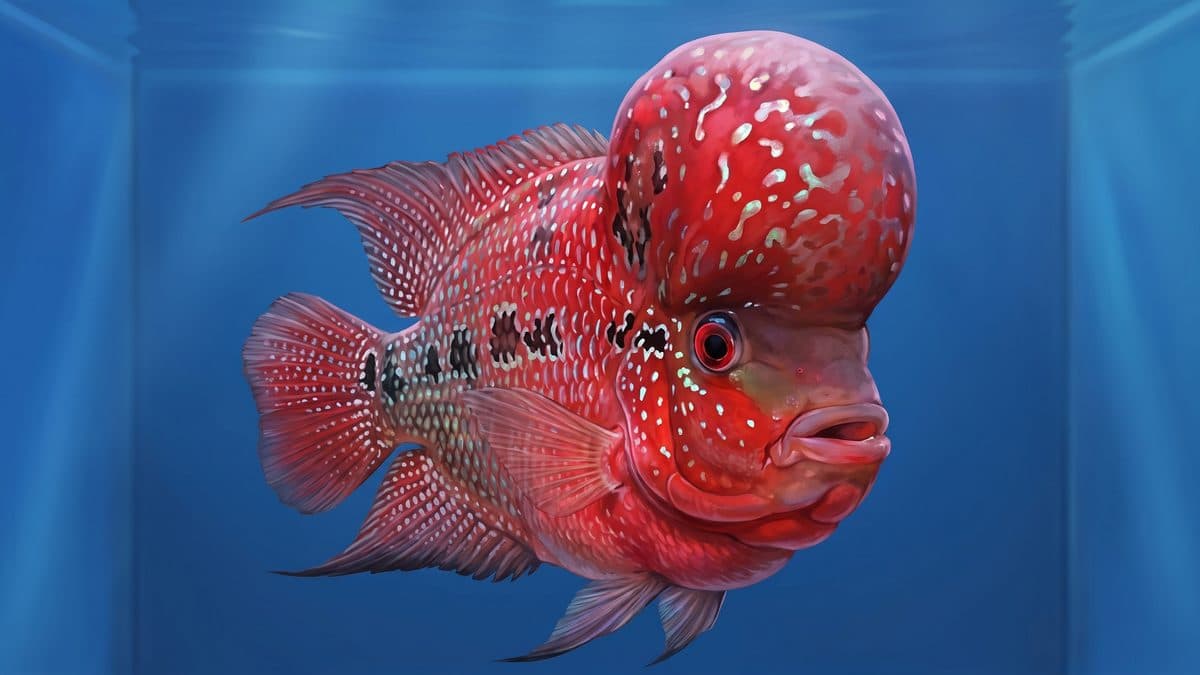
Origin and History of the Flowerhorn
The Flowerhorn Cichlid is not a natural species — it is an entirely man-made creation. In the late 1990s, Malaysian and Taiwanese breeders began crossing various Central and South American cichlids, primarily Blood Parrot Cichlids (themselves a hybrid) with Trimac Cichlids (Amphilophus trimaculatus), Red Devil Cichlids (Amphilophus labiatus), and Midas Cichlids (Amphilophus citrinellus). The goal was a fish combining intense coloration, a prominent nuchal hump, and aggressive interactivity.
By 2001, Flowerhorn mania had swept across Southeast Asia. Specimens with auspicious markings — particularly Chinese characters appearing in scale patterns — sold for tens of thousands of dollars. The cultural significance of the nuchal hump (associated with the Chinese god of longevity) and certain body markings (believed to bring luck and prosperity) drove prices to extraordinary levels.
Today, the Flowerhorn hobby has matured into a sophisticated breeding and competition culture. Multiple distinct strains exist, each with specific aesthetic targets, and international competitions judge fish on standardised criteria. The market ranges from $20 pet-grade juveniles to $60,000 Grand Champion adults. View our cichlid collection for available Flowerhorn specimens.
Major Flowerhorn Strains
Flowerhorn breeding has produced distinct strains, each with different aesthetic priorities:
- Kamfa: Square body, prominent kok, strong pearl scaling, sunken eyes, and typically blue/green base colour with red tones. Kamfa strains prioritise body shape and pearling over raw colour intensity. Derived from crosses involving Vieja cichlids.
- Zhen Zhu (Pearl): Rounder body, prominent kok, extensive pearl scaling covering the body and face. Zhen Zhus are the most heavily pearled strain, with the best specimens showing metallic iridescence from head to tail.
- Golden Monkey: Red-gold base colour, pronounced kok, strong pearl scaling. One of the original premium strains, less common now but still highly valued for competition.
- King Kamfa: A refined Kamfa sub-strain with a wider body, stronger pearl density, and more prominent kok. Considered the pinnacle of modern Flowerhorn breeding.
- Thai Silk (Titanium): A distinctly different appearance — metallic silver or blue body with minimal patterning. Thai Silks lack the pearling of other strains but compensate with a stunning metallic sheen and often impressive kok development.
- Super Red Dragon (SRD): Intense red colouration is the primary selection criterion. SRDs are bred for maximum red saturation, sometimes at the expense of pearling and body shape.
Understanding Kok Development
The kok (nuchal hump) is the defining feature of the Flowerhorn and the primary driver of value in both the pet and competition markets. It is a fat-filled sac that develops on the forehead, growing progressively larger as the fish matures.
Genetics vs Environment
Kok size is primarily determined by genetics — a fish with weak kok genetics will never develop a competition-grade hump regardless of husbandry. However, genetics set the ceiling, and environment determines how close the fish gets to it.
Factors that maximise kok development:
- Genetics: Purchase from breeders who can show parent stock with strong kok development. This is the single most important factor.
- Diet: High-protein foods (pellets with 45%+ protein, supplemented with shrimp, krill, and bloodworm) support kok growth. Some breeders use specific kok-enhancing pellets containing astaxanthin and fatty acids.
- Stimulation: Flowerhorns flare their kok in response to perceived threats. Placing a mirror against the tank for 15–30 minutes daily, or housing the fish adjacent to (but separated from) another Flowerhorn, stimulates kok inflation. Overstimulation causes chronic stress — limit mirror sessions.
- Water quality: Clean, warm water (28–31 °C) supports optimal growth. Frequent water changes (30–50 % weekly) remove growth-inhibiting hormones.
- Solitary housing: Flowerhorns kept alone develop larger koks than those housed with tank mates. The absence of sustained aggression allows the fish to direct energy toward growth rather than defence.
Tank Setup for Flowerhorn
Flowerhorn tank setup is straightforward — these fish demand space, cleanliness, and minimal décor:
- Tank size: 75 gallons minimum for a single adult. A 125-gallon tank is preferred for full-sized males (30+ cm). Length matters more than height — a 4-foot tank is the minimum; 5–6 feet is ideal.
- Filtration: Robust biological and mechanical filtration rated for 8–10× turnover. Flowerhorns are messy eaters. A sump or large canister filter (FX6 or equivalent) is standard. Supplementary sponge filters provide backup biological filtration.
- Substrate: Bare bottom is standard for serious Flowerhorn keepers — it is easiest to clean and allows uneaten food to be removed immediately. If aesthetics matter, fine gravel or sand works but requires more maintenance.
- Décor: Minimal. Flowerhorns rearrange everything in the tank. Large, heavy rocks (if used) must be siliconed to the glass or placed directly on the tank bottom before substrate is added — a Flowerhorn can and will undermine and topple unsecured décor, potentially cracking the glass.
- Lid: Secure. Flowerhorns jump, especially when startled or during feeding excitement.
For more on setting up predator and cichlid tanks, see our exotic fish tank setup guide.
Water Parameters
Flowerhorns are relatively tolerant of a range of water chemistry, but optimal parameters promote the best colour, growth, and kok development:
- Temperature: 28–31 °C (82–88 °F). Warmer temperatures within this range accelerate metabolism and growth.
- pH: 7.0–8.0. Flowerhorns prefer slightly alkaline water, reflecting the preferences of their Central American cichlid ancestry.
- Hardness: 8–20 dGH. They perform well in moderate to hard water.
- Ammonia/Nitrite: 0 ppm — non-negotiable.
- Nitrate: Below 20 ppm. Weekly 30–50 % water changes maintain this.
For detailed water chemistry guidance for cichlids, see our cichlid water parameters guide.
Feeding for Colour and Growth
Diet directly influences Flowerhorn colouration, kok size, and overall health:
- Staple pellets: High-quality cichlid pellets with 40–48 % protein (Grand Sumo, Okiko Platinum, Hikari Cichlid Gold). Feed 2–3 times daily — enough that the fish finishes within 2 minutes.
- Colour-enhancing foods: Pellets and supplements containing astaxanthin and canthaxanthin intensify red pigmentation. Spirulina-enriched foods enhance blue-green tones. Natural colour enhancement through diet is preferable to any artificial method.
- Supplementary protein: Frozen shrimp, krill, bloodworm, and mealworms 2–3 times per week. These boost growth and kok development. Whole shrimp with shell provides carotenoids for colour.
- Hard-shelled foods: Occasional snails and small crayfish exercise the jaw and provide enrichment.
- Avoid: Feeder fish (parasite and disease risk), beef heart in excess (fatty, pollutes water), and any food containing artificial dyes (these do not enhance the fish's actual colour and may be harmful long-term).
Juveniles (under 10 cm) should be fed 3–4 times daily for maximum growth. Adults do well on 2 feeds daily with one fasting day per week to prevent obesity.
Managing Flowerhorn Aggression
Flowerhorns are among the most aggressive aquarium fish kept in the hobby. This aggression is a feature, not a bug — it is part of what gives them their bold, interactive personality. However, it means:
- Keep them alone. The simplest and most reliable approach. A single Flowerhorn in a 75+ gallon tank eliminates all compatibility concerns.
- Tank dividers for adjacent viewing. If you want multiple Flowerhorns, use clear or mesh dividers in a large tank. Visual contact stimulates kok development and colour display without physical combat.
- Tank mates are risky. Some keepers successfully house Flowerhorns with large Plecos (armour provides protection), large Bichirs (they occupy different tank zones), or similarly sized aggressive cichlids in 200+ gallon tanks. Success is never guaranteed — monitor constantly and have a backup plan.
- Human interaction is expected. Flowerhorns often flare and charge at their keepers during feeding, which is normal behaviour. Use feeding tongs for larger foods and keep your hands out of the tank when possible — Flowerhorn bites are painful.
Breeding Flowerhorn Cichlids
Breeding Flowerhorns is straightforward compared to many fish species, but producing competition-quality offspring is extraordinarily difficult. Most Flowerhorn fry (90%+) are culled because they do not meet colour, body shape, or kok-development criteria — a reality that beginners find uncomfortable but is standard practice in the Flowerhorn breeding community.
Basic breeding protocol:
- Introduce a female to the male's tank with a clear divider separating them. Allow 1–2 weeks for the pair to assess each other.
- If the female shows vertical barring (a sign of readiness) and the male is not excessively aggressive through the divider, remove the divider while monitoring closely.
- The pair will clean a flat surface (tile, slate, tank bottom) and the female will deposit 500–2,000 eggs.
- Remove the female immediately after spawning if the male shows aggression — male Flowerhorns frequently kill females post-spawn.
- The male typically guards the eggs, which hatch in 3–4 days. Fry become free-swimming at day 7–8.
- Feed fry newly hatched brine shrimp, transitioning to crushed pellets at 2–3 weeks.
Selective culling begins at 4–6 weeks when body shape and colour begin to differentiate. Serious breeders retain only 5–10 % of each spawn for grow-out.
Competition Grading Criteria
Flowerhorn competitions judge fish across standardised criteria (percentages vary by organisation):
- Body shape (20–25 %): Symmetrical, wide, and proportional. The ideal body is roughly 1:1.5 height-to-length ratio.
- Kok / Head (20–25 %): Symmetrical, full, and proportional to the body. The kok should not obstruct the fish's vision or distort the face.
- Colour (20–25 %): Intensity, evenness, and contrast. Red base colour with strong blue/green pearling is the classic standard, though judging varies by strain class.
- Pearling (15–20 %): Density, coverage, and iridescence of metallic scales. The best pearling covers the entire body, gill covers, and extends into the fins.
- Fins and tail (10 %): Symmetrical, undamaged, with colour extension and appropriate spread.
- Overall impression (5–10 %): Deportment, alertness, and "presence" — the intangible quality that makes a fish command attention.
The Flowerhorn Market
Flowerhorn pricing spans an enormous range. Pet-grade juveniles start at $20–$50. High-quality sub-adults with promising kok development and colouration sell for $200–$1,000. Proven show-quality adults command $2,000–$10,000. Grand Champion competition winners and elite breeding stock can exceed $60,000.
When purchasing, always request current photos or video showing the specific fish from multiple angles. Kok size, colour intensity, and pearling can look dramatically different depending on lighting and camera angle. Buy from breeders or dealers who photograph fish under standardised conditions.
The Fish Collection carries select Flowerhorn specimens with individual photographs and detailed lineage information. For care guidance, see our Flowerhorn care guide.