What Makes Freshwater Fish Colorful
Fish coloration arises from specialised cells called chromatophores embedded in the skin. Different chromatophore types produce different colours: melanophores (black/brown), xanthophores (yellow/orange), erythrophores (red), iridophores (iridescent/metallic), and leucophores (white). The interplay between these cell layers, combined with structural coloration (microscopic light-refracting structures in scales), produces the extraordinary colour diversity seen in freshwater species.
Genetics determine a fish's colour potential, but environment dictates whether that potential is fully expressed. Water chemistry, diet, lighting spectrum, stress levels, substrate colour, and social dynamics all influence how vivid a fish appears. Two genetically identical Discus kept in different systems can look like different species — one washed out and pale, the other blazing with colour. Understanding these factors is as important as species selection.
Top 10 Most Colorful Freshwater Fish
1. Discus (Symphysodon)
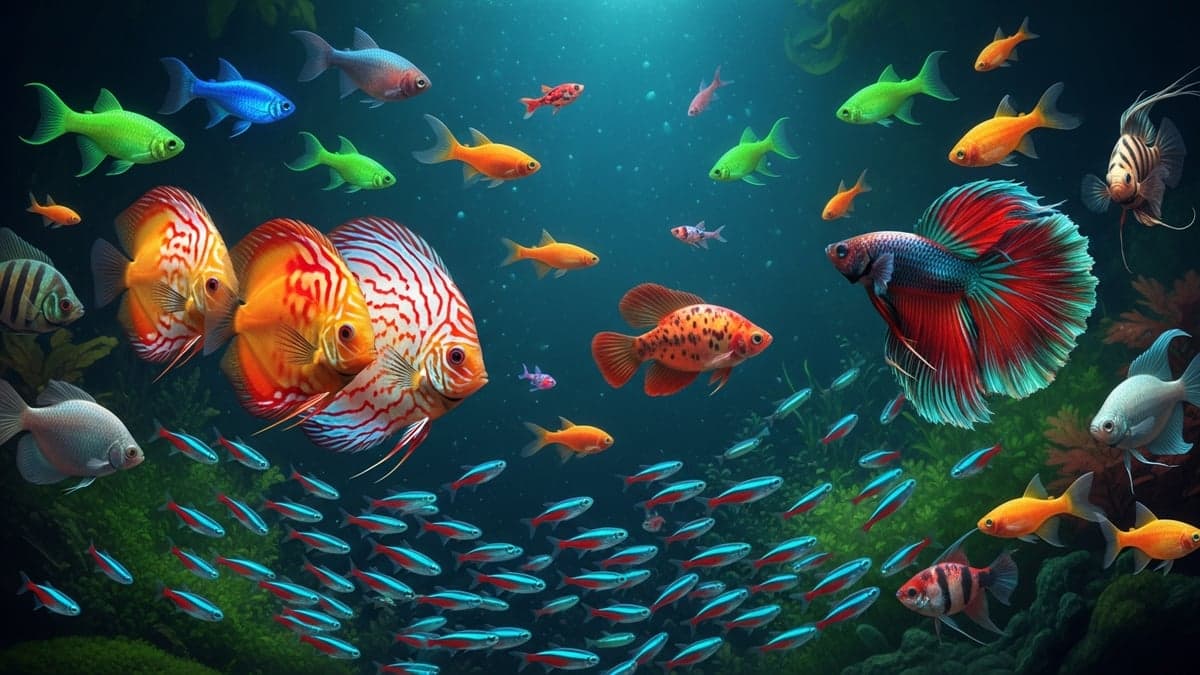
Discus are the undisputed kings of freshwater colour. Wild-caught Discus display earthy reds, greens, and blues, but decades of selective breeding have produced varieties that look almost artificial in their intensity: Pigeon Blood (orange-red with white patterning), Snakeskin (intricate turquoise reticulation), Cobalt Blue (solid electric blue), Red Melon (uniform deep red), and dozens more. A school of six matched show-grade Discus in a planted tank is one of the most visually stunning displays in the freshwater hobby.
The trade-off is their legendary sensitivity. Discus demand pristine water (pH 5.5–6.8, temperature 28–30 °C, near-zero nitrate), frequent water changes (30–50 % twice weekly), and a varied high-protein diet. They are not beginner fish. Tank: 75+ gallons for a group of 6. Price: $30–$300+ per fish depending on strain and grade. For water parameter details, see our Discus care guide.
2. Flowerhorn Cichlid
Flowerhorn Cichlids are living works of art — selectively bred hybrids displaying vivid red, blue, gold, and pearl colouration across their flanks, topped with a massive nuchal hump (kok) that can reach absurd proportions in competition-grade specimens. The "pearling" effect — iridescent, metallic scales scattered across the body — adds a dimension of colour that photographs cannot capture.
Varieties include Kamfa (short body, intense colour, heavy pearling), Golden Monkey (deep red with gold kok), and Thai Silk (pastel tones with extreme pearling). Competition winners have sold for $60,000+. Standard specimens start at $30–$100 for juveniles. Tank: 75+ gallons, solitary housing. They are highly aggressive and will destroy most tankmates. Browse The Fish Collection's cichlid collection for available Flowerhorn specimens.
3. Betta Splendens
No fish offers more colour diversity per dollar than the Betta. Selective breeding has produced every colour imaginable: solid red, royal blue, turquoise, copper, black orchid, white platinum, koi (multi-coloured), galaxy (speckled), and marble (colour-changing). Tail types add another dimension — Halfmoon, Crowntail, Plakat, Dumbo Ear, and Rosetail each create a different silhouette.
A single male Betta in a well-planted, properly lit 10-gallon tank is one of the most cost-effective display setups in the hobby. Price: $5–$50 depending on variety and source. Thai imports offer the widest selection of rare colours and fin types. Parameters: pH 6.5–7.5, temperature 25–28 °C. For proper housing, see our Betta care guide.
4. Peacock Cichlid (Aulonocara)
Peacock Cichlids from Lake Malawi are the jewels of the African cichlid world. Males display electric blue, sunshine yellow, deep orange, ruby red, and combinations thereof — with iridescent sheen that shifts with viewing angle. Popular species include the OB Peacock (mottled orange-blue), Sunshine Peacock (solid yellow), and Flavescent Peacock (blue face with yellow body).
They are among the most manageable African cichlids temperamentally — less aggressive than Mbuna, compatible in mixed-Peacock displays. Tank: 55+ gallons with coral sand substrate (maintains alkaline pH). Parameters: pH 7.8–8.6, temperature 24–28 °C, GH 10–20 dGH. Price: $10–$40 per fish. A 75-gallon tank with 12–15 mixed Peacock males creates a constantly shifting colour display rivalling any marine reef.
5. German Blue Ram (Mikrogeophagus ramirezi)
The German Blue Ram packs astonishing colour into a 7 cm body: electric blue flanks, golden head and chest, black vertical bar through the eye, red-orange ventral fins, and iridescent blue-green speckles across the dorsal fin. The Gold Ram and Electric Blue Ram morphs offer alternative colour schemes. They are peaceful dwarf cichlids ideal for planted community tanks of 20+ gallons.
The challenge is sensitivity — Rams are demanding about water quality and temperature. They prefer warm water (27–30 °C), soft and acidic conditions (pH 5.5–7.0, GH 1–5 dGH), and will not tolerate ammonia or nitrite at any level. Lifespan is shorter than most cichlids at 2–4 years. Price: $8–$20.
6. Killifish (Various Species)
Killifish are perhaps the most underappreciated colorful freshwater fish. Species like the Nothobranchius rachovii (Rachow's Nothobranch) display vivid red-orange bodies with metallic blue scale edging that looks hand-painted. The Aphyosemion australe (Lyretail Killifish) offers orange and blue coloration with elegant lyre-shaped tail fins. The Fundulopanchax gardneri (Steel Blue Killifish) combines electric blue, red, and yellow in striking patterns.
Most killifish are small (5–8 cm), peaceful, and suitable for nano tanks of 10+ gallons. Annual species (Nothobranchius) have short lifespans (6–12 months) but reproduce prolifically via drought-resistant eggs. Non-annual species (Aphyosemion, Fundulopanchax) live 2–5 years. Parameters vary by species but generally prefer soft, slightly acidic water. Price: $8–$25 per pair.
7. Dwarf Gourami (Trichogaster lalius)
The Dwarf Gourami combines brilliant colour with accessibility. The wild form is striking enough — alternating vertical bands of turquoise blue and red-orange — but selective breeding has produced the Flame Gourami (solid red-orange), Neon Blue (solid electric blue), and Honey (golden-yellow) variants. At 8 cm adult size, they fit comfortably in a 20-gallon planted community tank.
Parameters: pH 6.0–7.5, temperature 24–28 °C. They are labyrinth fish (air breathers) and need access to the water surface. Be aware of Dwarf Gourami Iridovirus (DGIV) — a species-specific disease with high mortality that has become endemic in mass-bred stocks. Buy from reputable sources that quarantine and health-screen their fish. Price: $5–$12.
8. Cardinal Tetra (Paracheirodon axelrodi)
The Cardinal Tetra is the gold standard of schooling fish colour. Unlike its cousin the Neon Tetra (where the red band covers only the posterior half), the Cardinal's red stripe extends the full length of the body below an electric blue neon band. In a school of 20+ against a dark substrate with subdued lighting, the effect is mesmerising — a flowing ribbon of blue and red that seems to glow from within.
Cardinals prefer soft, acidic water (pH 4.5–6.5, GH 1–4 dGH) at 24–28 °C. They are sensitive to parameter swings and should only be added to mature, fully cycled tanks. A 20-gallon planted tank with tannin-stained water (Indian almond leaves or driftwood) creates an ideal blackwater biotope. Price: $2–$5 per fish, but buy 20+ for proper visual impact.
9. Peacock Bass (Cichla)
Peacock Bass are not for small tanks, but their colour impact in a large predator system is unmatched. Adults display golden-green bodies with three prominent black vertical bars and a distinctive ocellus (eye-spot) on the caudal fin. During breeding, males develop a vivid golden-yellow body with intensified barring and a pronounced nuchal hump. Some species (Cichla piquiti) show brilliant blue opercular markings.
These are genuine predators that reach 50–75 cm in captivity. Minimum tank: 200 gallons for a single fish; 300+ for a pair. Parameters: pH 6.5–7.5, temperature 26–30 °C. They eat anything that fits in their mouth — feed large pellets, whole smelt, and jumbo shrimp. Legal in most US states but check local regulations. Price: $30–$100 for juveniles.
10. Endler's Livebearer (Poecilia wingei)
Endler's Livebearers are tiny (3 cm males) but their colour density per square centimetre rivals any fish on this list. Males display neon green, electric orange, metallic blue, and jet black in geometric patterns that vary between populations and strains. They breed prolifically and maintain their colour throughout their 2–3 year lifespan with minimal care.
Keep in groups of 8+ (1 male to 2–3 females to diffuse breeding harassment) in a planted 10+ gallon tank. Parameters: pH 7.0–8.0, temperature 24–28 °C, moderate hardness. Price: $3–$10 per fish. For maximum colour variety, maintain multiple pure-strain populations in separate tanks — hybridisation with common guppies dilutes the distinctive Endler patterns.
How to Maximise Fish Color
Regardless of species, these six factors determine whether your fish achieve their full colour potential:
- Diet. Colour-enhancing foods rich in astaxanthin and spirulina intensify red, orange, and yellow pigments. Frozen foods provide carotenoids that dry foods often lack. Northfin, New Life Spectrum, and Hikari's colour-enhancing lines are proven performers.
- Water quality. Stress washes out colour. Ammonia and nitrite at 0 ppm, nitrate below 20 ppm, and stable pH are non-negotiable. Frequent water changes produce visibly better coloration within days.
- Lighting spectrum. Full-spectrum LEDs (6,500 K) render colours naturally. Supplementary warm-white (3,000 K) or red-spectrum (620–660 nm) LEDs enhance warm tones. Avoid actinic blue lighting in freshwater — it washes out red and orange pigments.
- Dark substrate and background. Fish intensify their colouration against dark backgrounds (natural response to reduce predation visibility). A black sand substrate and dark rear panel produce dramatically more vivid fish than white gravel and a bare glass back.
- Social dynamics. Male fish often display their most intense colour when competing with conspecifics. A school of Peacock Cichlids or a male Betta that can see (but not reach) a rival will display significantly more intensely than a solitary specimen.
- Low stress. Adequate hiding spaces, appropriate tankmates, stable parameters, and a consistent light cycle all reduce cortisol levels. Chronically stressed fish display muted, washed-out coloration regardless of genetics.
Building a Colorful Display Tank
For maximum visual impact, consider these display approaches:
- The Discus showpiece: A 75+ gallon planted tank with 6–8 matched Discus, a school of 20+ Cardinal Tetras, and a black sand substrate. Warm lighting (3,000–5,000 K) with blackwater tannins. This is the pinnacle of freshwater colour displays.
- The Peacock parade: A 75-gallon Lake Malawi biotope with 12–15 mixed-species Peacock Cichlid males on coral sand with stacked rock formations. Bright, full-spectrum lighting. A constantly shifting mosaic of blue, yellow, orange, and red.
- The predator centrepiece: A 200+ gallon tank with a single show-grade Flowerhorn, dark substrate, and theatrical LED lighting. The fish becomes a living sculpture — interactive, intelligent, and brilliantly coloured.
Whatever direction you choose, The Fish Collection stocks exotic species across every colour spectrum. Browse our cichlid, Discus, and Betta collections to begin building your display.