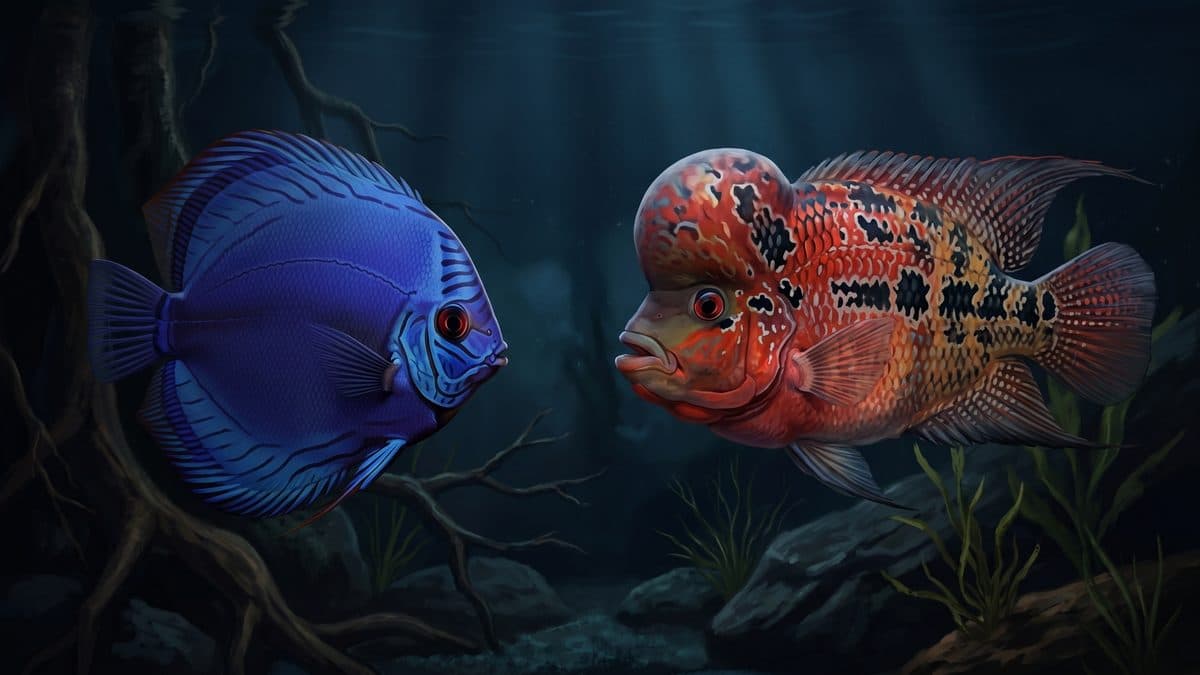
Discus vs Flowerhorn: Elite Centrepiece Fish Compared
Discus and Flowerhorns sit at the pinnacle of freshwater fishkeeping — both command premium prices, both inspire devoted collector communities, and both are considered "bucket list" fish for serious hobbyists. Yet they could hardly be more different in temperament, care philosophy, and the type of keeper they reward.
The Discus is the aristocrat: elegant, sensitive, demanding perfection in water quality and social environment. The Flowerhorn is the gladiator: bold, resilient, explosive in colour, and aggressively interactive. Choosing between them is less about which is "better" and more about which matches your temperament as a fishkeeper.
Discus Overview
Discus (Symphysodon spp.) are South American cichlids native to the slow-moving blackwater tributaries of the Amazon Basin. Three species are recognised: S. aequifasciatus (Green Discus), S. discus (Heckel Discus), and S. tarzoo (Blue Discus), though the taxonomy is debated. Wild Discus inhabit extremely soft, acidic water (pH 4.0–6.5, TDS below 50 ppm) at temperatures of 28–31 °C, shaded by dense rainforest canopy.
Domestically bred Discus have been adapted to tolerate a wider parameter range (pH 5.5–7.5), but they remain one of the most demanding freshwater species. Adults reach 15–20 cm (6–8 inches) in diameter and display a laterally compressed, disc-shaped body — the inspiration for their common name. Colour varieties are extraordinary: Pigeon Blood, Marlboro Red, Cobalt Blue, Turquoise, Snakeskin, Leopard, Checkerboard, and many more.
Discus are schooling fish that must be kept in groups of 6 or more in 75+ gallon tanks. They establish a social hierarchy through subtle body language — colour changes, posture, and lateral displays. A stressed Discus turns dark, clamps its fins, and refuses food. A healthy, confident Discus displays vivid colour, upright fins, and eager feeding response. Reading these cues is essential to successful Discus keeping.
Flowerhorn Overview
The Flowerhorn is a man-made hybrid cichlid created in the late 1990s from crosses between various Central American cichlids (primarily Amphilophus species). It does not exist in the wild and has no natural habitat. Adults reach 25–35 cm (10–14 inches), with males developing a prominent nuchal hump (kok) that is the species' signature feature and the primary criterion for show judging.
Flowerhorns are hardy, aggressive, and adaptable. They tolerate pH 6.5–8.0, temperatures of 26–30 °C, and moderate hardness variations. They eat virtually anything — pellets, frozen food, live food, earthworms, shrimp — and grow rapidly. Their hardiness is a stark contrast to Discus sensitivity, making them accessible to a much wider range of hobbyists.
The defining trait of the Flowerhorn is its interactive personality. These fish recognise their owners, follow them around the room (tracking movement through the glass), beg for food, and even allow gentle hand contact. Combined with spectacular colouration — deep reds, metallic blues, pearl scaling — and the dramatic kok, Flowerhorns are living art installations that engage actively with their keeper.
Key Differences
Care Difficulty
This is the most significant practical difference. Discus are widely considered the most demanding commonly kept freshwater fish. They require: stable temperatures of 28–31 °C, soft acidic water (pH 5.5–7.0 for bred strains), pristine water quality (near-zero nitrates preferred), daily or every-other-day water changes of 25–50 % in bare-bottom grow-out tanks, and high-quality varied diets including frozen bloodworms, beefheart mix, and premium Discus pellets. A Discus tank is a commitment — neglect is punished swiftly with disease and death.
Flowerhorns, by contrast, are remarkably forgiving. They tolerate a wide parameter range, eat anything, recover well from minor water quality lapses, and resist disease effectively. Weekly 30 % water changes and a good canister filter are sufficient. If Discus are Formula 1 cars (high performance, high maintenance), Flowerhorns are heavy-duty trucks (powerful, reliable, hard to break).
Social Structure
Discus are obligate social fish — keeping fewer than 6 causes chronic stress, hierarchy collapse, and failure to display natural colour. A Discus keeper must budget for 6+ fish at $30–$150+ each, plus a tank large enough to house them (75–125 gallons). Flowerhorns are the opposite: they are almost always kept alone. A single Flowerhorn in a 75-gallon tank is the standard setup. Keeping two Flowerhorns together requires 150+ gallons with dividers, and success is not guaranteed.
Cost Profile
Both fish can be expensive, but the cost profiles differ. Discus have a higher total entry cost: 6 juveniles at $40–$80 each ($240–$480), a 75+ gallon tank, heavy-duty filtration, a reliable heater, and RO/DI water system if local tap water is hard and alkaline. Ongoing costs are high due to frequent water changes, premium food, and RO filter replacement. A single pet-grade Flowerhorn costs $20–$80, needs one tank, basic filtration, and no special water treatment. Top-grade Flowerhorns ($500–$60,000) far exceed Discus prices, but the entry-level investment is much lower.
Quick Comparison Table
| Factor | Discus (Symphysodon spp.) | Flowerhorn (Hybrid) |
|---|---|---|
| Adult Size | 15–20 cm diameter | 25–35 cm length |
| Lifespan | 10–15 years | 10–12 years |
| Minimum Tank Size | 75 gal (group of 6) | 75 gal (single fish) |
| Temperature | 28–31 °C (82–88 °F) | 26–30 °C (79–86 °F) |
| pH | 5.5–7.0 | 6.5–8.0 |
| Social Needs | Group of 6+ required | Solo (aggressive to all tank mates) |
| Aggression | Low (peaceful schooling fish) | Very High |
| Care Difficulty | Expert | Moderate |
| Water Changes | Daily to every-other-day (25–50 %) | Weekly (30 %) |
| Entry Cost (setup + fish) | $500–$1,500+ | $200–$500 |
| Top Specimen Price | $200–$1,000 | $5,000–$60,000 |
Tank Requirements Comparison
Discus tank setup: The standard Discus setup is a 75–125 gallon tank (taller is better — Discus are vertically oriented fish), bare-bottom or with fine sand, minimal décor (driftwood, Amazon sword plants, or Anubias), a powerful canister filter (Fluval FX4/FX6 or equivalent), two reliable heaters (redundancy is critical — a heater failure that drops temperature below 26 °C can kill Discus), and an RO/DI water system if local tap water exceeds pH 7.5 or TDS 200 ppm.
The bare-bottom approach is preferred by serious Discus breeders because it simplifies waste removal and water changes. Planted Discus tanks are beautiful but harder to maintain because high temperatures accelerate plant decay and bacterial growth. Compatible tank mates include Cardinal Tetras, Rummy-nose Tetras, Sterbai Corydoras (one of the few Corydoras tolerant of 30 °C), and Bristlenose Plecos.
Flowerhorn tank setup: A 75–125 gallon tank with a powerful canister filter or sump, sand or bare-bottom substrate, minimal heavy décor, and a reliable heater set to 28 °C. No special water treatment is needed in most cases — Flowerhorns adapt to local tap water unless it is extreme (pH below 6 or above 9). No tank mates. A tight-fitting lid to prevent jumping. Simple, effective, and focused entirely on one fish.
Which Should You Choose?
Choose Discus if:
- You are an experienced fishkeeper ready for the ultimate freshwater challenge
- You find beauty in elegant, peaceful, schooling behaviour
- You are willing to commit to daily or near-daily water changes
- You have the budget for 6+ quality fish, an RO system, and premium food
- You want a living work of art that rewards meticulous, consistent care
Choose a Flowerhorn if:
- You want an interactive, personality-driven "wet pet"
- You prefer a hardy, forgiving fish that does not punish minor lapses
- You want bold, aggressive beauty — colour, kok, and attitude
- You have one tank to dedicate to one fish
- You are interested in the collector/competition aspect of the hobby
Our recommendation: These fish serve completely different needs. A Discus tank is a meditative experience — watching a group of six Pigeon Blood Discus glide through a planted blackwater aquarium is one of the most serene sights in the hobby. A Flowerhorn tank is a dynamic experience — your fish demands attention, interacts with you, and dominates the room with sheer presence. Many advanced hobbyists keep both, in separate systems. If you must choose one, let your experience level decide: Flowerhorn for intermediate keepers, Discus when you are confident in your water chemistry and maintenance discipline.