What Is the Nitrogen Cycle?
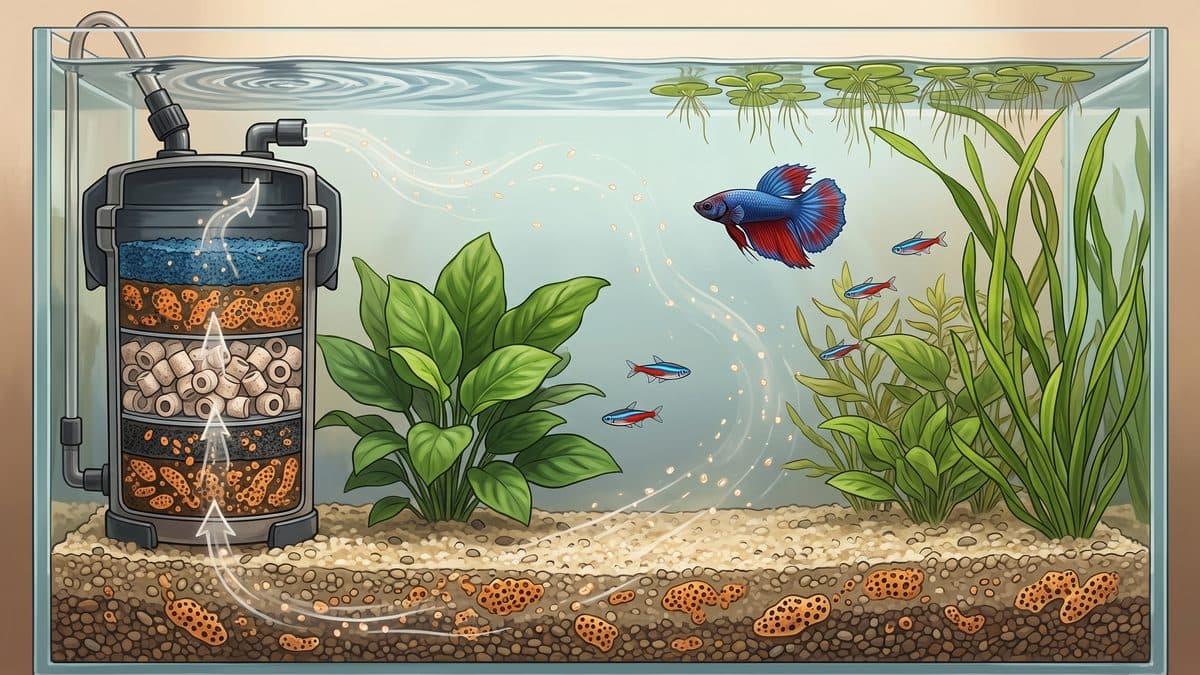
The nitrogen cycle is the most fundamental biological process in aquarium keeping. It is the conversion chain that transforms deadly ammonia — continuously produced by fish waste, uneaten food, and decomposing organic matter — into progressively less toxic compounds through the action of beneficial bacteria. Without an established nitrogen cycle, ammonia accumulates and kills fish within days. With it, an aquarium becomes a self-sustaining biological system capable of supporting life indefinitely.
The cycle has three key nitrogen compounds:
- Ammonia (NH₃/NH₄⁺): Highly toxic. Produced directly by fish (excreted through gills and in urine) and by the decomposition of organic material. Even 0.25 ppm is harmful; above 1 ppm is acutely lethal to most species.
- Nitrite (NO₂⁻): Also highly toxic. Produced when bacteria oxidise ammonia. Nitrite binds to haemoglobin in fish blood, preventing oxygen transport — a condition called "brown blood disease." Lethal above 0.5 ppm for most freshwater species.
- Nitrate (NO₃⁻): Comparatively low toxicity. Produced when bacteria oxidise nitrite. Tolerated at concentrations below 20–40 ppm by most freshwater fish. Removed through water changes and plant uptake.
A "cycled" aquarium has sufficient populations of two bacterial groups to process ammonia to nitrite to nitrate faster than the fish produce it, maintaining ammonia and nitrite at 0 ppm at all times.
Where Ammonia Comes From
- Fish respiration: Fish excrete ammonia directly through their gills — it is the primary nitrogenous waste product of protein metabolism. This is the largest ammonia source in a stocked aquarium.
- Fish urine and faeces: Additional ammonia is released as solid waste decomposes on the substrate.
- Uneaten food: Food that sits in the tank decomposes, producing ammonia. This is why overfeeding is so dangerous — it adds ammonia load without corresponding bacterial capacity.
- Dead organisms: A dead fish, dead plant material, or dead invertebrate decomposes rapidly, causing an ammonia spike that can overwhelm the cycle.
- Tap water: Some municipal water supplies contain chloramine (a chlorine-ammonia compound). When dechlorinated with a chloramine-safe conditioner (Seachem Prime, API Tap Water Conditioner), the chlorine is neutralised but ammonia is released — typically 0.5–1 ppm. This is a managed amount for a cycled tank but dangerous for an uncycled one.
The Nitrifying Bacteria
Ammonia-Oxidising Bacteria
The first group — historically called Nitrosomonas, though modern genomics shows multiple genera are involved — colonises filter media, substrate, and hard surfaces. These bacteria oxidise ammonia (NH₃) to nitrite (NO₂⁻), using ammonia as their energy source. They are slow-growing, obligately aerobic (requiring oxygen), and autotrophic (they do not need organic food — they fix carbon from CO₂).
Ammonia-oxidising bacteria establish first during cycling because their food source (ammonia) is available immediately. Their population doubles every 12–24 hours under optimal conditions, which is extremely slow compared to most bacteria. This slow growth rate is why cycling takes weeks, not days.
Nitrite-Oxidising Bacteria
The second group — primarily Nitrospira (not Nitrobacter, as older texts state) — converts nitrite (NO₂⁻) to nitrate (NO₃⁻). These bacteria establish after the ammonia-oxidising group because their food source (nitrite) only becomes available once ammonia oxidation is underway. Nitrospira are even slower-growing than ammonia oxidisers, which is why the nitrite phase of cycling often takes longer than the ammonia phase.
Fishless Cycling Method
Fishless cycling is the ethical and effective method for establishing the nitrogen cycle before any fish are added. You provide ammonia artificially, grow the bacterial colony to full capacity, and only introduce fish once the cycle can process ammonia and nitrite to 0 ppm within 24 hours.
Step-by-Step Protocol
- Set up the tank fully: Filter running, heater set to 80–84 °F (27–29 °C) — warmer temperatures accelerate bacterial growth. Substrate, decorations, and plants in place. Dechlorinated water.
- Obtain pure ammonia: Use Dr Tim's Ammonium Chloride (aquarium-specific) or hardware-store pure ammonia (must contain only ammonia and water — no surfactants, fragrances, or dyes. Shake the bottle: if it foams, it contains surfactants — do not use it).
- Dose ammonia to 2–4 ppm. Use an ammonia test kit to verify. For a 20-gallon tank, this typically requires 1–3 mL of Dr Tim's ammonia or 4–8 drops of concentrated household ammonia. Add gradually and test.
- Test daily with a liquid ammonia and nitrite test kit (API Freshwater Master Kit).
- Wait for the ammonia phase: Over the first 1–2 weeks, ammonia will remain detectable as the ammonia-oxidising bacteria slowly establish. You will begin to see nitrite appear in tests as ammonia starts being converted.
- Wait for the nitrite phase: Ammonia drops to 0 ppm, but nitrite rises (often to very high levels — 5+ ppm is common). Continue dosing ammonia to 1–2 ppm whenever it drops to 0, to keep feeding the ammonia-oxidising bacteria.
- Wait for nitrite to clear: As nitrite-oxidising bacteria establish, nitrite begins dropping. This phase can take 2–4 weeks. Do not perform water changes during cycling unless ammonia or nitrite exceed 5 ppm (which can inhibit the bacteria themselves). If levels get too high, perform a 25 % water change.
- Cycle is complete when: You can dose ammonia to 2 ppm and both ammonia and nitrite read 0 ppm within 24 hours. Nitrate will be elevated — perform a large (50–70 %) water change to bring nitrate below 20 ppm before adding fish.
The entire process takes 4–6 weeks. Bottled bacteria products (Fritz Zyme 7, Seachem Stability, Dr Tim's One and Only) can reduce this to 2–3 weeks by providing a starter colony, but they do not eliminate the need for ammonia dosing and testing.
Fish-In Cycling (Emergency Only)
Fish-in cycling — adding fish to an uncycled tank and allowing their waste to provide the ammonia — is stressful and harmful to the fish. It is only acceptable if you have already purchased fish and have no cycled tank available. If forced into this situation:
- Stock very lightly — 1–2 small, hardy fish (not the full intended stock list).
- Test ammonia and nitrite daily.
- Perform 25–50 % water changes whenever ammonia or nitrite exceeds 0.25 ppm.
- Use Seachem Prime as your dechlorinator — it temporarily detoxifies ammonia and nitrite for 24–48 hours (without removing them), providing a safety buffer between water changes.
- Add bottled bacteria (Fritz Zyme 7) to accelerate the cycle.
- Feed sparingly — once daily, small amounts — to minimise ammonia production.
Fish-in cycling takes 6–8 weeks and subjects fish to continuous low-level ammonia and nitrite exposure. Fishless cycling is always preferable.
Testing Schedule During Cycling
Test ammonia and nitrite daily during the cycling process. Record results in a log (spreadsheet or notebook) — the progression pattern tells you exactly where you are:
- Days 1–7: Ammonia high, nitrite 0. Ammonia oxidisers establishing.
- Days 7–14: Ammonia dropping, nitrite rising. Ammonia oxidisers active.
- Days 14–28: Ammonia 0 within 24 hours of dosing, nitrite high. Nitrite oxidisers establishing.
- Days 28–42: Ammonia 0 and nitrite 0 within 24 hours of dosing. Cycle complete.
Use a liquid test kit. Test strips are less accurate and can give false readings that lead to incorrect decisions during cycling. The API Freshwater Master Kit provides ammonia, nitrite, nitrate, and pH tests in one package and is the standard recommendation. For deeper water chemistry analysis, see our water testing guide and water chemistry guide.
Troubleshooting a Stalled Cycle
- Ammonia not dropping after 2 weeks: Check temperature (should be 80–84 °F), ensure the filter is running with adequate media, verify dechlorinator does not contain aloe or additives that inhibit bacteria. Add bottled bacteria to jumpstart.
- Nitrite stuck at high levels for weeks: Nitrite-oxidising bacteria are the slowest to establish. If nitrite exceeds 5 ppm, perform a 25 % water change (very high nitrite inhibits the bacteria themselves). Ensure pH is above 6.5 — nitrifying bacteria function poorly in acidic conditions.
- pH crash during cycling: Nitrification is an acidifying process. In tanks with low KH (carbonate hardness), pH can drop below 6.0, which stalls the bacteria. Add crushed coral or baking soda (1 teaspoon per 20 gallons) to buffer pH above 7.0 during cycling.
- Using medication during cycling: Antibiotics and some water treatments kill nitrifying bacteria. Never medicate during the cycling process.
Maintaining the Cycle Long-Term
Once established, the nitrogen cycle is self-sustaining as long as you do not disrupt it:
- Never replace all filter media at once. If your filter uses multiple cartridges, sponges, or media baskets, replace them one at a time with 2–4 week gaps. Replacing everything simultaneously removes the bacterial colony and crashes the cycle.
- Never wash filter media in tap water. Chlorine and chloramine in tap water kill nitrifying bacteria instantly. Always rinse filter sponges and media in used tank water during water changes.
- Do not over-clean. The substrate and decorations also host beneficial bacteria. Light vacuuming during water changes is sufficient — deep, thorough substrate cleaning removes too much of the bacterial colony.
- Stock gradually. After cycling, add fish in small batches (2–3 at a time) with 2-week gaps between additions. This allows the bacterial colony to increase in proportion to the rising ammonia load. Adding 20 fish at once to a freshly cycled tank overwhelms the cycle.
- Continue testing. Test ammonia and nitrite weekly for the first 3 months after stocking. Once consistently stable at 0/0, reduce to monthly testing unless problems arise.
The nitrogen cycle is the invisible engine that makes aquarium life possible. Every other aspect of fishkeeping — from species selection to feeding to disease prevention — depends on this biological foundation being in place and functioning. Invest the 4–6 weeks to cycle properly, and the reward is a stable, healthy system for years to come.