Overview
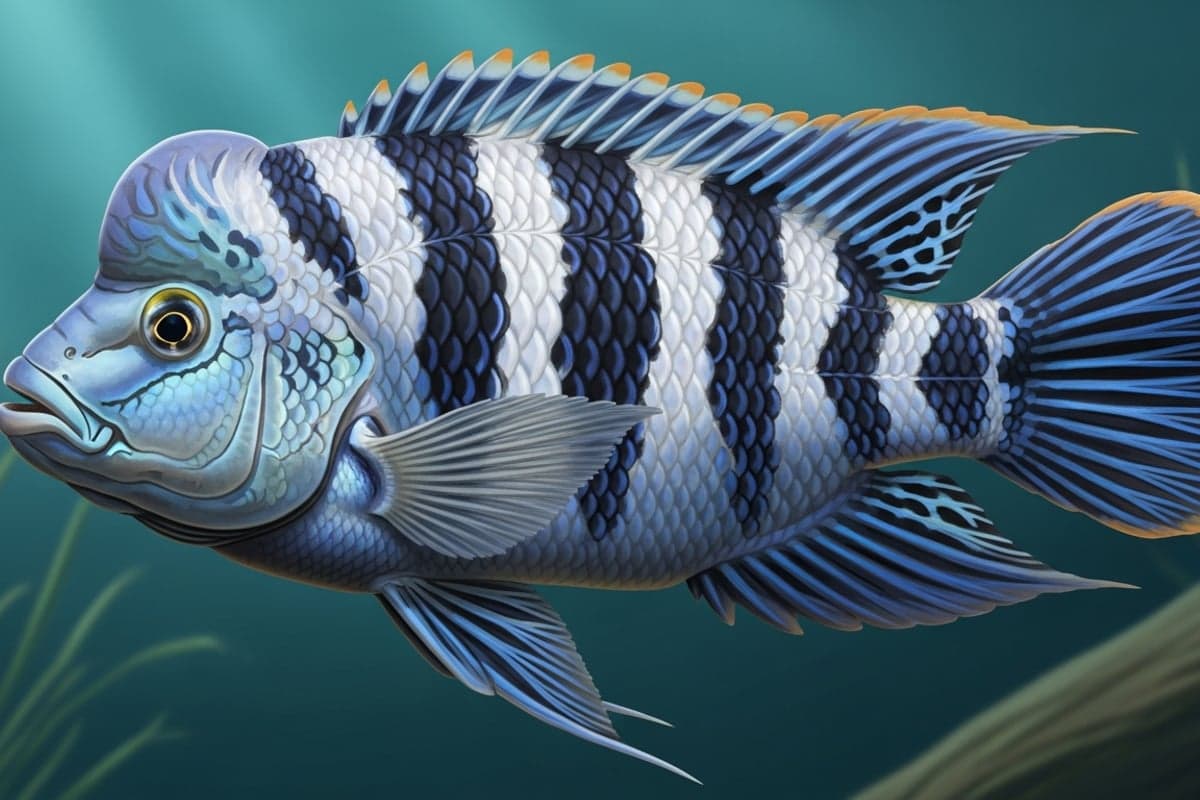
The Frontosa cichlid (Cyphotilapia frontosa) is the undisputed king of Lake Tanganyika — a slow-moving, deep-bodied predator whose prominent nuchal hump and bold black-and-white (or black-and-blue) banding make it one of the most recognisable and desirable freshwater fish in the world. Among the numerous geographic variants available, the "Blue Zaire" — collected from the deep rocky shores along the Democratic Republic of Congo's Tanganyikan coastline near Kapampa, Kitumba, and Moba — is universally regarded as the most spectacular, exhibiting a saturated indigo-blue colouration between the six or seven black vertical bars that far surpasses any other locality variant.
What elevates the Frontosa beyond mere aesthetic appeal is its personality. These are intelligent, deliberate fish with an almost regal bearing. They do not dart, dash, or chase in the frantic manner of Malawi mbuna. Instead, they patrol their territory with measured, dignified sweeps, interact socially through subtle body-language cues, and develop strong individual relationships with their keeper. Long-lived specimens (15–25 years) become genuine companion animals — many veteran keepers describe their Frontosa colony as the most rewarding fishkeeping experience of their career.
At The Fish Collection, we maintain dedicated Frontosa breeding colonies and have worked with Zaire Blue bloodlines since 2013. We import exclusively from trusted suppliers in Mpulungu (Zambia) and Bujumbura (Burundi) who use sustainable collection practices, and we maintain a closed breeding programme that preserves the intense Zaire Blue colouration through careful line selection. This guide represents our accumulated knowledge on the species, with particular emphasis on the Blue Zaire variant. For our broader cichlid species guides, see the dedicated category page.
Natural Habitat & Variants
Cyphotilapia frontosa is endemic to Lake Tanganyika, the second-oldest and second-deepest lake on Earth, stretching 673 km along the East African Rift Valley. Unlike most Tanganyikan cichlids that inhabit the shallow littoral zone (0–20 metres), Frontosa are deep-water specialists found at depths of 30–70 metres along rocky slopes and boulder fields. At these depths, ambient light is minimal, water temperature is stable at 24–26 °C, and dissolved oxygen is lower than at the surface — conditions that have shaped the species' slow metabolism, deliberate behaviour, and tolerance of relatively dim lighting in captivity.
The species exhibits significant geographic variation in colouration. Major variants include: Burundi (6-band, moderate blue), Kigoma (7-band, sky-blue tones), Mpimbwe (intense blue frontal hump and body, 6-band), Kapampa/Zaire (extremely deep indigo-blue, 6-band — the subject of this guide), and Kipili (lighter blue with wider bars). These are not separate species but geographic colour morphs maintained by the lake's vast size and the species' site-fidelity — individual Frontosa rarely disperse more than a few kilometres from their birth site. In the aquarium trade, variant integrity is maintained through separate breeding lines, and responsible breeders never cross-breed variants.
In the wild, Frontosa are nocturnal ambush predators that prey primarily on sleeping Cyprichromis and other small pelagic cichlids. At dawn and dusk, they ascend from the deep substrate to the mid-water column where schools of Cyprichromis roost for the night, using their large mouth and powerful suction strike to engulf prey. Understanding this predatory strategy explains why captive Frontosa are most active during low-light periods and prefer whole, meaty food items over processed flakes.
Tank Requirements
Tank Dimensions & Aquascaping
A Frontosa colony (1 male, 4–5 females) requires a minimum aquarium of 125 gallons (475 litres) with dimensions of at least 180 cm long × 45 cm wide × 55 cm tall. For mixed Tanganyika communities or larger colonies with multiple males, upgrade to 180–240 gallons. The tank's depth is more important for Frontosa than for most cichlids — they are deep-water fish that feel more secure in taller tanks that provide a vertical buffer from overhead disturbance.
Aquascaping should mimic the rocky slopes of Lake Tanganyika's deep littoral zone. Stack large, smooth river rocks or limestone to create caves, overhangs, and tunnels along the back and sides of the tank. Each female needs a dedicated cave or alcove that she can retreat to — dominant males will claim the largest central territory. Leave an open swimming area in the front third of the tank for the colony's display behaviour. Avoid sharp-edged rocks that can damage the prominent nuchal hump during territorial disputes.
Substrate should be fine sand (aragonite or pool-filter sand), which buffers pH upward and allows natural digging behaviour — brooding females will often excavate small pits near their caves. Avoid gravel, which traps waste and provides poor buffering.
Filtration & Flow
Lake Tanganyika is an exceptionally stable environment, and Frontosa are intolerant of measurable ammonia, nitrite, or significant nitrate accumulation. Target a turnover rate of 8–10× the tank volume per hour using a large canister filter (Fluval FX6 or equivalent) supplemented with an internal sponge filter or secondary canister for biological redundancy. Ceramic bio-media or sintered glass provides the surface area needed for robust nitrification.
Flow should be moderate and well-distributed. Frontosa do not appreciate strong directional currents — they are adapted to the still, deep waters of the lake. A spray bar along the back panel distributes flow evenly without creating zones of high turbulence. Aim for gentle, consistent circulation rather than powerful jets.
Maintain ammonia and nitrite at 0 ppm at all times. Nitrate should be kept below 20 ppm — lower is better, as Tanganyikan species are adapted to the lake's ultra-low nitrate environment. Weekly 25% water changes with temperature- and pH-matched water are the minimum; many successful Frontosa breeders perform twice-weekly 20% changes.
Lighting
Moderate to low lighting is ideal. Frontosa naturally inhabit depths where ambient light is heavily attenuated, and bright lighting can cause stress, colour washout, and chronic hiding behaviour. A dimmable LED fixture at 30–50% intensity on an 8-hour photoperiod works well. Many keepers use a dawn/dusk ramping programme that gradually increases and decreases light over 30–60 minutes, which encourages natural emergence behaviour. Moonlight LEDs or blue-spectrum supplementation during the dark period can reveal the dramatic nocturnal activity when Frontosa are most confident and display their deepest colouration.
Water Parameters
Frontosa require hard, alkaline water that replicates the mineral-rich conditions of Lake Tanganyika:
- Temperature: 25–27 °C (77–81 °F). Frontosa prefer the cooler end of the tropical range — temperatures above 28 °C for extended periods increase metabolic stress and reduce lifespan.
- pH: 7.8–9.0. The target should be 8.0–8.5 for most setups. Aragonite substrate and limestone décor naturally buffer to this range.
- General Hardness (GH): 12–20 dGH (214–357 ppm). If your tap water is soft, use a Tanganyika salt mix (Seachem Tanganyika Buffer + Cichlid Lake Salt, or equivalent) to raise mineral content.
- Carbonate Hardness (KH): 10–18 dKH. High KH provides the pH stability essential for Tanganyikan cichlids.
- Ammonia / Nitrite: 0 ppm — always.
- Nitrate: <20 ppm. Tanganyikan species are notably less tolerant of nitrate than Malawi cichlids.
Consistency is the overriding principle. Lake Tanganyika is one of the most chemically stable bodies of water on Earth — pH, temperature, and mineral content vary negligibly across seasons or depths. Captive Frontosa thrive when parameters remain rock-steady, and they struggle when subjected to fluctuations that would barely register for less specialised species. An auto-top-off system to compensate for evaporation (which concentrates minerals and raises pH) is a worthwhile investment.
Diet & Feeding
In the wild, Frontosa are piscivorous — their diet consists almost entirely of small cichlids (Cyprichromis, Paracyprichromis) captured during nocturnal ambush raids. In captivity, the dietary goal is to provide high-quality protein that supports the slow, steady growth and intense colouration the species is known for, while avoiding the high-fat, high-phosphorus diets that contribute to Malawi bloat — a misnomer, as the condition affects Tanganyikan cichlids equally.
Recommended dietary staples:
- Frozen krill: The single best food for Frontosa. Krill provides high-quality protein, natural carotenoids (astaxanthin) that enhance blue colouration, and the appropriate fat profile. Offer 3–4 times per week as the primary food.
- Frozen mysis shrimp: An excellent secondary protein source, lower in fat than krill. Feed 2–3 times per week.
- High-quality cichlid pellets: Northfin Cichlid Formula, New Life Spectrum, or Hikari Bio-Gold+ are all proven options. Pellets provide a balanced nutritional baseline and can form 30–40% of the diet.
- Frozen silversides or lance fish: Whole small fish mimic the natural diet and provide complete nutrition. Offer once weekly.
- Fresh market prawns: Chopped raw prawn (shell removed) is eagerly accepted and provides dietary variety.
Feed once daily, offering only what the colony consumes within 3–5 minutes. Frontosa have a slow feeding pace — they observe food before committing to strike, and subordinate individuals wait for the dominant male to feed first. Avoid overfeeding, which contributes to water quality deterioration and obesity-related health problems. Fast one day per week.
Critical dietary warnings: never feed beefheart, mammalian protein, or high-fat foods to Frontosa. The species' digestive system is not adapted to saturated animal fats, and chronic feeding of mammalian protein is a primary risk factor for bloat. Avoid also tubifex worms from unknown sources, feeder goldfish, and any food with artificial colour enhancers.
Behaviour & Colony Management
Frontosa are polygamous colonial fish that function best in a harem structure: one dominant male with 4–6 females. The dominant male occupies the largest cave or rock formation in the centre of the tank and patrols a territory that encompasses the entire colony's range. Subordinate females each claim a smaller cave within the male's territory. Social hierarchy is maintained through subtle displays — gill flaring, lateral body presentation, colour intensification — rather than the violent physical combat seen in many Malawi cichlids.
Aggression in a properly structured Frontosa colony is remarkably low. The dominant male will occasionally chase a female that strays too far from the colony or gently mouth-spar with a subordinate male (if present), but injuries are rare in appropriately sized tanks. Problems arise when:
- The tank is too small: Subordinate fish have no space to retreat, and the dominant male becomes a relentless bully.
- The sex ratio is wrong: Two males in a 125-gallon tank will result in constant conflict. Either keep one male with females, or house 3+ males in a 240+ gallon system where aggression is distributed.
- The colony is too small: A single pair is the worst configuration. Frontosa need the social dynamics of a group to express natural behaviour.
Frontosa grow slowly — a 5 cm juvenile may take 3–4 years to reach sexual maturity at 15–18 cm. Males continue growing to 30–35 cm and develop the iconic nuchal hump (cranial crest) over a period of 5–8 years. Patience is an absolute requirement. The species rewards long-term commitment with decades of regal, interactive behaviour that few other aquarium fish can match.
Compatible Tank Mates
Frontosa are best kept in a species-only colony, but they can coexist with other large, non-aggressive Tanganyikan species in sufficiently large tanks (180+ gallons):
- Cyprichromis leptosoma: A school of 12+ Cyprichromis occupies the open mid-water column and actually replicates the Frontosa's natural prey species (though adults in the aquarium are too large to be eaten). They add movement and colour without triggering territorial responses.
- Altolamprologus calvus / A. compressiceps: These deep-bodied shell-dwellers and crevice-dwellers occupy different microhabitats and are too large and laterally compressed for Frontosa to swallow.
- Large Synodontis catfish: Synodontis multipunctatus or S. petricola are Tanganyikan natives that coexist peacefully as bottom-zone scavengers.
Avoid all Malawi cichlids (different water chemistry requirements and incompatible aggression styles), aggressive Tanganyikan species (Tropheus, large Petrochromis), and any fish small enough to be swallowed (under 8 cm).
Breeding
Frontosa are maternal mouthbrooders. After a subtle courtship dance in which the male displays his cranial hump and flares his fins, the female deposits 20–50 large eggs (5–6 mm diameter) on a flat surface near the male's cave. The male fertilises them, and the female gathers the eggs into her buccal cavity. She then retreats to her cave and incubates the eggs for an extraordinarily long 28–35 days — one of the longest mouthbrooding periods of any cichlid. During this time, she does not eat.
Released fry are large (12–15 mm), fully formed, and immediately capable of accepting crushed pellets and baby brine shrimp. The female continues to accept fry back into her mouth for several days after release if she perceives a threat. Survival rates are high compared to free-spawning species, but brood sizes are small. A healthy colony may produce a spawn every 6–8 weeks from the dominant female, with subordinate females breeding less frequently.
Triggering breeding requires patience, stable water chemistry, and a mature colony. Fish under 4 years of age rarely breed, and wild-caught individuals may take 1–2 years to acclimate before spawning. Do not rush the process — Frontosa that are stressed by overcrowding, poor water quality, or aggressive tank mates will not reproduce regardless of other conditions.
Common Health Issues
Malawi Bloat
Despite its name, "Malawi bloat" affects Tanganyikan cichlids including Frontosa. The condition presents as rapid abdominal swelling, loss of appetite, white or stringy faeces, and lethargy. The aetiology is debated, but it is most closely associated with a flagellate protozoan (Cryptobia or Hexamita) that proliferates opportunistically when the fish's immune system is compromised — typically by dietary stress from inappropriate foods (beefheart, high-fat diets), poor water quality, or chronic social stress.
Treatment must be aggressive and immediate, as bloat can be fatal within 48–72 hours. Isolate the affected fish, raise temperature to 28 °C, and administer metronidazole at 250 mg per 40 litres (in the water column) or 1% by weight mixed into food for fish that are still eating. Epsom salt (magnesium sulfate) at 1 tablespoon per 20 litres can help reduce swelling. Prevention is always preferable: maintain pristine water quality, feed an appropriate diet free of mammalian protein, and manage social stress through proper colony structure.
Hole-in-the-Head Disease
Hole-in-the-head disease (HITH), also known as lateral line erosion, manifests as pitting and erosion of the head and lateral line, typically beginning as small white pits on the forehead that gradually enlarge into cratered lesions. It is strongly associated with Hexamita protozoan infection, elevated nitrate levels (>40 ppm), activated carbon use (which may deplete trace minerals), and vitamin/mineral deficiency. Frontosa are particularly susceptible owing to their long lifespan and sensitivity to water quality degradation.
Treatment involves removing activated carbon, improving water quality (target nitrate below 10 ppm), enriching the diet with vitamin-soaked foods (Selcon or Brightwell Aquatics Vitamarin-M), and treating with metronidazole if pitting is active and progressive. Early-stage HITH is reversible with environmental improvement alone. Advanced cases may leave permanent scarring even after the infection resolves.