Overview
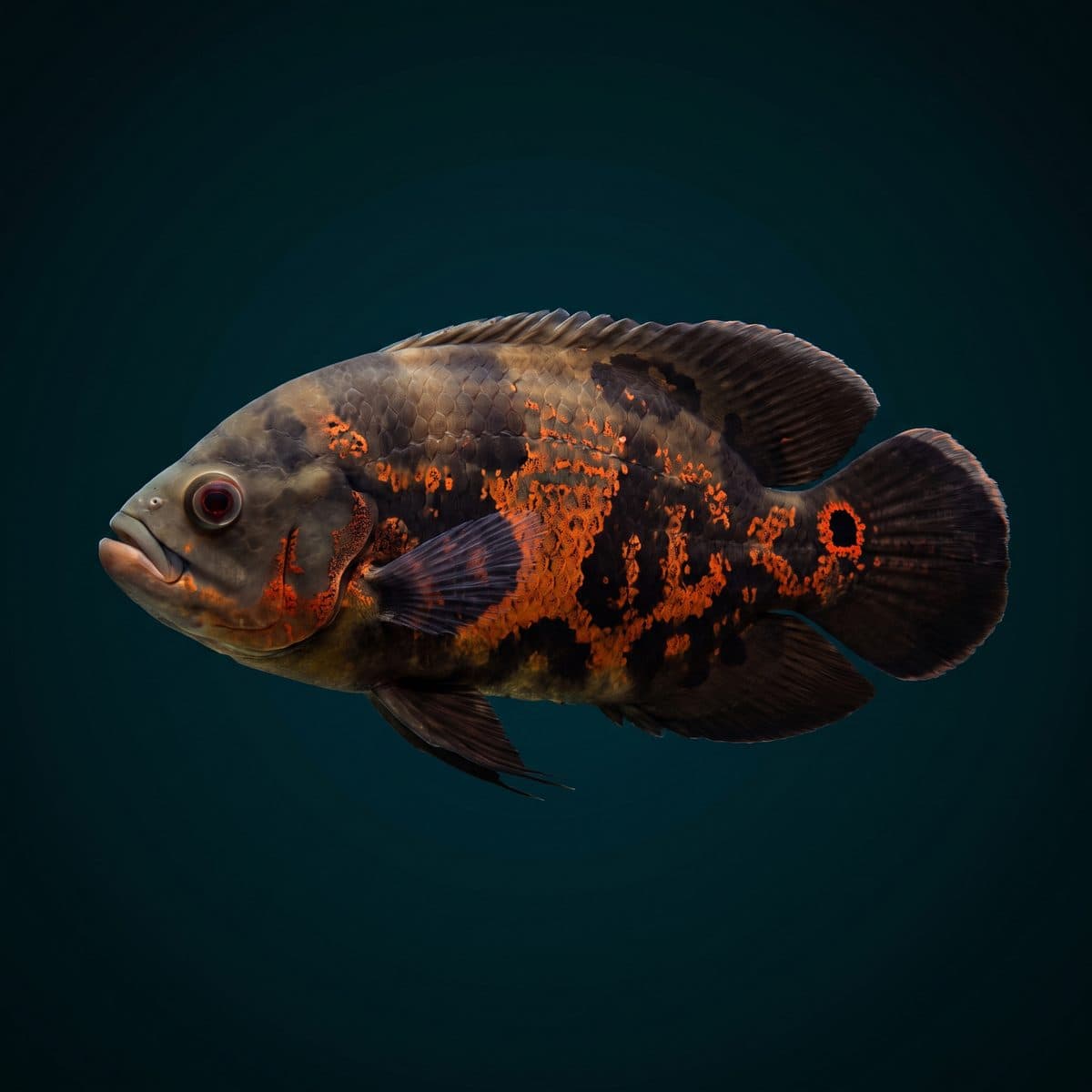
The Tiger Oscar is the iconic colour form of Astronotus ocellatus, one of the most recognisable and widely kept cichlids in the freshwater hobby. Characterised by a deep olive-to-black base overlaid with vivid orange or red irregular markings — the "tiger stripes" — this fish commands attention in any aquarium. Originally native to the Amazon, Orinoco, and Paraná river basins, Oscars have been captive-bred for decades, producing several colour variants of which the Tiger remains the most popular.
What truly sets Oscars apart is their intelligence and personality. They recognise their keepers, beg for food, rearrange tank décor to their liking, and display a range of behaviours more commonly associated with pets than fish. This interactivity makes them enduringly popular despite their significant space and maintenance requirements.
Natural Habitat
Wild Oscars inhabit slow-moving rivers, floodplain lakes, and forest streams throughout tropical South America. During the wet season, they move into flooded forests to exploit the abundance of fallen fruit, insects, and crustaceans. The water is typically warm (25–28 °C), slightly acidic to neutral (pH 6.0–7.5), and often tannin-stained from decomposing leaf litter. Substrates range from sand to mud with abundant submerged wood and root structures.
In captivity, replicating these conditions is straightforward: warm, well-filtered water with moderate hardness and plenty of open swimming space. Oscars do not require blackwater conditions but benefit from driftwood and subdued lighting that mimics their natural environment.
Appearance & Colour Variants
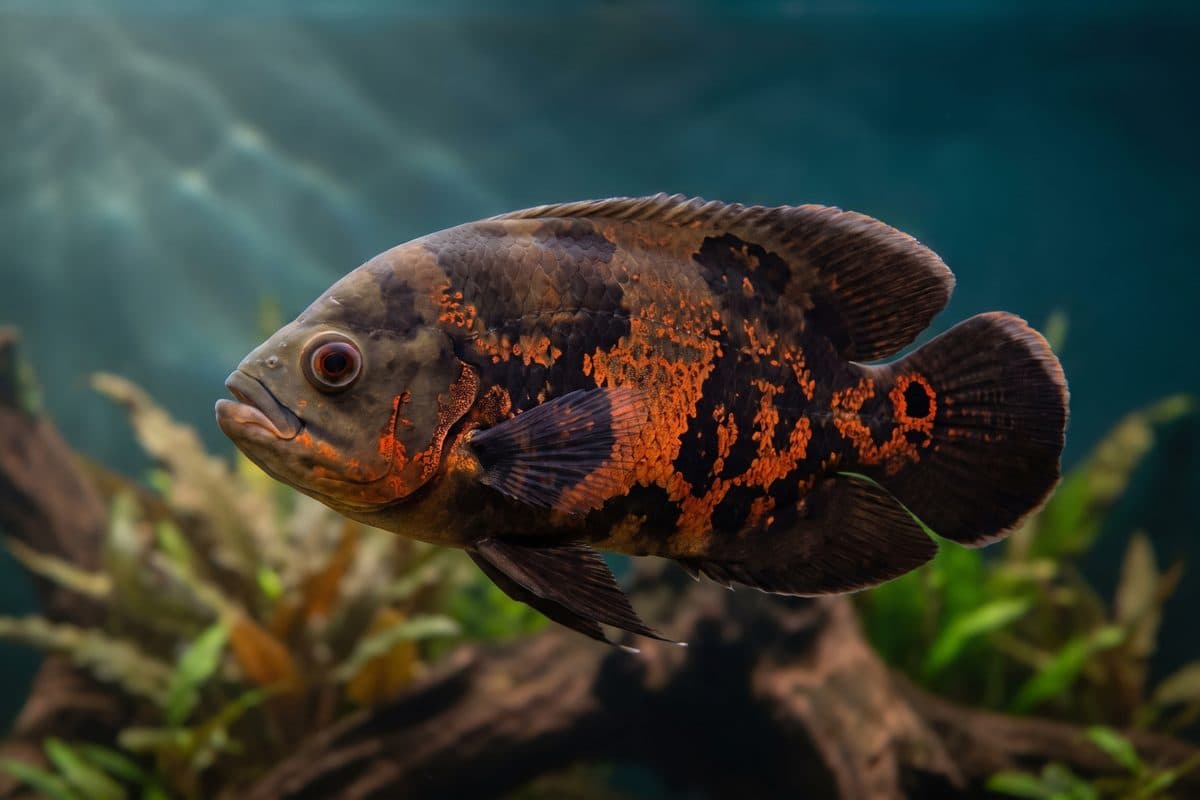
The Tiger Oscar's defining feature is its orange-and-black patterning. The base colour is a dark olive to jet black, broken by bold, irregular patches of bright orange, red-orange, or copper that extend across the body and into the fins. Each fish has a unique pattern — no two Tiger Oscars look identical. The caudal fin displays the characteristic ocellus (eye spot) that gives the species its name, a black spot ringed in orange or red that likely serves as a predator-deterrent.
Beyond the standard Tiger, commercially available Oscar variants include:
- Red Oscar: Predominantly red-orange with minimal black — essentially a Tiger with expanded orange coverage.
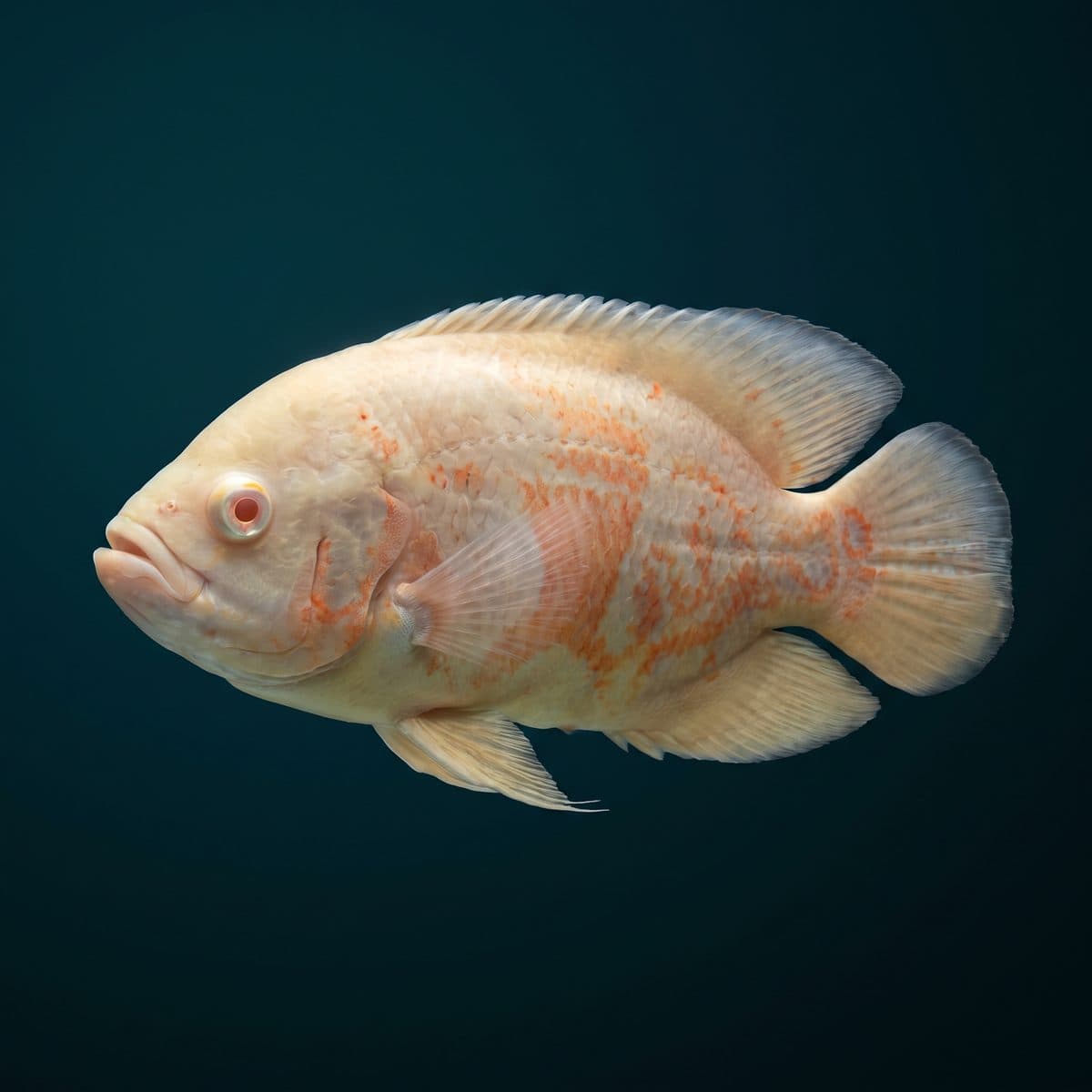
- Albino Oscar: Lacking melanin, displaying white/cream base with red or orange markings and pink eyes.
- Albino Tiger Oscar: Combines the Tiger pattern with the albino gene — cream base with intense red-orange markings.
- Lemon Oscar: Yellow-gold variant selectively bred from the orange colour morph.
- Long-fin Oscar: Standard colouring with extended, flowing finnage.
All colour variants are the same species and require identical care.
Tank Requirements
Oscars grow quickly — from 2.5 cm (1 in) juveniles to 25+ cm (10+ in) within their first year — and their tank must accommodate this rapid growth. Starting juveniles in small tanks and "upgrading later" is a common mistake that stunts growth and causes health problems.
- Single adult: 75 gallons (284 L) absolute minimum; 100 gallons (378 L) recommended.
- Pair: 125 gallons (473 L) minimum.
- Community with other large cichlids: 180+ gallons (680+ L).
Filtration: Oscars are messy eaters that produce substantial waste. Canister filters rated for 6–8× the tank volume per hour are essential. Many keepers run dual canisters or a canister plus a large HOB for redundancy. Weekly 30–40% water changes are non-negotiable.
Décor: Keep it minimal and heavy. Oscars rearrange everything they can move — plants will be uprooted, lightweight decorations tossed around. Use large river rocks, heavy driftwood, and potted or weighted plants (Anubias, Java Fern attached to wood) if you want greenery. Leave ample open swimming space in the centre of the tank.
Substrate: Fine sand or smooth gravel. Oscars sift substrate when feeding, so avoid sharp or coarse materials that could damage their mouths.
Water Parameters
Oscars are adaptable fish that tolerate a wide range of water chemistry, which is one reason they have thrived in captivity worldwide:
- Temperature: 74–81 °F (23–27 °C). Aim for 77 °F (25 °C) for most situations.
- pH: 6.0–8.0. Captive-bred Oscars tolerate higher pH than wild specimens.
- GH: 5–20 dGH.
- Ammonia/Nitrite: 0 ppm (critical — Oscars are sensitive to ammonia spikes due to their high bioload).
- Nitrate: Below 40 ppm; below 20 ppm ideal.
The most important parameter for Oscars is water cleanliness. Their heavy bioload means ammonia and nitrate can rise quickly without adequate filtration and water changes. Invest in a reliable liquid test kit and test weekly.
Diet & Feeding
Oscars are opportunistic omnivores with a strong preference for protein. In the wild, they consume insects, crustaceans, small fish, fallen fruit, and plant matter. In captivity:
- Staple: High-quality cichlid pellets (Hikari Cichlid Gold, Northfin Cichlid, or similar) — these should form 60–70% of the diet.
- Supplementary protein: Frozen or thawed market shrimp (shell-on for juveniles, peeled for adults), bloodworms, earthworms, crickets, and mealworms.
- Occasional treats: Fresh fruit (small pieces of banana, melon, or grape — Oscars enjoy these), blanched peas, and spirulina-based foods.
- Avoid: Feeder goldfish — they carry parasites, are nutritionally poor, and create a dependency on live prey that makes pellet training difficult.
Feed adults once daily, an amount they consume in 2–3 minutes. Fast one day per week. Juveniles can be fed 2–3 times daily in smaller portions to support rapid growth.
Behaviour & Temperament
Oscars are among the most intelligent and interactive freshwater fish available. They quickly learn to recognise their owners, will swim to the front of the tank when approached, and can be trained to accept food from the hand. Many keepers describe them as having "puppy-like" personalities.
However, that intelligence comes with territorial aggression, particularly during breeding or when defending their preferred area of the tank. Oscars will attack and kill fish they perceive as rivals or prey. They are also capable of sulking — refusing food, lying on their side, or darkening their colours when stressed or displeased with environmental changes.
Compatible Tank Mates
Choosing tank mates for Oscars requires careful consideration of size, temperament, and territory. Suitable options include:
- Large Plecostomus (Sailfin, Common, or Royal Pleco) — bottom-dwellers that stay out of the Oscar's way.
- Silver Dollars — fast-moving, schooling fish too large to be eaten and too quick to be caught.
- Large Bichirs (Senegal or Ornate) — armoured, bottom-dwelling fish that coexist well.
- Jack Dempsey Cichlids — similarly sized and tempered, though individual compatibility varies.
- Severum Cichlids — peaceful large cichlids that can hold their own.
- Firemouth Cichlids — in sufficiently large tanks (180+ gallons) with adequate territory.
Avoid small fish (anything under 10 cm), slow-moving species, and overly aggressive cichlids that could injure the Oscar. Never house Oscars with African cichlids — the water parameter requirements and aggression profiles are incompatible.
Breeding
Oscars form monogamous pairs that can remain bonded for life. Breeding is achievable in captivity but requires patience, space, and a proven pair.
Pairing: The most reliable method is to raise a group of 6–8 juveniles together in a large tank (180+ gallons) and allow them to pair naturally. Oscars reach sexual maturity at 12–18 months. Sexing is extremely difficult externally — the only reliable method is examining the genital papillae during spawning, where the female's ovipositor is wider and more blunt than the male's.
Spawning: A bonded pair will clean a flat surface (rock, clay pot, or bare tank bottom), then the female deposits 1,000–3,000 eggs in rows while the male follows to fertilise. Both parents guard the eggs fiercely. Eggs hatch in 3–4 days at 27 °C, and fry become free-swimming 4–5 days later.
Fry care: Oscar parents are generally excellent — they fan eggs, remove fungused eggs, and actively guard free-swimming fry. Fry can be started on baby brine shrimp and crushed pellets. Growth is rapid; fry reach 2.5 cm within 6–8 weeks.
Common Health Issues
- Hole-in-the-Head (HITH): The most common Oscar health problem. Presents as pitting erosion around the head and lateral line. Caused by poor water quality, inadequate diet (vitamin C and D deficiency), or parasitic infection (Hexamita). Treatment: improve water quality, supplement diet with vitamin-enriched foods, and treat with metronidazole if parasites are suspected.
- Ich (White Spot Disease): Oscars are moderately susceptible. Raise temperature to 86 °F (30 °C) and treat with aquarium salt (1 tbsp per 5 gallons) or a formalin-based medication.
- Fin rot: Usually secondary to poor water quality or injury. Improve water conditions; treat with antibacterial medication if severe.
- Bloat: Often caused by overfeeding or ingestion of gravel. Fast the fish for 48–72 hours; offer blanched peas. If swelling persists, treat with Epsom salt baths and consider internal bacterial infection.