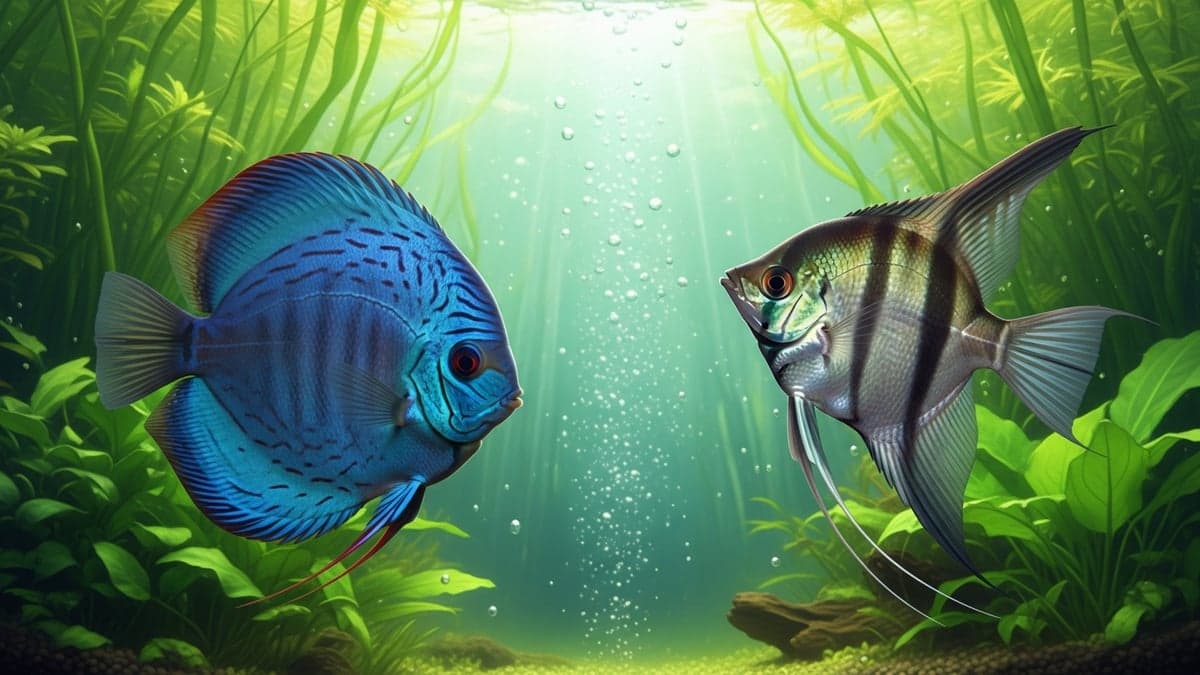
Discus vs Angelfish: South America's Elegant Rivals
Discus and Angelfish are the two most iconic South American cichlids — and the two fish most commonly considered by hobbyists wanting to build an elegant planted community tank. Both have laterally compressed body shapes, striking colour varieties, and a regal presence that other tropical fish cannot match. But the gap in care difficulty between them is enormous, and choosing the wrong one for your experience level can result in frustration, dead fish, and wasted money.
This comparison will give you an honest, detailed assessment of what each species truly demands — so you can make an informed decision before investing.
Discus Overview
Discus (Symphysodon spp.) are medium-sized cichlids reaching 15–20 cm (6–8 inches) with a disc-shaped, laterally compressed body. They originate from the slow-moving blackwater tributaries of the Amazon basin, where water is extremely soft (GH 0–4 dGH), acidic (pH 4.5–6.5), and warm (28–32 °C). In the wild, they live in groups among submerged tree roots and leaf litter.
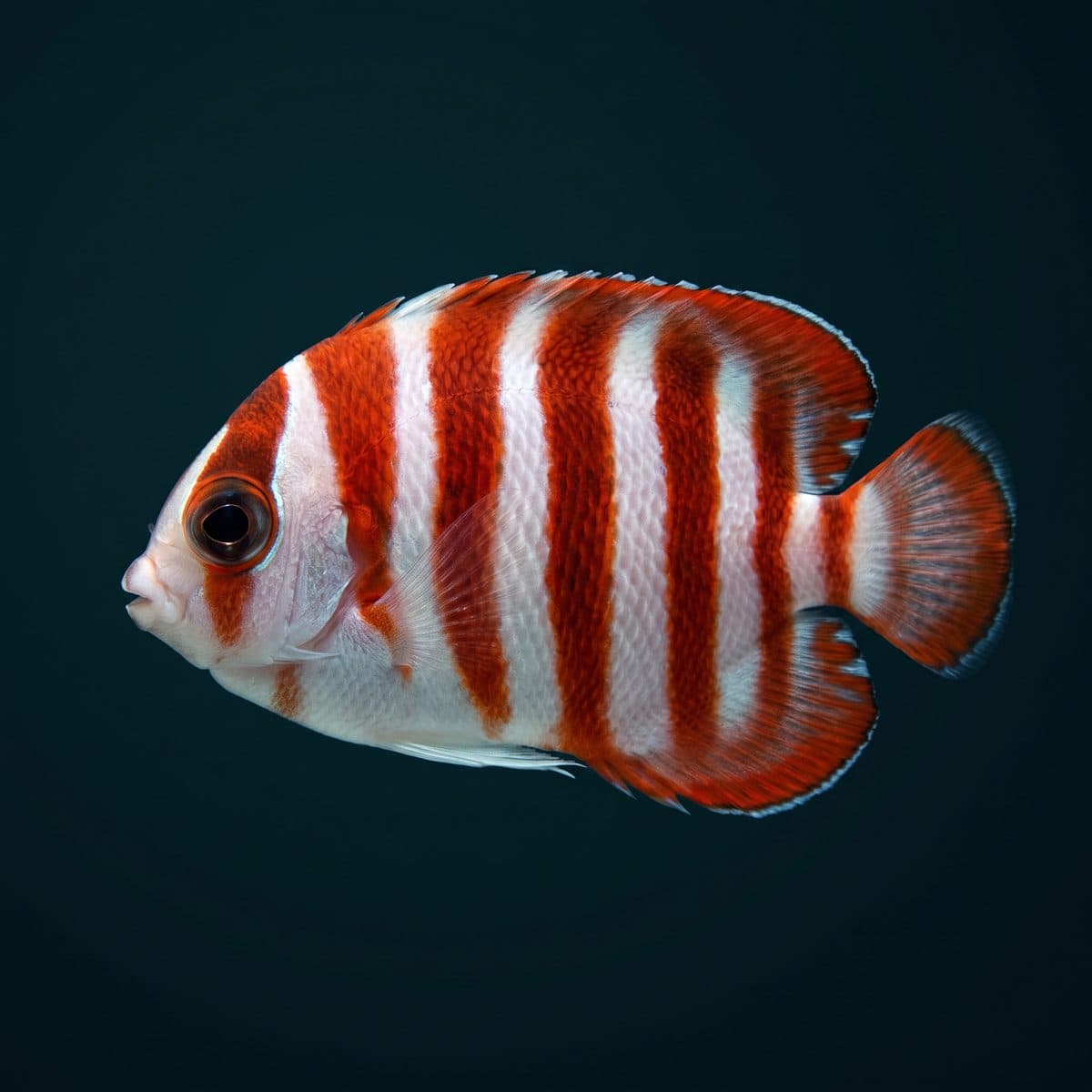
Decades of selective breeding have produced an extraordinary range of colour varieties: Pigeon Blood, Cobalt Blue, Marlboro Red, Snakeskin, Turquoise, and dozens more. Modern captive-bred Discus tolerate slightly harder and more neutral water than wild-caught specimens, but they remain demanding fish by any standard.
Discus are schooling fish — keeping fewer than five individuals causes chronic stress, suppressed colouration, and increased susceptibility to disease. A group of six in a 75-gallon tank is the recommended starting point. For comprehensive Discus care, see our Discus beginners guide.
Angelfish Overview
Freshwater Angelfish (Pterophyllum scalare) are medium-sized cichlids reaching 15 cm (6 inches) in body length with fins extending the total height to 20–25 cm. They originate from the Amazon basin but have been bred in captivity for over 100 years, producing hardy, adaptable stock available in numerous colour varieties: Silver (wild-type), Koi, Marble, Black, Platinum, Blue Pinoy, Altum crosses, and many more.
Angelfish are one of the most popular tropical fish worldwide for good reason: they combine visual elegance with relative ease of care, personality without unmanageable aggression, and breeding behaviour accessible to intermediate hobbyists. They thrive in planted community tanks of 55+ gallons with a minimum height of 45 cm (18 inches) to accommodate their tall body shape.
While Angelfish are cichlids and therefore more assertive than typical community fish — especially during breeding — they are far more forgiving than Discus in terms of water parameter requirements and overall hardiness.
Side-by-Side Comparison Table
| Factor | Discus | Angelfish |
|---|---|---|
| Scientific Name | Symphysodon spp. | Pterophyllum scalare |
| Adult Size (body) | 15–20 cm (6–8 in) | 12–15 cm (5–6 in) body; 20–25 cm total height |
| Lifespan | 10–15 years | 10–12 years |
| Temperature | 28–30 °C (82–86 °F) | 24–28 °C (75–82 °F) |
| pH | 6.0–7.0 | 6.5–7.5 |
| GH (Hardness) | 2–8 dGH | 4–12 dGH |
| Minimum Tank Size | 75 gal (group of 6) | 55 gal (group of 4+) |
| Care Difficulty | Advanced | Intermediate |
| Water Change Frequency | 25–50 % twice weekly | 25–30 % weekly |
| Purchase Price | $30–$150+ per fish | $5–$30 per fish |
| Minimum Group Size | 5–6 | 4+ (or a bonded pair) |
| Aggression Level | 2/5 — Semi-peaceful | 2/5 — Semi-peaceful (3/5 when breeding) |
| Community Potential | Limited (temperature-compatible species only) | Excellent (wide range of tank mates) |
| Colour Varieties | Dozens (Pigeon Blood, Cobalt, Marlboro, etc.) | Dozens (Koi, Marble, Black, Platinum, etc.) |
Care Difficulty
This is the defining difference between these two species, and it cannot be overstated.
Discus care demands: Discus require water quality standards that most hobbyists find challenging to maintain long-term. Nitrate levels must be kept below 10–20 ppm — in a tank with six large fish producing constant waste, this requires 25–50 % water changes twice per week using temperature-matched, dechlorinated water. The temperature must remain rock-steady at 28–30 °C; a drop to 26 °C can trigger Ich outbreaks. Discus are extremely sensitive to ammonia and nitrite — even 0.1 ppm ammonia can cause distress in this species.
Furthermore, commercially bred Discus are often weakened by hormonal colour enhancement and prophylactic antibiotic use at the farm level. This means many fish available in the retail market are less robust than their genetics should allow. Sourcing from reputable breeders who do not hormone-treat their stock is critical.
Angelfish care demands: Angelfish are dramatically easier. They tolerate temperature variations of 24–28 °C without issue, accept pH from 6.5–7.5 (and often wider), handle nitrate levels up to 30–40 ppm without visible stress, and need only standard weekly water changes. A century of captive breeding has produced stock that is genuinely hardy and forgiving — a well-maintained 55-gallon tank with a good canister filter is all they need.
The honest assessment: If you are not prepared to perform two large water changes every week for the next 10+ years, do not buy Discus. Angelfish deliver 80 % of the visual elegance at 20 % of the effort.
Water Parameters
Discus and Angelfish share Amazonian origins but have diverged significantly in their captive-bred parameter tolerances:
Discus: Temperature 28–30 °C (non-negotiable — below 27 °C invites disease, above 31 °C stresses them). pH 6.0–7.0; wild-caught Discus may need pH as low as 5.0, but captive-bred stock accepts 6.5–7.0. GH 2–8 dGH — soft water is important for Discus health and especially for breeding. KH 1–4 dKH. Ammonia and nitrite: strictly 0 ppm. Nitrate: below 10 ppm ideal, never above 20 ppm.
Angelfish: Temperature 24–28 °C (much wider tolerance). pH 6.5–7.5 (and many captive-bred Angelfish thrive up to pH 8.0). GH 4–12 dGH — far more flexible. KH 3–8 dKH. Ammonia and nitrite: 0 ppm (standard for any aquarium). Nitrate: below 40 ppm acceptable.
The practical implication: Discus require RO/DI water or water softening in most municipalities, because tap water typically has GH above 8 dGH and pH above 7.5. Angelfish can be kept on straight tap water in the vast majority of locations, needing only a dechlorinator.
Cost Analysis
| Cost Category | Discus (group of 6) | Angelfish (group of 6) |
|---|---|---|
| Purchase price | $180–$900+ | $30–$180 |
| Tank (75 gal + stand) | $300–$500 | $200–$400 (55 gal tall) |
| Filtration | $200–$350 (premium canister) | $100–$250 |
| Heater (high wattage) | $60–$100 | $35–$60 |
| RO/DI system | $150–$300 (often necessary) | $0 (rarely needed) |
| Monthly water conditioner | $10–$20 (twice-weekly changes) | $5–$10 (weekly changes) |
| Monthly food (premium) | $25–$50 | $10–$20 |
| First-year total | $1,200–$3,000+ | $500–$1,200 |
Discus cost 2–3x more than Angelfish across every category. The fish themselves are more expensive, the equipment needs to be higher-quality, the ongoing maintenance costs more (water conditioner, RO membrane replacements, premium food), and replacements cost more when fish are lost. This is not a hobby where you want to learn expensive lessons — get experience with Angelfish first.
Community Compatibility
Discus community: The 28–30 °C temperature requirement dramatically limits compatible species. Viable tank mates include Cardinal Tetras (the classic pairing), Rummy-nose Tetras, Corydoras sterbai (the only Cory that thrives at 30 °C), German Blue Rams, and Bristlenose Plecos. Most other common community fish — Neon Tetras, most Corydoras species, most Rasboras — prefer temperatures below 27 °C and will have shortened lifespans in a Discus tank.
Angelfish community: The 24–28 °C range is compatible with the vast majority of tropical community fish. Excellent companions include almost any tetra large enough to avoid being eaten (Rummy-nose, Bleeding Heart, Congo, Diamond), Corydoras (any species), Dwarf Gourami, Bolivian Ram, Kuhli Loaches, Bristlenose Pleco, and many others. The only restrictions are: no fin-nippers (Tiger Barbs, Serpae Tetras), no fish small enough to eat (Neon Tetras are risky with adult Angelfish), and no aggressive cichlids.
Angelfish win decisively on community versatility. The standard planted community tank — 75 gallons with mixed tetras, Corydoras, a Bristlenose Pleco, and a centerpiece group — is one of the most satisfying setups in the hobby, and Angelfish fit it perfectly.
Breeding Comparison
Discus breeding is an advanced endeavour. Pairs form naturally within a group (you cannot reliably sex juveniles, so buy 6+ and let them pair off). The pair selects a vertical spawning surface, lays 80–200+ eggs, and provides biparental care. Uniquely among cichlids, Discus fry feed on a mucus secretion from the parents' skin for the first 1–2 weeks — meaning separating fry from parents too early is fatal. Breeding requires pristine water (pH 6.0–6.5, GH below 4, temperature 30 °C), a dedicated breeding tank, and weeks of careful fry-rearing.
Angelfish breeding is one of the most accessible cichlid breeding projects. Pairs form readily, spawn on vertical surfaces (slate, Amazon Sword leaves, spawning cones), and provide biparental care for eggs and fry. Fry become free-swimming in 6–7 days and can be raised on newly hatched brine shrimp. Many hobbyists have bred Angelfish successfully in their community tank without any special modifications — though a dedicated breeding tank improves fry survival significantly.
Verdict: Which Should You Choose?
Choose Discus if:
- You have 2+ years of serious aquarium experience
- You are committed to twice-weekly water changes for the long term
- You have the budget for premium fish ($30–$150+ each) and potentially an RO/DI system
- You want the absolute pinnacle of freshwater beauty and are willing to work for it
- You find the challenge of demanding fishkeeping rewarding rather than stressful
Choose Angelfish if:
- You are an intermediate hobbyist looking for an elegant centrepiece fish
- You want a versatile community fish that works with a wide range of tank mates
- You prefer weekly water changes and standard municipal tap water
- You want to try cichlid breeding with a realistic chance of success
- You want 80 % of the Discus aesthetic at a fraction of the cost and effort
Our recommendation for most hobbyists: start with Angelfish. Master planted tank maintenance, learn cichlid behaviour, and enjoy the elegance they bring to your community. If, after a year or two, you find yourself wanting more and you are religiously performing water changes and testing parameters — then you are ready for Discus. Browse The Fish Collection's cichlid collection for both species.