Overview
The Showa was created by Jukichi Hoshino in 1927 by crossing a Ki Utsuri (black-and-yellow koi) with a Kohaku (red-and-white koi). The early results were crude — predominantly black fish with small, irregularly placed red and white patches. But the potential was recognised, and decades of selective breeding produced the modern Showa: a balanced tri-colour koi where black, red, and white each contribute roughly equal visual weight, creating a powerful, dramatic pattern that is often described as "painted" or "artistic."
The Showa's dramatic appearance has made it increasingly popular in international koi shows. A well-balanced modern Showa with deep sumi, vivid hi, and clean shiroji is among the most visually striking fish in the koi world — and top-quality specimens from breeders like Dainichi, Matsunosuke, and Omosako regularly win Grand Champion titles at the highest levels of competition.
Pattern Appreciation
The Showa's three-colour palette creates the most complex pattern dynamics of any koi variety:
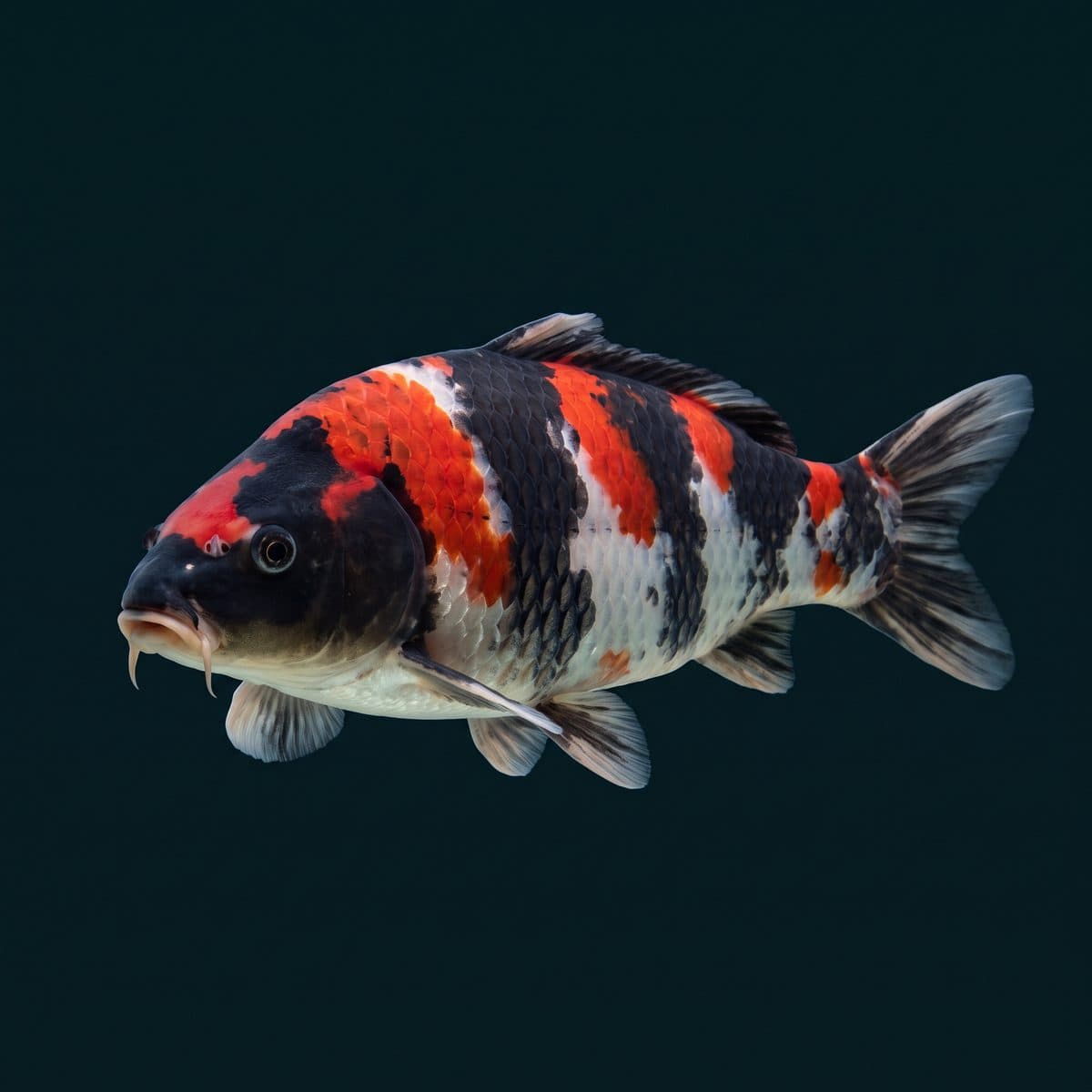
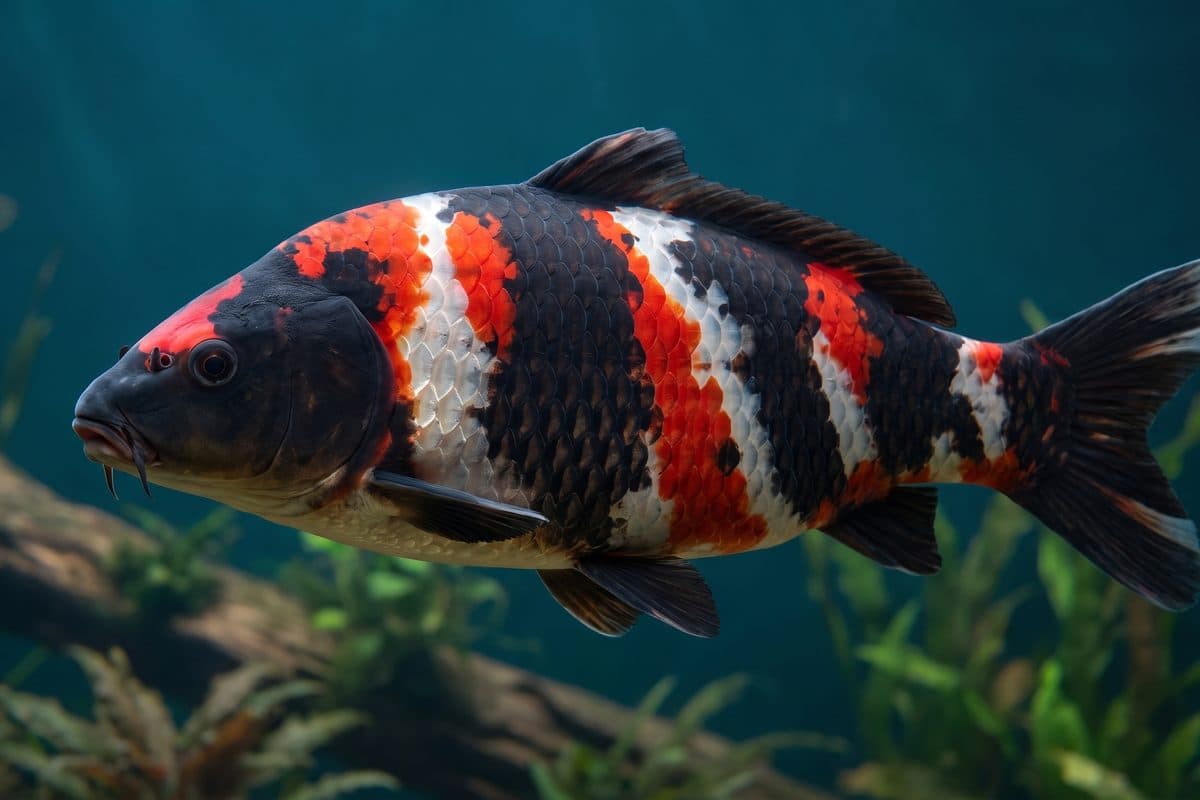
Sumi (black): The foundation of the Showa. Sumi should be deep, glossy, lacquer-black — not grey or brownish. It wraps around the body in bold, dramatic patches and crucially appears on the head (a defining Showa characteristic). Quality sumi has sharp, clean edges (kiwa) and appears three-dimensional — as if painted onto the fish.
Hi (red): Deep, uniform crimson, identical in quality standards to Kohaku and Sanke. Hi should be well-distributed, with clean edges where it meets both sumi and shiroji.
Shiroji (white): Clean, snow-white areas that provide visual breathing room between the hi and sumi. The quality and placement of shiroji is what separates a muddy, confusing Showa from an elegant, readable one.
The ideal Showa pattern features a bold, dramatic head with all three colours represented (often called "menware" — a lightning-bolt pattern of sumi splitting the head). The body should display a balanced interplay of the three colours, with each element complementing the others. A common judging principle: a great Showa should look balanced from any angle — front, side, and top view.
Showa vs Sanke
The definitive identification points:
- Head sumi: Showa always has black on the head; Sanke never does.
- Sumi distribution: Showa sumi wraps around the body in large, bold patches. Sanke sumi appears as smaller, discrete accent spots.
- Base colour perception: Showa reads as "black fish with red and white added." Sanke reads as "white fish with red and black added."
- Pectoral fins: Showa pectoral fins have motoguro — solid black at the base of the fin that radiates outward. Sanke pectoral fins have tejima — black stripes within the fin. This is one of the most reliable identification methods.
Modern vs Traditional Showa
Showa have evolved significantly since their creation:
- Traditional (old-style) Showa: Predominantly black — 60–70% of the body covered in sumi, with smaller patches of red and white. Bold, dramatic, but can appear "heavy" or unbalanced. The original Showa aesthetic.
- Kindai (modern) Showa: More balanced — roughly equal proportions of black, red, and white. Lighter, more elegant, and often compared favourably with Sanke for aesthetic refinement. The dominant style in contemporary koi shows.
Both styles have advocates, and judging standards accommodate both. However, the trend at major competitions favours the modern, balanced Showa — which has contributed to the variety's growing popularity relative to Sanke in recent decades.
Selection Criteria
- Balance: The three colours should be evenly distributed and visually balanced from all angles.
- Sumi quality: Deep, glossy black with sharp edges. Avoid fish with grey or brownish sumi.
- Head pattern: A striking menware (lightning) pattern or bold head sumi with all three colours represented on the head.
- Motoguro: Well-defined black pectoral fin joints — a quality indicator.
- Body conformation: Strong, well-proportioned torpedo shape.
- Skin quality: Lustrous sheen across all three colour elements.
Care Requirements
Showa care is identical to all koi — they share the same species and have no variety-specific needs. See our Koi Fish Complete Guide for comprehensive care instructions. The summary: 1,000+ gallon pond, robust multi-stage filtration, standard koi water parameters (59–77 °F, pH 7.0–8.5), and a high-quality pellet diet supplemented with vegetables and colour-enhancing foods.
One colour-specific note: Showa sumi development is particularly temperature-sensitive. Exposure to cooler water (55–65 °F / 13–18 °C) during autumn and winter helps sumi darken and solidify. Koi keepers in warmer climates sometimes struggle to develop the deepest sumi on their Showa because the water never gets cold enough to trigger maximum melanin production.
Pattern Development
Showa are the most dramatically variable of the Gosanke as they develop:
- Tosai (year one): Showa fry and tosai are often overwhelmingly black. Hi and shiroji are present but may be muted or patchy. The fish looks nothing like its eventual adult pattern.
- Nisai (year two): Sumi begins to recede and define itself. Hi intensifies. Shiroji cleans up. The pattern begins to emerge from what was previously a mostly-black fish.
- Sansai to Yonsai (years three to four): The mature pattern takes shape. Sumi solidifies into defined patches. The balance between the three colours becomes apparent.
- Year five and beyond: Continued refinement. Quality Showa improve dramatically with age as sumi deepens and the pattern achieves its final expression.
The extended development timeline means buying young Showa is inherently speculative — the best breeders can predict development based on bloodline, but even they acknowledge the uncertainty. This unpredictability is part of the Showa's appeal for many hobbyists.
Showa Bloodlines
Once you start looking seriously at Showa, you'll hear breeders' names attached to fish, and they matter more than you might expect. A koi's bloodline is a strong predictor of how its pattern and sumi will develop, and different Japanese breeders have spent generations fixing distinct Showa traits. Knowing the main houses helps you buy with some idea of what a young fish will become.
Among the most respected Showa breeders are Dainichi, Matsunosuke (via the Kanno line), Sakai Fish Farm, and Omosako. Dainichi Showa are known for powerful, glossy sumi and impressive body shape. The Matsunosuke line is famous for a softer, wrapping sumi that develops beautifully with age. Others prioritise bright, thick hi or clean, early-finishing patterns. None is simply "better" — they represent different interpretations of the Showa ideal.
For a keeper, the practical value of bloodline is prediction. Sumi is the most unstable element in any Showa, appearing, shifting, and deepening over years, and a known bloodline gives you and the breeder a reasonable basis to forecast how a tosai will mature. You're paying not just for the fish in front of you but for the genetic likelihood of what it'll look like at four or five years old. If you're buying young and hoping for show quality, bloodline is one of the few reliable guides you have.
Seasonal Care & Sumi Development
Koi keeping runs on the seasons, and with Showa there's an extra payoff: temperature swings through the year are part of what develops that all-important black. As autumn cools the pond, a Showa's metabolism slows, appetite drops, and — crucially — the cooler water encourages the melanin production that helps sumi darken and solidify. Keepers in warmer climates often find their Showa never develop the deepest black precisely because the pond never gets cold enough.
Through spring and summer, feed generously with quality growth food while the water sits in the 68–77 °F range; this is the growing season when the fish put on size and the hi brightens. As the water drops through autumn, switch to lower-protein, wheatgerm-based food, and once it falls below about 50 °F (10 °C), stop feeding altogether — a koi's digestion essentially shuts down in cold water, and food left in the gut can rot and kill the fish.
Over winter, koi become dormant, resting near the pond bottom where the water is warmest and most stable. A pond at least 4 feet deep, with a hole kept open in any ice for gas exchange, lets them ride out the cold safely. Don't be alarmed by a Showa that looks a little washed out in the cold months; the pattern typically snaps back — often improved — as the water warms again in spring.
Health & Common Problems
Showa are no more or less disease-prone than any other koi — they're the same species, and the whole pond stands or falls on water quality. The problems to know about are the standard koi concerns:
- Parasites: Flukes, ich, costia, and trichodina all cause flashing, rubbing, and clamped fins. They're often brought in on new, un-quarantined fish, which is the number one way disease enters a pond.
- Bacterial ulcers and fin rot: Aeromonas and similar bacteria cause open sores and red, ragged fins, usually taking hold after an injury or in poor water. They need prompt topical or systemic treatment.
- Koi Herpesvirus (KHV): A serious, often fatal viral disease that becomes active around 63–77 °F. There's no cure, so prevention through strict quarantine of every new fish is essential.
- Spring vulnerability: Koi are at their weakest coming out of winter dormancy with lowered immunity. A stable, clean pond and a careful spring warm-up reduce the risk of the ulcers and infections that often strike at this time.
The golden rule of koi health is a long, strict quarantine — four weeks minimum, in a heated holding tank — for every new arrival, no matter how clean the source looks. Combine that with excellent filtration, low nitrate, and stable parameters, and a Showa can live 25–35 years or more.
Buying a Showa — What to Expect
Buying a Showa is different from buying most fish, because you're partly buying a prediction. Sumi develops slowly and unpredictably, so a young Showa rarely looks like it will as an adult — many tosai are overwhelmingly black, with the balanced pattern still years away. That means patience and trust in the source matter as much as the fish in front of you.
Decide first what you're after. If you want an affordable, beautiful pond fish, domestic or lower-grade imported Showa from £20–£100 will give you years of pleasure without the pressure of show standards. If you're chasing competition quality, expect to pay from several hundred to many thousands of pounds for a Japanese-bred fish from a known bloodline, and consider buying a slightly older nisai or sansai whose pattern has begun to reveal itself.
When assessing an individual, put body shape and skin quality first — a strong, well-proportioned body carries any pattern, and lustrous skin separates good koi from great ones. Then look for deep, glossy sumi with clean edges, bright even hi, and clear white. Check for the telltale motoguro (black at the base of the pectoral fins), a hallmark of a proper Showa. Above all, buy from a seller who quarantines and can speak knowledgeably about the fish's bloodline and likely development.
Is a Showa Right for You?
Showa are the bold, dramatic members of the Gosanke, and they reward keepers who enjoy watching a pattern unfold over years. But like all koi, they're a pond commitment, not a tank fish.
A Showa is a great choice if you:
- Have (or are building) a 1,000+ gallon pond with serious multi-stage filtration.
- Enjoy the long game — watching sumi develop over 3–5 years is part of the appeal.
- Want a high-impact, high-contrast koi and appreciate its "painted" look.
- Are prepared to quarantine new fish and manage the pond through all four seasons.
Look elsewhere if you:
- Only have an indoor aquarium — koi grow far too large for tank life long-term.
- Want a fish whose final look is predictable at the point of purchase.
- Aren't ready for the cost and upkeep of a proper koi pond.
If the idea of a fish that changes and improves with age excites you rather than frustrates you, the Showa is deeply rewarding. Its unpredictability is precisely why so many serious koi keepers rank it as their favourite of the Big Three — and why a great one is such a prize.