Discus Breeding Overview
Discus fish exhibit one of the most remarkable parental behaviours in the freshwater aquarium hobby. Both parents produce a mucus secretion on their skin that serves as the first food for newly hatched fry — a feeding strategy seen in only a handful of fish species worldwide. This parental mucus is rich in proteins, antibodies, and nutrients, giving parent-raised fry a significant health advantage over artificially raised offspring.
Breeding Discus is not technically difficult, but it requires patience, stable conditions, and a willingness to let the fish proceed at their own pace. Forced pairing rarely succeeds; natural pair formation from a group of juveniles is the proven approach. Once a pair bonds, they will typically spawn repeatedly every 1–2 weeks if conditions are suitable.
Pair Formation
The most reliable method for obtaining a breeding pair is to purchase six or more juvenile Discus (ideally 8–10) and raise them together in a group tank of 75–125 gallons. As they mature at 10–14 months of age, pairs will form naturally. You will recognise a bonded pair by these behaviours:
- The two fish separate from the group and swim together constantly
- They jointly clean a vertical surface (tank wall, driftwood, cone, or leaf) — a clear pre-spawning behaviour
- They defend their chosen spawning site aggressively against other tank mates
- Body quivering and lateral display between the pair members
Do not attempt to "force pair" two random Discus by placing them together in a breeding tank. Incompatible pairs will fight, refuse to spawn, or eat their eggs. Natural selection produces compatible pairs with higher success rates.
Once a pair is identified, move them to a dedicated breeding tank. If they continue cleaning and displaying in the new tank within 48 hours, the pair bond is strong.
Breeding Tank Setup
A Discus breeding tank prioritises water quality control and simplicity:
- Tank size: 40–55 gallons. Larger is not necessarily better — a compact space focuses the pair's attention on each other and the eggs rather than on patrolling territory.
- Substrate: Bare bottom. Essential for hygiene — fry and uneaten food are immediately visible, and cleaning is effortless. Bare bottoms also prevent detritus accumulation that can host pathogens.
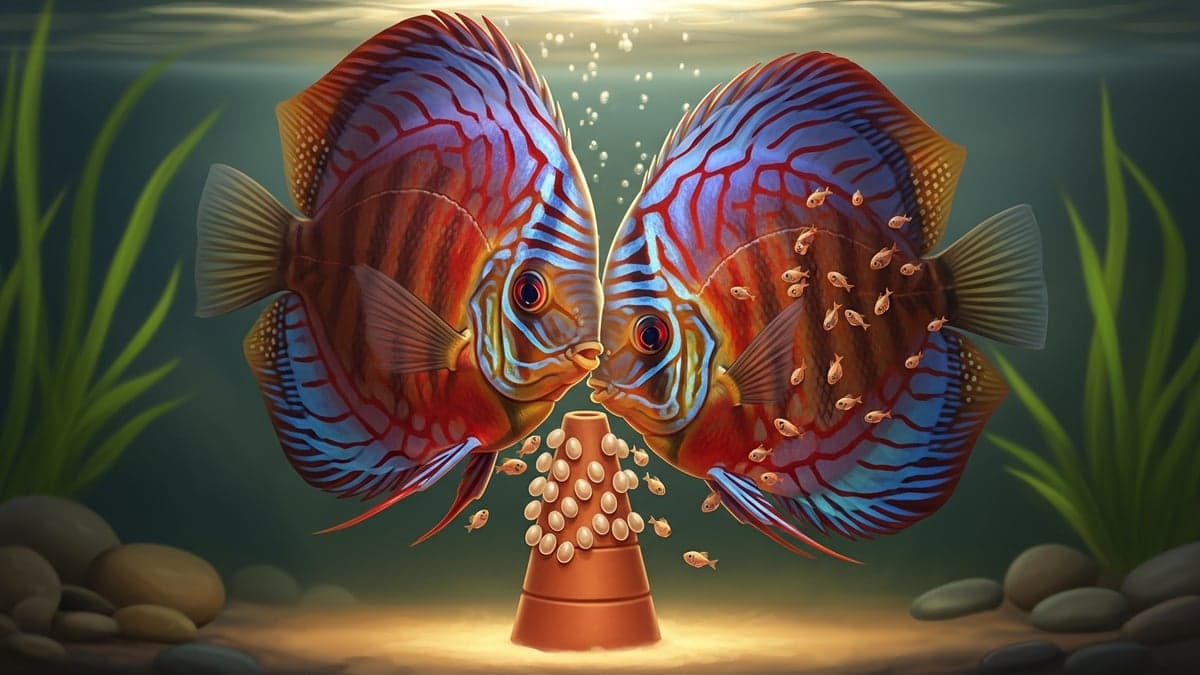
- Spawning surface: A vertical spawning cone (ceramic or terracotta, available from aquarium suppliers) or a piece of vertical slate propped against the tank wall. The surface should be smooth and positioned so both parents can access it simultaneously.
- Filtration: Sponge filter only. Sponge filters provide gentle biological filtration without intakes that can trap or injure fry. Run a mature sponge (pre-cycled in an established tank for 4+ weeks) to ensure immediate biological capacity.
- Heater: Set to 30–31 °C (86–88 °F) — warmer than the display tank temperature to stimulate breeding behaviour.
- Lighting: Dim, on a timer (8–10 hours daylight). Dim lighting reduces stress and encourages natural behaviour. Include a dim moonlight option to prevent total darkness, which can cause fright responses and egg eating.
Triggering Spawning
A bonded pair in a properly set up breeding tank will often spawn within 1–2 weeks without further intervention. If spawning does not occur, the following environmental triggers can help:
- Large water change: A 50 % water change with slightly cooler, softer water (2–3 °C cooler than tank temperature) mimics the rainy season influx that triggers spawning in the wild. This is the most effective single trigger.
- Lower pH: Gradually reduce pH to 5.5–6.0 using RO water or blackwater extract over 3–5 days. The combination of soft, acidic water and a large cool-water change closely replicates natural spawning conditions.
- Varied, high-quality diet: Feed beefheart mix, frozen bloodworm, and live blackworms in the weeks preceding a spawning attempt. Well-nourished fish in peak condition are more likely to spawn.
- Reduce disturbance: Minimise foot traffic, noise, and light changes near the breeding tank. Stressed pairs delay or abort spawning.
Egg Laying and Care
When ready to spawn, the female develops a blunt, rounded ovipositor (breeding tube) visible just anterior to the anal fin. The male's papilla is narrower and more pointed. The pair will intensify their cleaning of the spawning surface, then the female makes slow, upward passes over the cone, depositing rows of small, amber-coloured eggs. The male follows each pass, fertilising the eggs.
A typical clutch contains 100–400 eggs depending on the female's size and experience. First-time pairs often produce smaller clutches and may eat them — this is normal. Most pairs improve after 3–5 spawning attempts.
After egg laying:
- Both parents fan the eggs with their pectoral fins to maintain water circulation and prevent fungal growth.
- The parents remove unfertilised or fungused eggs (which turn white) by eating them.
- Do not disturb the pair. Avoid water changes, net intrusions, or sudden light changes during the egg stage. Stressed parents will eat the entire clutch.
- Eggs hatch in approximately 50–60 hours at 30 °C. The wriggling larvae remain attached to the spawning surface by adhesive threads for an additional 48–72 hours.
Parental Mucus Feeding
At day 3–4 post-hatch, fry become free-swimming and immediately seek out their parents. This is when the remarkable mucus feeding begins. Both parents produce a thick, opaque mucus layer on their flanks that serves as the sole food source for the fry.
The fry attach to the parents' sides and graze on the mucus, often in large clusters. You will see the fry swarm from one parent to the other as mucus is depleted on one side. This behaviour continues for 10–14 days, during which the fry grow rapidly.
Key points during mucus feeding:
- Do not add any supplementary food during the first 5–7 days — the fry rely exclusively on parental mucus and will not consume other food.
- Minimize disturbance. Parents that are stressed may eat fry or produce insufficient mucus.
- Light water changes (10–15 %) can be performed carefully, siphoning from the opposite side of the tank, if ammonia begins to rise. Use airline tubing as the siphon to avoid suction that could trap fry.
- If one parent becomes aggressive toward the fry (this occurs occasionally, particularly with inexperienced males), remove the aggressive parent and leave the fry with the remaining parent.
Fry Rearing and First Foods
At 7–10 days post-free-swimming, begin supplementing the parental mucus diet with first foods:
- Newly hatched brine shrimp (Artemia nauplii): The standard first food for Discus fry. Hatch daily using a brine shrimp hatchery (simple DIY setups with airline tubing and a 2-litre bottle work well). Feed 2–3 times daily in small amounts.
- Microworms: A secondary live food option that is easy to culture. Less nutritious than brine shrimp but a useful supplement.
By day 14–21, fry should be eating brine shrimp actively and weaning off parental mucus. At this point, you can separate the fry from the parents by moving the adults back to the display tank. The fry remain in the breeding tank, which now becomes their grow-out tank.
Transition to finely crushed Discus granules and decapsulated brine shrimp eggs at 3–4 weeks. By 6 weeks, fry should accept a varied diet of crushed granules, frozen baby brine shrimp, and fine frozen bloodworm.
Grow-Out Protocol
Growing Discus fry to sellable or display-tank size (5–8 cm) takes 3–6 months of intensive care:
- Tank: The breeding tank (40–55 gallons) serves as the grow-out tank for up to 20–30 fry. Larger spawns require a 75+ gallon grow-out tank.
- Feeding: 4–6 small meals daily. Beefheart mix and finely crushed granules are the primary growth foods. Supplement with baby brine shrimp and frozen bloodworm.
- Water changes: 25 % twice daily is the standard for professional Discus grow-out. This intensive water change schedule prevents growth-inhibiting hormone accumulation and maintains nitrate at near-zero levels. Automated drip systems simplify this.
- Temperature: Maintain at 30–31 °C for maximum growth rate.
- Culling: Sort fry by size every 2–3 weeks to prevent size bullying. Smaller fry can be grown out separately. Remove any deformed fry (spinal curvature, underdeveloped fins) — these will not develop into healthy adults.
Troubleshooting Breeding Failures
- Pair eats eggs repeatedly: Normal for first-time parents. Most pairs stop eating eggs after 3–5 spawning cycles. If egg eating persists, cover the spawning cone with a fine mesh cage that allows water flow but prevents adult access — the eggs can be hatched artificially, though fry will miss the crucial mucus feeding stage.
- Eggs turn white (fungus): Unfertilised eggs fungus rapidly. If the majority of eggs turn white, the male may be infertile. Try the female with a different male.
- Pair refuses to spawn: Check water chemistry — pH above 7.0 or temperature below 28 °C inhibits spawning. Perform a large, cool water change to simulate rainy season. Ensure the diet includes high-protein conditioning foods.
- Fry dying during mucus stage: Usually caused by insufficient mucus production (stressed parents) or bacterial contamination in the breeding tank. Maintain impeccable water quality and minimise all disturbance.
- Stunted fry growth: Insufficient feeding frequency or inadequate water changes. Fry require 4–6 meals daily and twice-daily water changes for optimal growth. Reduce group size if growth is uneven — dominant fry outcompete smaller siblings.
Discus breeding is deeply rewarding when it succeeds. The sight of fry swarming over their parents' flanks, feeding on mucus, is one of the most extraordinary behaviours in freshwater fishkeeping. Patience, stable conditions, and minimal interference are the keys to success.
For foundational care, see our Discus beginner's guide, feeding guide, and water parameters guide.