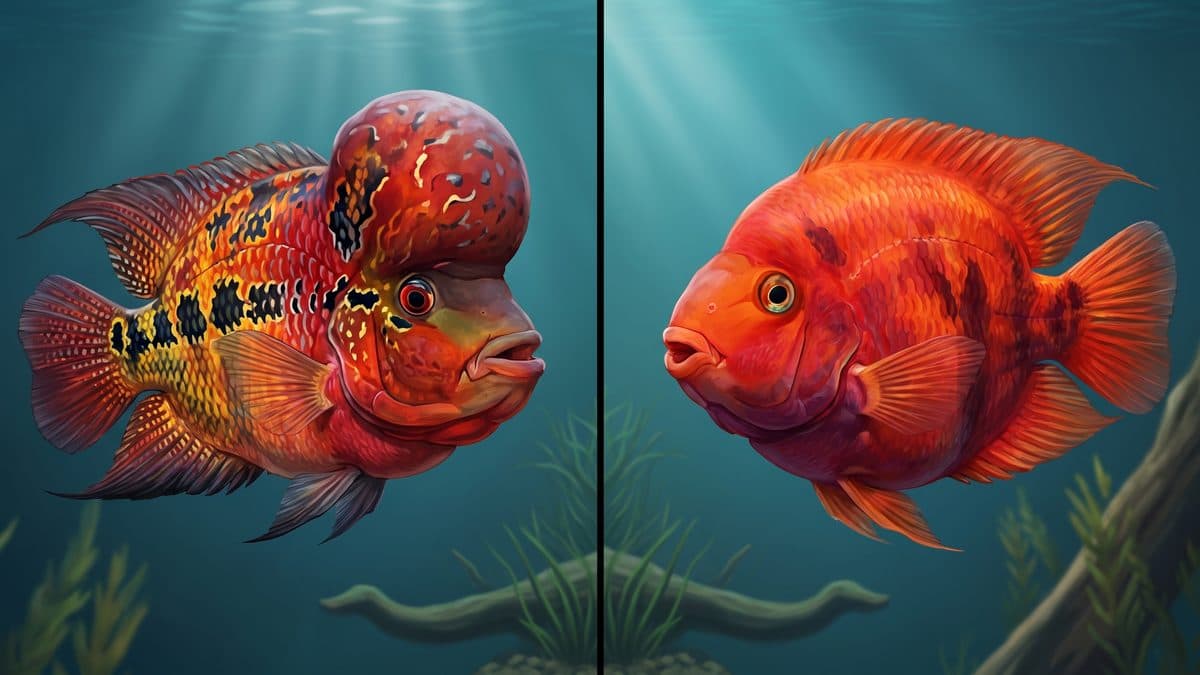
Flowerhorn vs Blood Parrot: The Hybrid Cichlid Debate
Flowerhorns and Blood Parrots represent two of the most commercially successful — and most debated — hybrid cichlids in the aquarium hobby. Neither species exists in the wild; both are the product of deliberate cross-breeding programmes in Southeast Asia. They share the distinction of dividing hobbyists into passionate camps: some appreciate their unique beauty and personality, while purists object to the creation of hybrid fish on ethical and ecological grounds.
Setting aside the philosophical debate, both fish have earned massive followings for good reason. This guide compares them objectively across every practical factor so you can make an informed choice.
Flowerhorn Overview
The Flowerhorn cichlid emerged in Malaysia and Taiwan in the late 1990s, created by crossing various Central American cichlids — most likely Amphilophus trimaculatus, Amphilophus citrinellus (Midas Cichlid), and Vieja synspila (Redhead Cichlid), among others. The exact parentage remains a closely guarded trade secret among breeders. The fish became an overnight sensation in Asian markets, driven partly by feng shui beliefs that the nuchal hump (kok) and markings resembling Chinese characters bring luck and prosperity.
Adult Flowerhorns reach 25–35 cm (10–14 inches) and are powerfully built, with a prominent nuchal hump on the forehead that is especially pronounced in males. The kok size, body colour (Super Red, King Kamfa, Golden Monkey, Thai Silk, and other lines), pearl scaling (iridescent scales called "pearling"), and markings all contribute to a specimen's value. Competition-grade Flowerhorns with perfect kok development, vivid colour, and desirable markings have sold for $5,000–$60,000 at auction.
Flowerhorns are aggressive — often extremely so. Most are kept as solo specimens because they will attack and kill virtually any tank mate in a standard-sized aquarium. They are also intelligent and interactive, recognising their owners and responding enthusiastically to feeding time. Their combination of beauty, personality, and rarity in top-grade specimens drives a global collector market worth millions annually.
Blood Parrot Overview
The Blood Parrot Cichlid (also called Blood Red Parrot or Parrot Cichlid) was first created in Taiwan around 1986, likely by crossing the Midas Cichlid (Amphilophus citrinellus) with the Redhead Cichlid (Vieja melanurus or V. synspila). The exact parentage is disputed. The hybridisation produces a fish with a distinctive rounded, beak-like mouth that cannot fully close — a deformity that, along with the compressed body shape and vibrant orange-red colour, defines the breed.
Adults reach 20–25 cm (8–10 inches). The natural colour is bright orange to red, though dyed specimens (injected or dipped in chemical dyes) are unfortunately still sold — avoid these on ethical and health grounds. Natural colour variants include orange (most common), red, yellow, and rarely, purple or "King Kong" (dark brown-black). A naturally coloured, well-cared-for Blood Parrot is a strikingly attractive fish.
Blood Parrots are significantly less aggressive than Flowerhorns. While territorial during breeding attempts, they are generally manageable in community settings with robust, similarly-sized tank mates. Their permanently open mouth limits their ability to inflict damage in conflicts. They are personable fish that recognise owners and often "greet" them at the glass, though they lack the sheer intensity of Flowerhorn interactivity.
Key Differences
Aggression
This is the most practical difference between the two hybrids. Flowerhorns are among the most aggressive aquarium fish available — they will attack their own reflection, destroy tank dividers to reach perceived rivals, and kill fish several times their size. Most Flowerhorn keepers maintain them as solo specimens in dedicated tanks. Blood Parrots, while cichlids with territorial instincts, are manageable in mixed setups. Their deformed mouth limits bite force, and their temperament is comparatively mild. A Blood Parrot community with Severums, large Tetras, or Plecos is entirely feasible.
The Nuchal Hump (Kok)
The kok is the Flowerhorn's signature feature — a water-and-fat-filled protrusion on the forehead that can grow to remarkable proportions in quality specimens. Kok size is influenced by genetics (primarily), diet (high-protein foods promote growth), and water quality. Blood Parrots do not develop a significant nuchal hump; their head profile remains rounded but smooth. For collectors who value the kok as the centrepiece of the fish's appearance, only Flowerhorns deliver.
Market Value
Top-grade Flowerhorns occupy a completely different price tier. While pet-grade Flowerhorns cost $20–$80, competition-grade fish from premium bloodlines (Kamfa, King Kamfa, Golden Base, Thai Silk) cost $200–$5,000, and Grand Champion specimens at shows in Malaysia, Thailand, and Singapore have sold for $10,000–$60,000. Blood Parrots are affordable — $10–$40 for standard specimens, $40–$80 for unusually large or well-coloured individuals. The Blood Parrot market lacks the collector-driven price escalation of Flowerhorns.
Quick Comparison Table
| Factor | Flowerhorn | Blood Parrot |
|---|---|---|
| Origin | Hybrid (Central American cichlid crosses) | Hybrid (Midas × Redhead Cichlid) |
| Adult Size | 25–35 cm (10–14 in) | 20–25 cm (8–10 in) |
| Lifespan | 10–12 years | 10–15 years |
| Minimum Tank Size | 75 gal (solo) | 55 gal (solo); 75+ gal (community) |
| Temperature | 26–30 °C (79–86 °F) | 24–28 °C (75–82 °F) |
| pH | 6.5–8.0 | 6.5–7.5 |
| Aggression | Very High (typically solo only) | Moderate (community possible) |
| Nuchal Hump | Prominent (males) | Absent/minimal |
| Mouth | Normal, functional | Permanently open (deformity) |
| Cost | $20–$60,000+ | $10–$80 |
| Fertility | Most males sterile; some fertile | Males sterile; females can cross with other cichlids |
Tank Requirements Comparison
Flowerhorn tank setup: A single Flowerhorn requires a minimum of 75 gallons, with 90–125 gallons preferred. The tank should be bare-bottom or use sand substrate — Flowerhorns dig relentlessly and will scatter gravel. Décor must be minimal and heavy: large rocks siliconed to the glass base, heavy driftwood, or no décor at all. Many Flowerhorn keepers run bare tanks with just a sponge filter and a heater for maximum cleanliness and to showcase the fish.
Filtration should be powerful — canister filters or sumps rated for 2–3 times tank volume. Flowerhorns are heavy feeders and waste producers. Water changes of 30–40 % weekly are standard. Heaters should maintain 27–29 °C for optimal colour development and kok growth. Some breeders use slightly warmer temperatures (30 °C) to stimulate kok development, though this increases metabolic rate and waste production.
Blood Parrot tank setup: A single Blood Parrot does well in 55 gallons, with 75+ gallons for a group or community. Blood Parrots appreciate hiding spots — caves, clay pots, and driftwood shelters — more than Flowerhorns, as they can be shy when not feeding. They dig but are less destructive than Flowerhorns; hardy plants like Anubias and Java Fern can survive.
Filtration should be a canister or large HOB rated for 1.5–2 times tank volume. Blood Parrots are less messy than Flowerhorns but still produce significant waste for their size. Weekly 25–30 % water changes are sufficient in a well-filtered tank. Temperature of 25–27 °C is ideal. Blood Parrots have a slight sensitivity to poor water quality — they can develop black patches on their body (stress markings) when ammonia or nitrites spike.
Which Should You Choose?
Choose a Flowerhorn if:
- You want a solo "wet pet" with maximum visual impact and personality
- You are interested in the breeding, collecting, or competition aspect of the hobby
- You have 75+ gallons dedicated to a single fish
- You appreciate the nuchal hump and are willing to invest in quality genetics
- You are comfortable with a fish that cannot have tank mates
Choose a Blood Parrot if:
- You want a colourful, personable cichlid that can live in a community
- You prefer a more affordable entry point with lower ongoing costs
- You want multiple fish interacting in the same tank
- You prefer a less aggressive, more manageable cichlid
- You have a 55+ gallon tank and want a unique centrepiece fish
Our recommendation: For the dedicated cichlid enthusiast who wants a showpiece fish with unmatched personality, the Flowerhorn is the clear winner — especially if you can source quality genetics from a reputable breeder. For a hobbyist who wants colour, personality, and community compatibility in a single package, the Blood Parrot is the more practical and versatile choice. Both fish reward attentive care with years of entertaining, interactive behaviour.