Axolotl Breeding Overview
Axolotls (Ambystoma mexicanum) breed readily in captivity — often more readily than keepers anticipate. A single female can produce 100–1,000 eggs per spawn, and axolotls reach sexual maturity at 12–18 months. The breeding process involves a fascinating courtship dance, spermatophore-based internal fertilisation (unique among commonly kept aquarium species), and a larval phase that requires daily live-food feedings for weeks.
The primary challenge is not triggering spawning — a simple temperature manipulation accomplishes that — but managing the resulting hundreds of larvae. Before breeding, ensure you have homes planned for the offspring. Responsible axolotl breeding means never producing more animals than you can properly house or rehome.
Sexing Axolotls
Axolotls are relatively easy to sex once sexually mature (12–18 months, typically 15+ cm body length):
- Males: Develop a visibly swollen cloaca (the vent area at the base of the tail). The swelling is pronounced and obvious in mature males — a rounded, protruding bulge behind the rear legs.
- Females: The cloaca remains flat or slightly raised. The body is typically rounder and wider, especially when carrying eggs.
- Juveniles: Cannot be reliably sexed before 10–12 months. Wait for cloacal development before determining sex.
Conditioning and Cooling
Axolotls in the wild spawn in spring, triggered by rising water temperatures after winter. In captivity, simulating this seasonal shift is the key to triggering breeding:
- Pre-conditioning (4–6 weeks): Feed heavily with high-quality foods — earthworms (the staple), frozen bloodworm, and sinking carnivore pellets. The female should appear round with developed eggs visible through her belly skin (axolotls are slightly translucent).
- Cooling period (2–4 weeks): Gradually lower the tank temperature from the normal 60–68 °F to 50–55 °F (10–13 °C) over one week. Use an aquarium chiller or place the tank in a cold room (unheated garage, basement). Maintain the cold temperature for 2–4 weeks. Reduce feeding to once every 3–4 days during the cold period — metabolism slows significantly.
- Warming trigger: After the cooling period, gradually raise the temperature back to 64–68 °F (18–20 °C) over one week. This simulates the spring warming that triggers spawning. Increase feeding to daily. Resume daily water changes to keep water pristine.
Spawning typically begins within 1–2 weeks of the warming trigger.
Courtship and Spermatophore Deposition
Axolotl courtship is a slow, subtle dance:
- The male initiates by nudging the female's cloaca with his snout.
- He then performs a "tail waggle" — a rhythmic undulation of his tail to fan pheromones toward the female.
- The male walks forward slowly, and if the female is receptive, she follows closely behind.
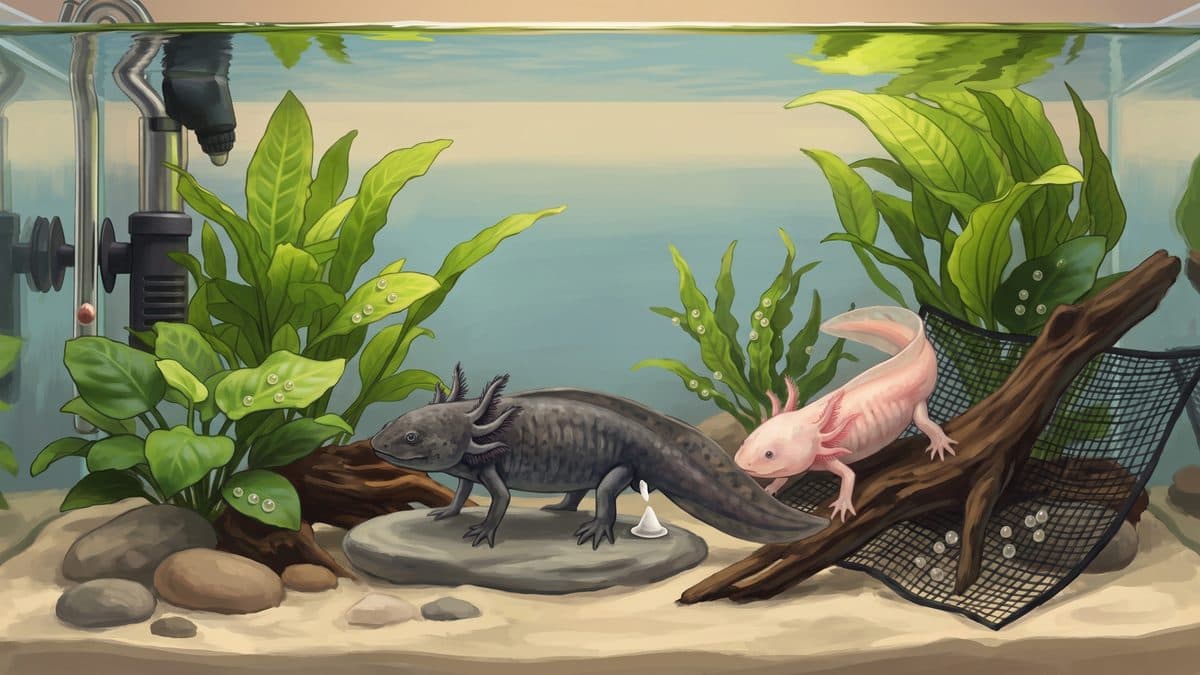
- The male deposits spermatophores — small, gelatinous capsules containing sperm — on the substrate surface. He may deposit 5–25 spermatophores during a single courtship session.
- The female walks over the spermatophores, positioning her cloaca directly above them to collect the sperm internally.
This process can take several hours and often occurs at night. Provide a smooth substrate (slate tiles or bare glass bottom) for spermatophore deposition — they are fragile and can be lost in coarse gravel.
Egg Laying
12–72 hours after spermatophore collection, the female begins laying eggs:
- Eggs are laid individually or in small clusters, attached to plants, decorations, tank walls, and any available surface.
- Each egg is 2–3 mm in diameter, enclosed in a clear jelly capsule (10–15 mm total diameter with jelly).
- Laying takes 12–72 hours. The female may produce 100–1,000 eggs depending on age, size, and conditioning.
- Provide plenty of laying surfaces — Java Fern, Anubias, artificial plants, spawning mops, and PVC structures all work.
Remove the adults after egg laying is complete. Adult axolotls will eat their own eggs and hatched larvae. Transfer the eggs (on the plants/surfaces they are attached to) to a separate hatching container, or remove the adults to another tank.
Egg Incubation
- Temperature: 64–68 °F (18–20 °C). Warmer temperatures (up to 72 °F) accelerate hatching but increase deformity risk. Cooler temperatures (below 60 °F) slow development significantly.
- Duration: 14–21 days at 68 °F. You can observe embryo development through the transparent jelly — the developing larvae are visible from day 3–4 onward.
- Water quality: Gentle water movement (airstone nearby, not directly on the eggs). Daily 10–20 % water changes in the hatching container. Remove any eggs that turn white (unfertilised or fungused) immediately — they can spread fungus to viable eggs.
- Methylene blue: A few drops of methylene blue (enough to tint the water light blue) prevents fungal growth on eggs. This is optional but recommended for large clutches where egg density is high.
Larvae hatch by wriggling free of the jelly capsule. Newly hatched larvae are 10–12 mm long, with external gills already visible, and remain stationary for 24–48 hours as they absorb their yolk sac.
Larval Care and First Foods
Once the yolk sac is absorbed (day 2–3 post-hatch), larvae begin actively hunting:
- First food: Newly hatched brine shrimp (BBS / Artemia nauplii). This is the essential first food — axolotl larvae hunt by detecting movement, and the swimming BBS triggers their feeding response. Feed 2–3 times daily.
- Alternative first foods: Microworms and daphnia can supplement BBS but should not replace it as the primary food.
- Individual containers: For best survival, rear larvae individually or in very small groups (3–5 per container) in 500 mL to 2 L containers with daily 100 % water changes. Axolotl larvae are cannibalistic — they will bite each other's limbs and gills. While lost limbs regenerate, severe bites can be fatal.
- Communal rearing: Possible in larger tubs (10–20 gallons) but with higher casualty rates from cannibalism. Provide dense hiding spots (Java Moss clumps) and feed heavily to reduce aggression.
Transition to larger foods as larvae grow: chopped blackworms and frozen bloodworm (3–4 weeks post-hatch), then whole blackworms and small earthworm pieces (6–8 weeks). By 8–10 weeks, juveniles should accept sinking pellets.
Grow-Out Protocol
- 2–4 weeks: Individual or small-group containers with daily water changes. BBS primary food.
- 4–8 weeks: Transition to 5–10 gallon grow-out tanks. Groups of 5–10 similarly sized larvae. Sponge filter (gentle). Feed blackworms and chopped bloodworm 2× daily.
- 8–16 weeks: Juveniles are 5–10 cm and can be moved to standard axolotl tanks (bare bottom or fine sand, sponge filter, 60–68 °F). Feed earthworms, pellets, and frozen foods.
- 4–6 months: Juveniles are large enough (10+ cm) for rehoming. Most axolotl morphs are sellable or adoptable at this size.
Sort by size every 2 weeks — larger siblings will prey on smaller ones. Remove any individuals with persistent deformities (curved spines, underdeveloped gills) from the breeding programme.
Managing Large Spawns Responsibly
A single axolotl spawn can produce 500+ eggs. Not all will hatch, and not all larvae will survive, but you may still face 200–400 juvenile axolotls requiring individual care:
- Plan rehoming before breeding. Contact local fish stores, axolotl groups, online classifieds, and hobbyist communities.
- Cull unfertilised eggs immediately to reduce waste and fungal risk.
- If you cannot house all larvae, select the healthiest 50–100 for rearing and humanely euthanise the remainder (clove oil method at recommended concentrations). This is preferable to rearing hundreds of animals in substandard conditions.
- Never release axolotls into the wild. They are invasive in non-native habitats and critically endangered in their native Lake Xochimilco — wild release harms both the released animals and native ecosystems.
Axolotl breeding is a fascinating window into amphibian reproductive biology. The courtship, spermatophore transfer, and larval development are genuinely remarkable to observe. But the scale of production demands responsible planning. For axolotl care fundamentals, see our tank setup guide and feeding guide.